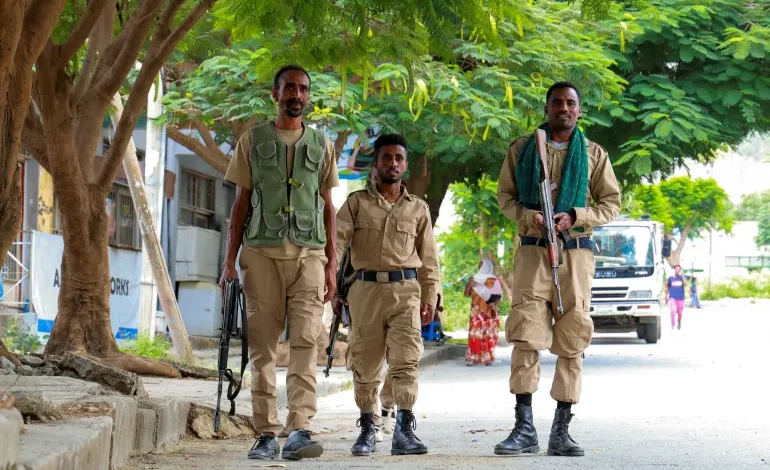
Ethiopia’s worsening security crisis has deepened after its army accused Sudan and other external actors of supporting armed groups fighting the federal government, while Sudan has rejected the allegation as baseless.
The accusations came as fighting continued in northern Ethiopia, where forces linked to the Tigray People’s Liberation Front (TPLF) have been engaged in renewed clashes with Ethiopian federal troops and allied forces.
Ethiopian National Defense Force Chief of General Staff Field Marshal Birhanu Jula accused Sudan, Egypt and other external actors of backing an alliance of armed and political groups opposed to Prime Minister Abiy Ahmed’s government.
He also accused Eritrea of acting as a link between external supporters and armed groups inside Ethiopia. Birhanu did not provide evidence for the allegations, which come amid a renewed escalation of fighting in northern Ethiopia.


The latest clashes have raised fears of a return to the devastating 2020–2022 Tigray war, which ended with the Pretoria peace agreement in November 2022.
The renewed fighting intensified last week, with Tigrayan forces seizing local airports and launching attacks into neighbouring Afar and Amhara regions. The developments have increased concerns that the conflict could spread beyond Tigray and draw in other countries in the Horn of Africa.
A humanitarian source told AFP that the Afar town of Erebti, near the border with Tigray, fell to Tigrayan forces on Sunday after heavy artillery bombardment. The source said the TPLF was advancing towards Afdeera, about 100 kilometres to the east.
The same source estimated that at least 150,000 people had been displaced in Afar, while stressing that precise figures were difficult to establish.
The violence has also affected civilian infrastructure and communications. Tigrai TV, a broadcaster based in the Tigrayan capital Mekelle, was hit by a drone on Sunday, causing significant damage and taking the station off air. No casualties were immediately reported.
Communications have also been disrupted in parts of Tigray, making it more difficult for residents to communicate and for independent observers and journalists to verify developments on the ground.
SUDAN’S DENIAL
Sudan has strongly rejected Ethiopia’s accusation that it is supporting armed groups opposed to the Ethiopian government.
In a statement issued late Sunday, Sudanese army spokesperson Asim Awad Abdelwahab directly rejected the allegations.
READ RELATED STORY
Ethiopia’s Hayli Gubbi volcano erupts after 12,000 years
Foreign arms, drone strikes raise war crimes concerns in sudan
Sudanese man jailed after taking hatchet, knife, petrol to Manchester school
“The Armed Forces confirm their categorical rejection of these claims and consider them baseless accusations,” Abdelwahab said.
The Sudanese military also accused Ethiopia of allowing support for Sudan’s paramilitary Rapid Support Forces (RSF) from Ethiopian territory, including training, supplies and military activities involving drones. Those counter-allegations have not been independently verified.
Sudan said it respects international law and the principles of non-interference in neighbouring countries’ internal affairs, while maintaining that it would protect its sovereignty and national security.
The Sudanese army called on Ethiopia to address disagreements through dialogue and official diplomatic channels, amid growing tensions between the two neighbours.
The competing accusations add another layer to the complicated security situation in the Horn of Africa, where Ethiopia, Sudan and Eritrea have longstanding political and security tensions.
The fighting is also creating concerns about humanitarian access and regional trade. Ethiopia relies heavily on neighbouring Djibouti for international cargo, including fuel, and instability in Afar could threaten important supply routes.
REGIONAL DIPLOMATIC EFFORTS
International efforts to prevent the renewed conflict from developing into another full-scale war are continuing.
The African Union has called for restraint and an immediate de-escalation of the fighting while supporting renewed diplomatic engagement. Former Nigerian President Olusegun Obasanjo has been involved in the African Union’s mediation efforts aimed at encouraging dialogue between the parties.
The United Nations has also expressed concern over the renewed violence and reports of drone attacks and civilian harm.
The renewed fighting has also affected foreign nationals in northern Ethiopia. Reports on Monday said about 20 Israelis were stranded in the northern part of the country amid disrupted flights and deteriorating security conditions.
With fighting continuing and competing accusations being exchanged between Ethiopia and Sudan, the situation remains fluid.
The immediate concerns include protecting civilians, maintaining humanitarian access and preventing further escalation between Ethiopian federal forces, Tigrayan forces and other armed groups.
Regional and international diplomatic efforts will be closely watched as Ethiopia and its neighbors face growing pressure to prevent the latest confrontation from developing into a wider conflict.