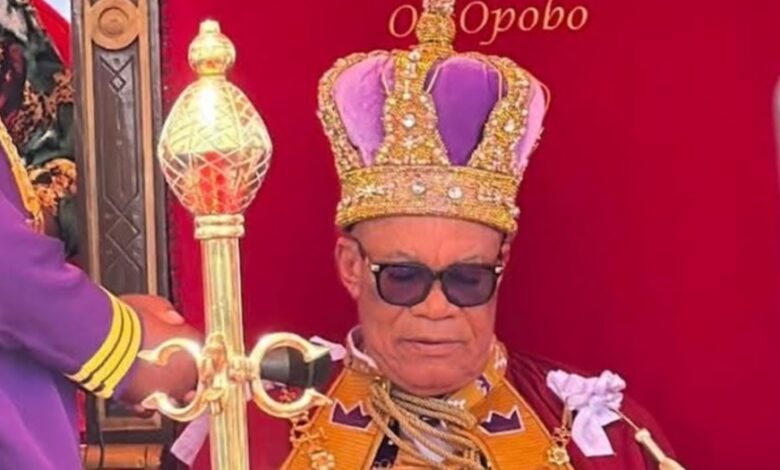
King Charles Douglas MacPepple Jaja has been formally crowned the sixth Amanyanabo of Opobo Kingdom, taking charge of one of the Niger Delta’s most historically significant traditional institutions with a pledge to preserve its heritage while pursuing development, unity and global relevance.
The coronation took place on Saturday at King Jaja Square in Opobo, Rivers State, drawing former President Goodluck Jonathan, Rivers State political leaders, traditional rulers and dignitaries from across Nigeria.
The ceremony marked the formal installation of the monarch as Jeki VI, succeeding the late King Dandeson Douglas Jaja, who died last year. Charles Douglas MacPepple Jaja had been selected as the kingdom’s Amanyanabo-Elect in December 2025 before Saturday’s coronation.
A throne steeped in history

His ascension carries historical significance beyond the ceremonial transfer of a royal title.
The Opobo throne traces its roots to King Jaja, who established the kingdom in the 19th century after leaving Bonny amid a conflict involving rival trading houses. From Opobo, Jaja built a formidable commercial network around the palm-oil trade and emerged as one of the most influential political and economic figures in the Niger Delta.
His growing influence eventually brought him into conflict with British commercial interests. Jaja was recognised as King of Opobo in 1873 but was later arrested and exiled by the British in 1887 after tensions over trade and colonial interests intensified. He died in 1891 while attempting to return to his kingdom.
Jeki VI promises new direction
That history gave added weight to the words of the new monarch after his coronation.
Jeki VI pledged to protect the freedom and rights of the people of Opobo and uphold the dignity attached to the throne.
“I will never bring dishonour to the throne that Chief Jaja and the founders of Opobo built with courage. The exodus of 1870 was a journey to freedom. Our journey in 2026 is a journey to development, unity and global relevance,” he declared.
The statement draws a direct line between the kingdom’s past and the priorities of the new reign. While the original Opobo movement was shaped by the search for political and commercial independence, the new monarch has framed his own chapter around development and cohesion.
READ RELATED NEWS
Jonathan backs Opobo royal transition, confirms attendance at Jaja VI Coronation
Fubara returns to Opobo church, says prayers shielded him from shame
Jonathan, Fubara hail new reign
Former President Goodluck Jonathan congratulated the monarch and the people of Opobo, recalling the historical importance of King Jaja and his struggle for freedom.
Jonathan called on the new king to use his reign to foster peace, development and unity while preserving the dignity of the kingdom.
The Rivers State Governor, Siminalayi Fubara, was represented by his Deputy, Professor Ngozi Odu.
Odu described the coronation as a celebration of the identity, history and culture of Rivers State, noting the role traditional rulers play in preserving the heritage of their communities.
She conveyed the governor’s prayers for a reign marked by wisdom, peace, unity and progress.
Traditional rulers gather in Opobo
The ceremony also highlighted the historical connections between Opobo and other traditional institutions.
The Obi of Onitsha, Igwe Nnaemeka Achebe, spoke about the relationship between Onitsha and Opobo and described King Jaja as a courageous leader who fought for the freedom and prosperity of his people.
Among the traditional rulers at the ceremony were the Obong of Calabar; the Amanyanabo of Bonny, King Edward Asimini Dappa Pepple; the Olu of Warri, Ogiame Atuwatse III; Eze Eberechi Oji, Eze Aro; Eze Iweka III of Obosi; King Buribaye Dakolo of Ekpetiama Kingdom, Bayelsa State; and Eze Eberiuogo of Omuma.
Ten days of culture and tradition
The coronation formed the centrepiece of a 10-day programme of cultural, traditional, religious and ceremonial activities scheduled from September 18 to 27.
The programme was designed to bring together Opobo indigenes at home and abroad, traditional institutions, political leaders and other guests to celebrate the kingdom’s heritage.
Preparatory activities included traditional rites and cultural displays intended to connect the ceremony with Opobo’s historical identity.
With Jeki VI now formally installed, the new reign opens another chapter in the history of a Niger Delta kingdom whose story has been shaped by commerce, political authority, cultural identity and encounters with colonial power.
His inaugural message has placed development, unity and international relevance alongside the freedom associated with the kingdom’s founding story.