The deaths of 37 men arrested on suspicion of illegal mining and held by the Nigeria Security and Civil Defence Corps (NSCDC) in Niger State have left one central question unanswered: what exactly caused them to die?
NewDailyPrime had reported that the 37 detainees died on Thursday, 17 September, after they were arrested during NSCDC operations in Minna on 15 and 16 September.
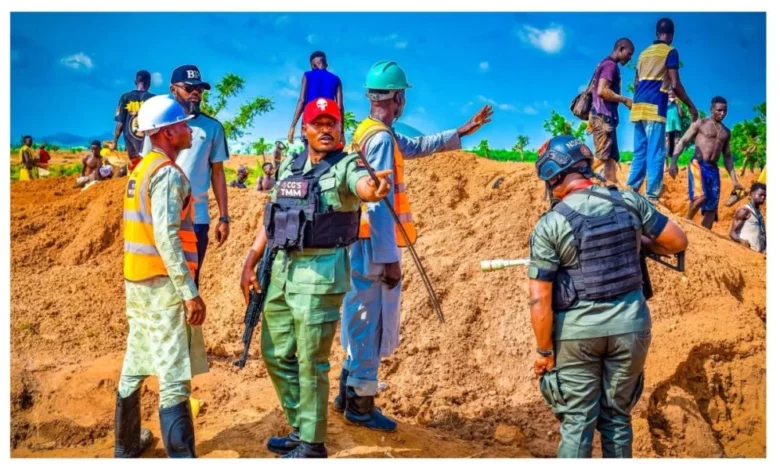
The operations were carried out around the Lt Gen Mohammed Inuwa Wushishi Estate in Minna, the Niger State capital. The men were arrested over alleged illegal mining activities.
The NSCDC initially said scores of the detainees were found dead following a suspected disease outbreak. The Corps later said the actual cause of death had not been established.
That question is now the subject of investigations by the Federal Government, the Niger State Government and security agencies.
In a separate report by NewDailyPrime on 18 September, Niger State Governor Umar Bago said authorities were considering several possibilities, including suffocation caused by overcrowding and exposure to hazardous substances associated with mining.
He stressed, however, that the scientific cause of the deaths had not been established.
“We don’t know the real causes of this… some of the people that survived have claimed that it’s suffocation and dehydration,” he said.
Forensic, medical and autopsy examinations were ordered to help determine what happened.
Independent committee investigates deaths
The Federal Government has since set up a 10-member independent committee to investigate the deaths.
The committee was inaugurated by the Minister of Interior, Olubunmi Tunji-Ojo, on 20 September after President Bola Tinubu directed a comprehensive investigation into the incident.
Its mandate covers the immediate and underlying causes of the deaths, the circumstances surrounding the arrests and detention, and responsibility for any wrongdoing established by the investigation.
The committee has two weeks to submit its report.
It is chaired by Jonathan Kure, a retired Deputy Director-General of the Department of State Services. Prof Isa Hayatu Chiroma, SAN, a former Director-General of the Nigerian Law School, serves as secretary.
Other members include retired Assistant Inspector-General of Police Hosea Hassan Karma and Prof Olayinka Buhari, a professor of histopathology and former Chief Medical Director of the University of Ilorin Teaching Hospital.
Representatives of the Minna Emirate Council and the Niger State Government are also members.
The committee is empowered to visit relevant locations, examine documents and records, interview people with information about the incident and engage additional experts where necessary.
The investigation is already receiving medical input. A medical team attached to the committee has reportedly begun work to establish the cause, mechanism and manner of the deaths.
Until those examinations and the wider investigation are completed, there is no established scientific explanation for the deaths of the 37 detainees.
The people affected
The 37 deceased were among a larger group of people arrested over suspected illegal mining activities in Minna, Niger State.
The International Human Rights Commission (IHRC) compiled names from records at the General Hospital, Minna. The commission later received four additional names from relatives who said their family members were missing from the hospital’s initial record.
The names provided were Ibrahim Sani, Ibrahim Musa, Yusuf Nasiru, Umar Lawal, Isyaku Amisu, Fahad Sa’adu, Abdulsalam Ismail, Safiyanu Abdullahi, Suleiman Dantala, Idris Haruna, Sani Yakubu, Safiyanu Abubakar, Abdullahi Abubakar, Abubakar Musa, Usman Aliyu, Abubakar Alhaji Musa, Ibrahim Idris, Bashir Kabiru, Suleiman Sani, Nasir Sanusi, Khalid Ahmad, Aliyu Abdul, Mudassir Suleiman, Lawal Usman, Abdullahi Samuel Sambo, Bissallah Adamu, Abdulbari Suleiman, Shafisu Lado, Usman Ahmad, Usman Ibrahim Sani, Isyaku Emmanuel Emeka, Abdul Gafar Abubakar, Usman Haruna, Mu’awiya AbdulKarim and Yaro Salihu Soba.
NewDailyPrime had earlier published the list. Reports said Abdul Gafar Abubakar, Usman Haruna, Mu’awiya AbdulKarim and Yaro Salihu Soba were not included in the initial General Hospital record. Their names were later supplied to the IHRC after relatives approached the commission.
Awaisu Giwa, the IHRC international peace ambassador, said the commission obtained the initial list from the hospital’s mortuary attendant, who prepared it on the instruction of the hospital’s chief medical director. The commission said the record could also help in identifying families who may be entitled to compensation.
Survivors give accounts of detention conditions
The impact of the incident has not been limited to those who died.
Survivors have also given accounts of the conditions inside the detention facility.
Former Vice-President Atiku Abubakar said one survivor told him that more than 68 detainees had been held in a small detention facility.
According to Atiku, the survivor said conditions became so difficult that detainees drank one another’s urine in an attempt to stay hydrated.
“It was a gory tale listening to one of the survivors. He told us that more than 68 of them were crammed into one small detention facility and that conditions became so desperate that they had to drink one another’s urine just to stay hydrated,” Atiku said.
The account remains a survivor’s allegation and has not, by itself, established the cause of the deaths.
Other reports have also raised questions about the conditions in which the detainees were held.
Reuters reported accounts from survivors who alleged that a substance was sprayed into an overcrowded cell before some detainees began experiencing breathing difficulties and collapsing.
Reuters said it could not independently verify those accounts or establish what the substance was.
Those accounts have not established the cause of death.