Nigeria has called for a fundamental restructuring of the global governance and financial systems, where it said international institutions must reflect the economic and demographic realities of the 21st century.
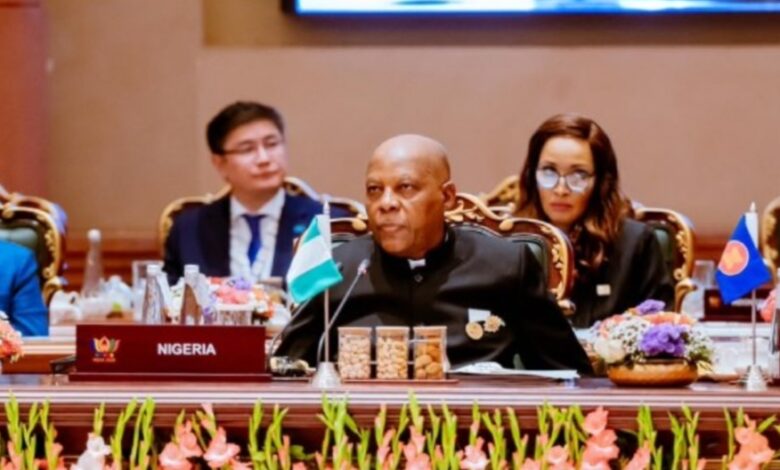
Vice-President Kashim Shettima made the call on behalf of President Bola Tinubu at the 18th BRICS Leaders’ Summit in India on Sunday, where he also positioned Nigeria as a potential gateway to Africa’s expanding market.
Shettima said the transformation being pursued through BRICS should extend beyond cooperation among member and partner countries to the institutions that shape global economic and political affairs.
“Nigeria supports a more representative, equitable and responsive global governance architecture, including reform of the United Nations Security Council and the international financial system,” he said.

The Vice-President added that BRICS had strengthened the voice of developing nations in international affairs and aligned with Nigeria’s longstanding position that global institutions should correspond with present-day economic and population realities.
“BRICS amplifies the voice of the Global South and advances a more inclusive international order, consistent with Nigeria’s call for institutions that reflect contemporary economic and demographic realities,” he stated.
Shettima also pressed for BRICS cooperation that produces tangible economic benefits rather than stopping at diplomatic discussions and formal commitments.
He described Nigeria as a gateway to Africa’s expanding consumer and investment market under the African Continental Free Trade Area, and highlighted sectors where the country seeks deeper collaboration.
“We welcome BRICS cooperation in trade, agriculture, food security, energy, infrastructure, manufacturing, healthcare and critical minerals, especially partnerships that advance technology transfer, local value addition, industrial capacity and employment,” he said.
Nigeria’s large youthful population, he noted, is another asset capable of driving innovation, entrepreneurship and technological development.
Shettima listed digital skills, entrepreneurship, research, artificial intelligence and technology-driven enterprises among areas requiring increased investment. He mentioned initiatives including 3MTT, Project BRIDGE and national artificial intelligence programmes as part of the country’s efforts to develop its digital economy.
He further identified artificial intelligence, digital public infrastructure, fintech, telecommunications, cybersecurity, biotechnology and advanced manufacturing as fields where Nigeria wants intensified BRICS collaboration.
“Developing countries must produce technology, create knowledge and own intellectual property. A nation that owns no technology risks renting its future,” he said.
The Vice-President said Nigeria viewed engagement with BRICS as a practical avenue for attracting investment, expanding trade, transferring technology and developing human capital.
He also linked Project BRIDGE, which is expanding broadband, fibre connectivity and digital public services, to Nigeria’s ambition for an open, secure and inclusive digital environment.
“Our partnerships must create jobs, expand trade, transfer technology, and strengthen our nations’ productive capacity,” Shettima said.
He called for an Africa that could move from the margins of global development to the forefront of economic growth and technological innovation.
Earlier, Indian Prime Minister Narendra Modi, who opened the summit, said confidence in BRICS had grown across the Global South because participating countries were increasingly being heard and involved in developing solutions.
Modi said the bloc’s diversity was one of its principal strengths; it added that its cooperation now extended beyond governments to entrepreneurs, farmers, researchers, women and young people.
He also highlighted BRICS initiatives aimed at strengthening skills, employment, enterprise development and knowledge-sharing while stressing that economic advancement must be matched by environmental responsibility.
READ RELATED NEWS UPDATES
Trump vows to slam extra 10% tariffs on Nigeria for joining BRICS
Tinubu calls for fairer global finance, healthcare at BRICS Summit
ECC endorses purchase of $582m capital shares in BRICS’s New Development Bank
Shettima turns 60, asks well-wishers to pray instead of placing birthday ads