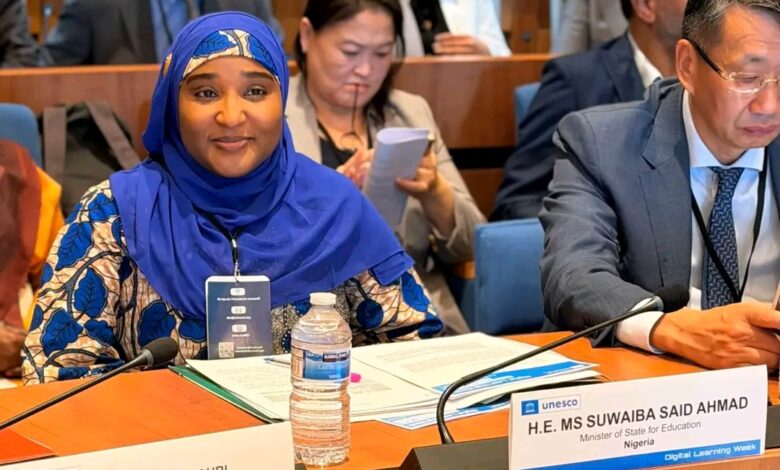
Nigeria’s Minister of State for Education, Suwaiba Said Ahmad, has called for tighter safeguards around the use of artificial intelligence in Nigerian classrooms and warned that educational technology must narrow the country’s digital divide rather than deepen it.
Ahmad made the position known on Tuesday, September 8, 2026, after participating in a UNESCO ministerial roundtable on Artificial Intelligence in Education during Digital Learning Week 2026 in Paris, France.
The session brought together representatives from 25 countries to examine the growing role of artificial intelligence in education and the safeguards required to ensure that its adoption benefits learners and teachers.
Ahmad said Nigeria’s circumstances made the discussion particularly important because access to digital technology varies significantly among learners.
“For Nigeria, this conversation is not a distant or theoretical one,” she said.


The minister noted that while some Nigerian learners already use AI tools regularly, others still lack reliable access to devices or internet connectivity.
READ RELATED NEWS UPDATES
Education minister flags malpractice behind some 9A WAEC results
FG launches Jos boostcamp to tackle out-of-school crisis
Nigeria needs AI policy, UI VC warns
She therefore maintained that technology designed for Nigerian education must account for this disparity from the outset.
“Some Nigerian learners can use AI every day, while others still lack a reliable device or internet connection, so any solution we build has to close that gap rather than widen it,” Ahmad stated.
She identified Nigeria’s National AI Strategy and the Nigeria Data Protection Act as key frameworks for shaping the country’s approach to artificial intelligence in education.
According to her, the challenge is no longer simply to formulate policies but to translate those policies into practical protections for people using AI in schools.
Ahmad cited two initiatives, AskFME and the Naija Teacher AI pilot, as examples of Nigeria’s efforts to put that approach into practice.
She disclosed that the Naija Teacher AI pilot had already onboarded 50,000 Nigerian teachers to AI tools designed for mobile and offline use.
The minister said such initiatives could help extend the benefits of artificial intelligence beyond communities with dependable internet access and sophisticated digital infrastructure.
She also outlined the standards she expects to govern AI applications used in Nigerian classrooms.
“Every AI tool used in a Nigerian classroom must be checked for accuracy, curriculum alignment, age suitability and data protection,” she said.
Ahmad stressed that safeguards should not stop at the initial assessment of an AI product.
She said teachers and learners must have accessible channels through which they can report faulty or inappropriate outputs, while tools that repeatedly fail to meet required standards should be corrected or withdrawn.
“Our responsibility does not end there,” she stated.
The minister also highlighted the continuing importance of teachers in an education system increasingly influenced by artificial intelligence.
She observed that children would still turn to their teachers when they encounter uncertainty, despite the growing availability of automated tools.
“In Nigeria, a child who is unsure will always look to the teacher,” Ahmad said.
She added that Nigeria’s objective was to enable children to benefit from AI without surrendering their curiosity or willingness to question information.
“We want our children to gain from AI while staying curious and asking questions of their own,” she stated.
The minister’s position places access, accountability, data protection and teacher oversight at the centre of Nigeria’s emerging conversation on artificial intelligence in education.