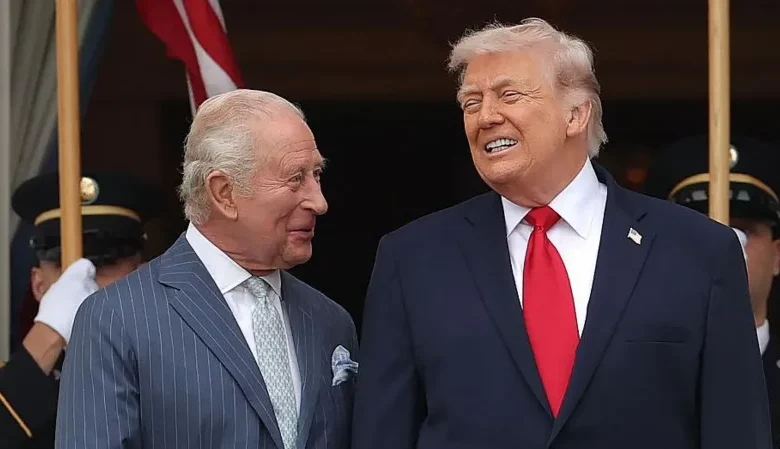
US President Donald Trump has said he would “love” to see a united Ireland, predicting that Northern Ireland would eventually join the Republic of Ireland despite the UK Government’s current opposition to holding a referendum. His remarks, made during a visit to Dublin on Saturday, 12 September, have reopened a sensitive constitutional debate, although Trump has no power to determine Northern Ireland’s future.
Trump made the comments after meeting Irish Taoiseach Micheál Martin in Dublin, where the two leaders discussed political and economic relations between Ireland and the United States.
Speaking to reporters, Trump said he would like to see Ireland unified and described reunification as a positive outcome.
“The way I look at it, it’s going to happen eventually,” he said, adding that it would be a “fantastic thing”.


Trump acknowledged that the British Government would have a role in the process, saying the UK would “have something to say about it”.
His intervention is politically significant because US presidents have traditionally been careful about taking sides on Northern Ireland’s constitutional status since the 1998 Good Friday Agreement.
UK says position on united Ireland has not changed
Downing Street responded by making clear that Prime Minister Andy Burnham’s position remained unchanged.
Burnham recently said he was not aware of majority support in Northern Ireland for another referendum and that a vote would not be held unless that changed.
A Downing Street spokesperson confirmed on Saturday that those remarks still stood following Trump’s intervention.
Burnham had already faced criticism after saying during his first official visit to Northern Ireland in August that a referendum on Irish unity was “off the table”.
He later stressed that his Government remained fully committed to the Good Friday Agreement and said the comment referred to the current political circumstances rather than an attempt to remove the referendum mechanism contained in the peace settlement.
NewDailyPrime has previously examined Burnham’s rise to the Labour leadership and the political challenges facing his government. Andy Burnham takes Labour leadership — Can he deliver?
Trump cannot order a united Ireland referendum
Despite the attention surrounding Trump’s remarks, the US president cannot call a vote or change Northern Ireland’s constitutional position.
Under the Northern Ireland Act 1998, which implemented key parts of the Good Friday Agreement, Northern Ireland remains part of the United Kingdom unless a majority of people voting there choose otherwise.
The legislation gives the Northern Ireland Secretary the power to order what is commonly called a border poll.
More importantly, the Secretary of State is required to call such a referendum if it appears likely that a majority of voters in Northern Ireland would support leaving the UK and becoming part of a united Ireland.
A referendum therefore does not automatically take place because an Irish, British or American political leader supports it.
Any constitutional change would have to follow the democratic procedures established under the Good Friday Agreement, including the principle of consent.
If a majority in Northern Ireland voted for unity, the UK Government would then be required to bring forward proposals to give effect to that decision in agreement with the Irish Government.
Unionists push back at Trump
Trump’s comments drew criticism from unionist politicians, who argue that Northern Ireland’s future must be decided by its own people.
DUP leader Gavin Robinson rejected the intervention, while Conservative leader Kemi Badenoch also criticised Trump’s remarks. Sinn Féin figures, by contrast, welcomed the renewed attention on Irish reunification.
The debate remains one of the most politically sensitive issues on the island.
Northern Ireland was created in 1921 and remained within the United Kingdom after most of Ireland became independent.
Decades of sectarian and political violence followed, particularly during the period known as the Troubles.
The Good Friday Agreement, reached in 1998, helped bring most of that violence to an end and established power-sharing institutions alongside the principle that Northern Ireland’s constitutional future should be decided democratically.
Trump made comments during Ireland visit
Trump’s comments came during a two-day visit to Ireland, which included talks with Martin and Irish President Catherine Connolly before he travelled to his golf resort in Doonbeg, County Clare.
His remarks marked a departure from the cautious approach normally taken by Washington on Irish reunification and immediately attracted attention in both London and Belfast. However, Trump’s prediction that reunification will eventually happen is an expression of his political view, not a formal policy decision or a prediction that carries legal force.
Related news
Andy Burnham takes Labour leadership — Can he deliver?
Anti-immigrant violence spreads across Belfast and beyond
Trump predicts Keir Starmer resignation