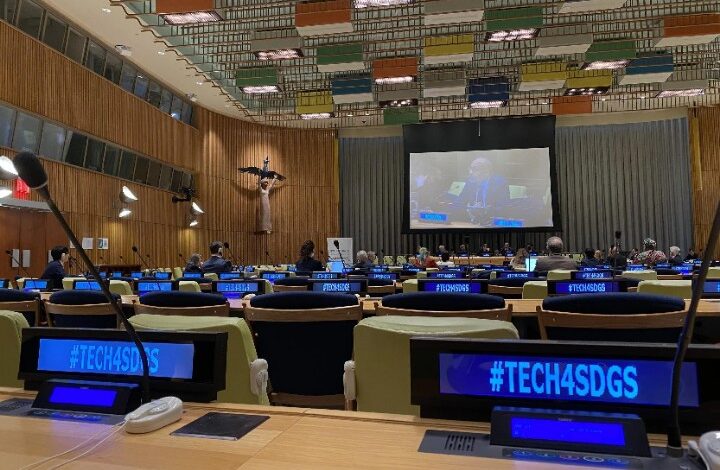
The global digital agenda is increasingly shifting from the development of new technologies to ensuring that people have affordable access, relevant skills and opportunities to participate in the digital economy, as the 81st United Nations General Assembly (UNGA) places inclusion at the centre of technology discussions.
The shift was highlighted at Digital@UNGA 2026, a multistakeholder platform organised by the International Telecommunication Union (ITU) and the United Nations Development Programme (UNDP) in New York, bringing together governments, technology companies, civil society, investors, academia and other stakeholders.


The development comes as the rapid adoption of artificial intelligence (AI), digital platforms and other emerging technologies raises concerns that countries and communities with limited connectivity, infrastructure and digital skills could be left further behind.
The President of the 81st UN General Assembly has identified digital governance, AI, science, technology and innovation among the session’s priority areas, with emphasis on bridging the digital divide through investments in connectivity, digital literacy and affordable access.
At the Digital@UNGA event, ITU Secretary-General, Doreen Bogdan-Martin, said the speed of technological change, particularly the acceleration of AI, makes wider participation in shaping the digital future increasingly important.
According to her, the global digital future is being built rapidly and requires more voices to participate in determining how emerging technologies are developed and deployed.
The 2026 Digital@UNGA programme is structured around innovation, inclusion and the future, with the inclusion component focusing on initiatives designed to expand access, opportunity and participation in the digital world.
A major initiative announced at the gathering is a commitment by the ITU and Google to provide 100,000 scholarships for online certificates through the AI for Good Skills Coalition.
The certificates are expected to support the ITU-UNICEF Giga initiative and will be delivered in coordination with national governments, with the broader objective of strengthening the skills required to participate in an increasingly AI-driven economy.
The focus on skills reflects a growing concern that investment in AI infrastructure and applications alone may not translate into broad-based economic benefits where populations lack the knowledge required to use the technology effectively.
For developing economies, the challenge is particularly significant because access to broadband, devices, affordable data and digital training remains uneven. The UN Secretary-General has also called for greater international efforts to address gaps in AI capacity-building, including consideration of a global fund for developing countries.
Gender inclusion also featured prominently in the discussions, with the ITU Gender Champions Programme moving beyond its pilot phase into a wider initiative aimed at supporting young leaders working to advance gender equality in the digital age.
The EQUALS Global Partnership for Gender Equality in the Digital Age also marked its 10th anniversary during the programme and has set an ambition to empower 100 million women and girls to become active contributors to the digital economy over the next decade.
Meanwhile, the digital inclusion debate extends beyond internet connectivity to digital public infrastructure, online government services and access to digital financial and economic opportunities. A recent UNDP policy paper on Africa identified digital public infrastructure as a potential catalyst for inclusive growth, while stressing the importance of safeguards and practical implementation.
However, for Africa, the discussions have particular relevance as governments seek to expand connectivity while developing local digital industries and ensuring that young populations acquire the skills required for emerging technologies.
UNDP said Africa’s UNGA 81 agenda is also examining who controls the infrastructure behind the AI economy, who captures value from African data and talent, and how access to capital can be improved.
The Digital@UNGA programme is also taking the conversation beyond the main UN headquarters, with more than 100 affiliate sessions scheduled in New York and other locations through November. The sessions cover areas including AI in education and digital government, providing opportunities for stakeholders to translate global discussions into sector-specific initiatives.