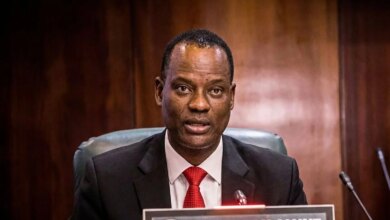
A Federal Capital Territory High Court in Abuja has dismissed a ₦120 million fundamental rights suit filed by former Kaduna State Governor Nasir El-Rufai against the Department of State Services (DSS) and other federal agencies over an attempted arrest at Nnamdi Azikiwe International Airport and the seizure of his passport.
Justice Sylvanus Oriji, who delivered the judgment, ruled that the suit lacked merit and substance as presented by the former governor.
The court held that the invitation letters issued by the relevant government agencies for investigations did not violate El-Rufai’s fundamental rights.
The judge also ordered El-Rufai to pay ₦200,000 in costs to each of the respondents involved in the case.

The ruling represents a setback for the former governor’s attempt to obtain judicial relief over the actions taken by security and anti-corruption agencies in connection with allegations against him.
The court maintained that the agencies were acting within their statutory responsibilities and that the evidence presented did not establish a breach of his constitutional rights.
Justice Oriji specifically addressed the invitations issued by the Economic and Financial Crimes Commission (EFCC) and the Independent Corrupt Practices and Other Related Offences Commission (ICPC).
He held that the letters requesting El-Rufai to appear for questioning were lawful and did not amount to an infringement of his rights.
The court’s position was that government agencies could invite individuals to assist with investigations into allegations raised against them, provided their actions complied with the law and constitutional requirements.
It therefore rejected the argument that the invitations, by themselves, constituted a violation of the former governor’s fundamental rights.
The judge also considered the circumstances surrounding the DSS’s attempt to arrest El-Rufai at Nnamdi Azikiwe International Airport in Abuja.
The former governor had challenged the action, arguing that the attempted arrest infringed on his rights, particularly because he maintained that there was no warrant authorising his arrest.
However, Justice Oriji upheld the position presented by the DSS, which maintained that it had the legal authority to monitor individuals of interest and take appropriate action within its statutory mandate.
The court rejected El-Rufai’s argument on the absence of an arrest warrant, holding that the DSS possessed relevant powers under the legal framework governing its operations, including the instrument establishing the service and the National Security Agencies Act.
Justice Oriji further maintained that El-Rufai could not obtain an order preventing security and law enforcement agencies from carrying out their lawful responsibilities.
The ruling reinforced the court’s position that the exercise of investigative powers by government agencies does not automatically amount to a violation of fundamental rights.
The seizure of El-Rufai’s passport was another major issue considered during the proceedings.
The former governor had questioned the legality of the action, seeking to establish that it violated his constitutional rights.
The court, however, found that the DSS had acted within its powers in taking possession of the travel document.
Justice Oriji said the evidence before the court did not establish that the seizure was continuous, permanent or unlawful.
The judge consequently held that El-Rufai had failed to provide sufficient evidence to support his claim that the action amounted to an infringement of his fundamental rights.
The decision means that the former governor was unsuccessful in securing the reliefs he sought in the ₦120 million action.
In addition to dismissing the case, the court imposed a cost of ₦200,000 on him in favour of each respondent.
In a related development, POLITICS NIGERIA reported on August, that El-Rufai had filed a fresh ₦10 billion suit against the Independent Corrupt Practices and Other Related Offences Commission over the alleged denial of access to his wife and son while he was in custody.
The former governor sought several declarations concerning his fundamental rights, arguing that his rights remained enforceable despite his detention.
That case was separate from the ₦120 million suit dismissed by Justice Oriji, as it concerned allegations relating to access to family members during custody.
El-Rufai has also pursued legal action over other aspects of the investigations involving him.
His cases have raised questions about the boundaries between the investigative powers of government agencies and the constitutional protections available to individuals facing investigation.
Fundamental rights are protected under the 1999 Constitution of Nigeria, as amended. These protections include the rights to personal liberty, privacy and fair hearing.
However, the exercise of such rights must be considered alongside the powers granted to security agencies under applicable laws.
The dismissal does not, by itself, amount to a determination of the merits of any separate criminal allegations or investigations involving the former governor.
Rather, it resolves the particular claims brought before Justice Oriji in the ₦120 million fundamental rights suit.