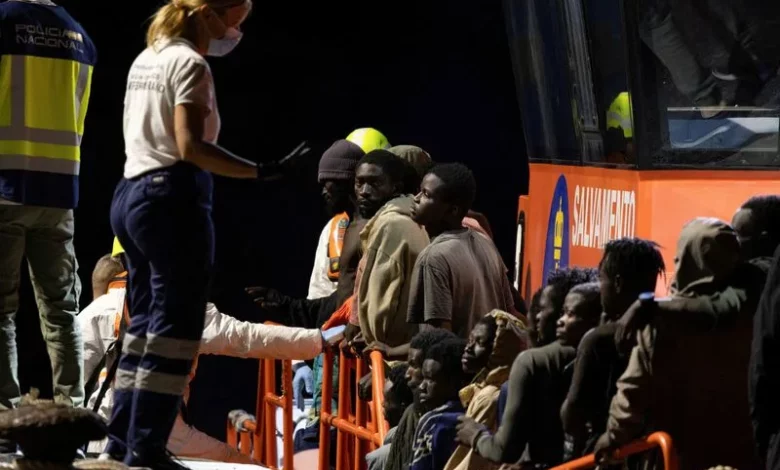
At least four migrants have died following an eight-day journey across the Atlantic Ocean from Gambia to Spain’s Canary Islands, in another tragedy highlighting the dangers of irregular migration along one of the world’s deadliest sea routes.
The migrant boat, carrying more than 100 people, was rescued off the coast of El Hierro early Friday, October 30, after Spanish emergency services received distress calls late Thursday.
According to Spain’s EFE news agency, only two of the four victims’ bodies were recovered, while the other two were reportedly thrown into the sea during the journey.
A young girl, approximately two years old, was airlifted to hospital in serious condition after becoming critically ill during the crossing.


RESCUE OPERATION OFF EL HIERRO Rescue
Spanish maritime rescue authorities located the overcrowded vessel approximately 68 kilometres south of La Restinga, a coastal settlement on El Hierro.
The rescue operation began after emergency services received two distress calls from the boat shortly before 11 p.m. on Thursday.
Authorities deployed the Salvamar Navia rescue vessel and Helimer 204 helicopter to locate and assist those aboard.
READ RELATED STORY
Indian immigrant jailed for life for killing girlfriend in UK
Spain Mourns 68 as second rail disaster in a year raises safety fears
Rescuers subsequently brought 110 survivors ashore at La Restinga harbour at approximately 4 a.m. on Friday.
Among those rescued were eight women and eight minors, according to Spanish authorities.
The survivors received initial medical attention from healthcare workers and the Spanish Red Cross.
Five other passengers were reportedly taken to hospital on El Hierro for medical treatment, while the seriously ill toddler was evacuated by helicopter to a hospital in Tenerife.
FOUR DEATHS REPORTED DURING THE CROSSING
The latest information from EFE indicates that four people died during the journey from Gambia, which reportedly lasted eight days.
Although only two bodies were recovered, survivors told authorities that two additional people had died and their bodies were thrown overboard during the voyage.
Spanish authorities subsequently clarified that the two recovered bodies belonged to young adult men, correcting an earlier report that one of the victims was a baby.
The tragedy has renewed concerns about the humanitarian consequences of dangerous migration journeys undertaken by people seeking better living conditions and opportunities in Europe.
ATLANTIC MIGRATION ROUTE REMAINS DANGEROUS
The Atlantic route connecting West Africa to Spain’s Canary Islands remains one of the most dangerous migration corridors in the world.
Thousands of migrants attempt the crossing every year aboard overcrowded boats, frequently facing rough seas, powerful ocean currents, limited food supplies and inadequate medical assistance.
Although migrant arrivals in the Canary Islands have declined compared with last year, crossings increased considerably in October, putting additional pressure on reception facilities and emergency services.
According to figures from the Spanish government’s representative office in the Canary Islands, migrant arrivals in the archipelago declined by 18 per cent year-on-year to 11,527 as of Friday.
However, the latest incident demonstrates the continuing risks confronting migrants attempting to reach European territory through irregular sea crossings.