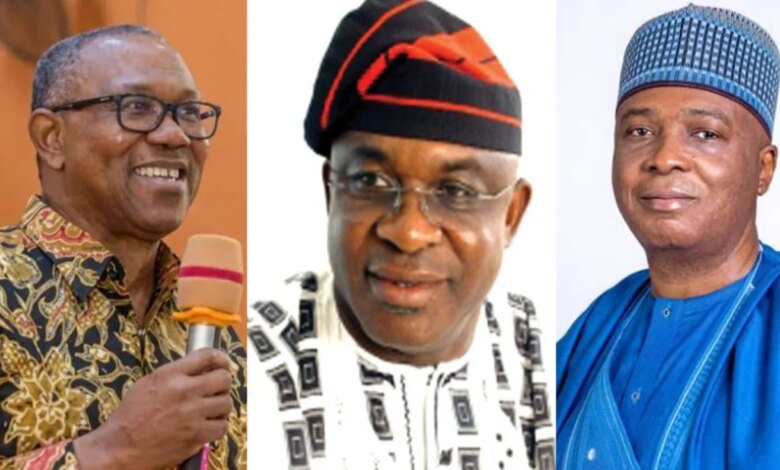
The Code of Conduct Bureau (CCB) has commenced investigations into former Anambra State Governor Peter Obi, former Senate Presidents Bukola Saraki and David Mark, and four other individuals over allegations involving undeclared offshore assets and business interests.
The investigation follows revelations from the Panama Papers and Pandora Papers, two international journalistic investigations that examined how individuals, including politicians and businesspeople, used offshore companies to hold assets and conduct transactions outside their home countries.
According to reports by PREMIUM TIMES, sources within the CCB confirmed that seven individuals have been assigned to case officers who have begun examining the allegations.
The investigation also involves former Aviation Minister Stella Oduah, former Bayelsa State Governor Diepreye Alamieyeseigha, former Delta State Governor James Ibori, and retired Delta State judicial officer Stella Ogene.

“All the Nigerian officials named in the Panama and Pandora papers will be investigated. But seven of them have been assigned to case officers who have already commenced investigations,” one CCB source said.
The bureau’s inquiry centres on whether the individuals complied with Nigeria’s laws on asset declaration and restrictions governing the private business interests and foreign bank accounts of public officers.
However, the allegations do not automatically establish wrongdoing, and the investigation is expected to determine whether any laws were breached.
The CCB has also indicated that its inquiries could extend to other Nigerians named in the international investigations.
An aide to the bureau’s chairman reportedly confirmed that the agency was examining the allegations involving public officials identified in the reports.
CCB Revisits Offshore Asset Allegations
The latest development comes after years of questions about the status of the bureau’s response to the revelations.
In October 2021, the CCB contacted the newspaper following its reporting on the Pandora Papers, acknowledging the significance of the investigation and requesting cooperation to support possible inquiries and prosecutions.
“The primary motivation for our work is to help the public obtain the information they need to ask questions and make informed decisions and for law enforcement agencies to have the leads they require for necessary actions,” Mr Mojeed said.
However, several years passed without a detailed public account of the progress made on a number of the allegations.
It subsequently wrote to the bureau on 29 July 2026, requesting an update on the investigations into public officials allegedly linked to offshore assets, foreign accounts and business interests.
In September, the CCB responded that the relevant information and documents were being reviewed in line with its constitutional and statutory responsibilities.
It added that any action considered necessary would follow due process.
The bureau also indicated that it could invite a representative of the newspaper to provide additional information or clarify issues arising from the reports.
It declined to release further details, citing the confidential nature of investigative and verification procedures and the need to avoid compromising any ongoing or planned action.
The latest confirmation that case officers have been assigned to seven individuals suggests that the bureau has moved beyond reviewing the allegations and begun examining specific cases.
However, no final findings or conclusions against the individuals have been established in the information made public.
Peter Obi’s Offshore Business Interests
Peter Obi, who governed Anambra State from 2006 to 2014, was among the Nigerian public figures named in the Pandora Papers investigation published in 2021.
The investigation, coordinated by the International Consortium of Investigative Journalists (ICIJ), examined leaked financial records from offshore service providers in several jurisdictions.
The documents revealed how companies and trusts were used to hold assets and manage business interests across national borders.
According to PREMIUM TIMES, the investigation found that Obi remained a director of NEXT International (UK) Limited, a British company, for about 14 months after becoming governor of Anambra State.
The report raised questions about whether retaining the position complied with Section 6 of the Code of Conduct Bureau and Tribunal Act.
The newspaper also reported that Obi had not declared certain offshore interests and operated a foreign bank account while serving as governor.
These findings raised questions about the requirements imposed on public officers under Nigerian law.
Obi reportedly said he was unaware that assets jointly owned with other people were required to be declared.
He did not deny the reported issues concerning asset declaration, the foreign account and his continued directorship, according to account of his response.
He has also repeatedly maintained that he did not divert public funds. The Source, however, did not accuse him of diverting public money in its original report.
The CCB’s investigation will determine whether the matters raised in the reporting amount to violations of the rules applicable to public officers.
Saraki’s Family Assets Under Scrutiny
Former Senate President Bukola Saraki and members of his family were also named in the Panama Papers investigation, published in 2016.

The investigation examined leaked records from Mossack Fonseca, a Panamanian law firm that helped clients establish offshore companies.
PREMIUM TIMES reported that at least four assets associated with the Saraki family were held through offshore structures and had not been disclosed to the CCB as required.
Among the companies examined was Sandon Development Limited, registered in Seychelles.
Documents cited by the newspaper showed that Saraki’s wife, Toyin Saraki, held an interest in the company, which was used to acquire a property on Whittaker Street in Belgravia, London, in 2012.
Babatunde Morakinyo, a longtime aide and associate of the former Senate president, was also listed as a shareholder in the company.
The investigation further examined Girol Properties Limited and Landfield International Developments Limited, both registered in the British Virgin Islands.
According to the published findings, Toyin Saraki was initially listed as a shareholder in the companies.
Documents reviewed by the newspaper also indicated that Saraki later assumed control of Landfield through Longmeadow Holdings Limited, an offshore company registered in Jersey.
A purported board meeting held in January 2015 approved the sale of Landfield to him for more than £3 million.
Under Nigeria’s asset declaration requirements, public officers covered by the law must declare their assets, those of their spouses and those of their children under 18.
The allegations involving the Saraki family therefore raise questions about whether the relevant interests were properly disclosed.
The CCB’s investigation is expected to examine the available records and determine whether the arrangements breached any applicable provisions.
David Mark Linked To Offshore Companies
David Mark, who served as Senate president before Saraki, was also identified in the Panama Papers investigation.

According to PREMIUM TIMES, leaked records linked Mark to at least eight active companies registered in the British Virgin Islands while he held public office. The companies included Sikera Overseas S.A., Colsan Enterprises Limited, Goldwin Transworld Limited, Hartland Estates Limited, Marlin Holdings Limited, Medley Holdings Limited, Quetta Properties Limited and Centenary Holdings Limited.
Documents from Mossack Fonseca repeatedly classified Mark as a politically exposed person, a designation generally applied to individuals holding prominent public positions because their roles can expose them to particular financial and corruption risks.
The records also showed that Mark supplied documents to the law firm to establish his identity and address concerns about his status.
However, the newspaper said its investigation could not establish the nature of the businesses conducted through the companies.
The existence of an offshore company does not, by itself, constitute an offence.
The central questions for the CCB are whether the companies and related interests were properly declared and whether Mark’s activities complied with the restrictions applicable to him as a public officer.
Those issues remain subject to investigation, and the reported links a lone do not establish that the former Senate president committed an offence.