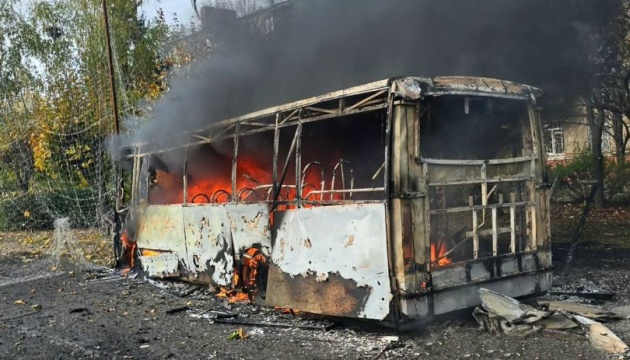
At least 33 people have been killed and 18 others injured after a Russian guided bomb struck two passenger buses in the eastern Ukrainian city of Kramatorsk on Thursday, October 8, in one of the deadliest attacks on civilians in Ukraine in recent weeks.
The attack occurred in the Donetsk region, close to the front line, as the conflict continues to intensify through long-range missile and drone strikes. Ukrainian authorities said the bomb hit a street where the buses were travelling, setting the vehicles on fire and causing extensive damage.
CIVILIANS CAUGHT IN DEADLY ATTACK
Local Ukrainian officials accused Russia of deliberately targeting civilians, saying the strike hit ordinary public transportation carrying passengers.


Donetsk regional administration head Vadym Filashkin said the attack appeared to have been designed to cause a high number of civilian casualties.
“The Russians are deliberately targeting civilians,” Filashkin wrote on Telegram. “For them, a bus full of passengers is an attractive target precisely because a single strike can kill the maximum number of people.”
READ RELATED STORY
Russian strikes disrupt three Kyiv bridges as Ukraine seeks ceasefire
Russia-Ukraine War: Russian strikes kill five as Zelenskyy prepares to meet Trump
Foreign arms, drone strikes raise war crimes concerns in sudan
“Russia consciously disregards all conceivable rules of warfare and norms of international humanitarian law. It selects targets where it can inflict the greatest suffering on civilians,” he wrote.
The strike caused fires and extensive damage, while emergency workers were deployed to search for victims, treat the wounded and put out the flames.
The rescue operation was reportedly complicated by further Russian drone activity in the area, according to Ukrainian officials.
DEATH TOLL RISES AS ATTACKS SPREAD
The Kramatorsk attack came only a day after another deadly Russian strike in the Ukrainian town of Pryluky.
A missile attack there killed 22 people, including five children, while more than 50 others were injured, according to Ukrainian authorities and international news reports.
The two attacks have brought the reported number of people killed in Russian strikes across Ukraine over the two-day period to more than 70, according to Ukrainian President Volodymyr Zelenskyy.
The attacks have also placed renewed pressure on Ukraine’s already strained transport and energy systems.
UKRAINE SEEKS STRONGER INTERNATIONAL SUPPORT
The latest strikes have increased calls from Kyiv for additional military assistance from its international partners as winter approaches.
Zelenskyy, who visited Pryluky alongside British Foreign Secretary Ed Miliband on Thursday, urged NATO countries to provide more air-defence equipment, ammunition and other military assistance.
“It is important that support in words takes concrete form in new packages for Ukraine’s defence,” Zelenskyy said, calling for additional capabilities to protect Ukrainian cities from Russian missile and drone attacks.
He also criticised what he described as insufficient international pressure on Moscow, arguing that continued Russian attacks showed the need for stronger measures.
POWER OUTAGES ADD TO PRESSURE ON CIVILIANS
The latest attacks have also worsened Ukraine’s energy problems.
Emergency power cuts were reported in Kyiv as Russian attacks continued to place pressure on the country’s electricity infrastructure. Ukrainian authorities have warned residents to prepare for possible disruptions as colder weather approaches.
Russia has increasingly targeted infrastructure including energy facilities, railways, transport networks and other systems that support everyday life and Ukraine’s economy.
Meanwhile, Ukraine has continued launching drone attacks against targets inside Russia. Ukrainian authorities said their forces struck a major oil refinery complex in Salavat, while Russian authorities reported drone activity in several regions. Some of those claims could not be independently verified.
The latest escalation comes as the broader war remains without a clear resolution. While diplomatic efforts continue, the intensification of attacks on Ukrainian cities is raising fears of a particularly difficult winter for civilians.