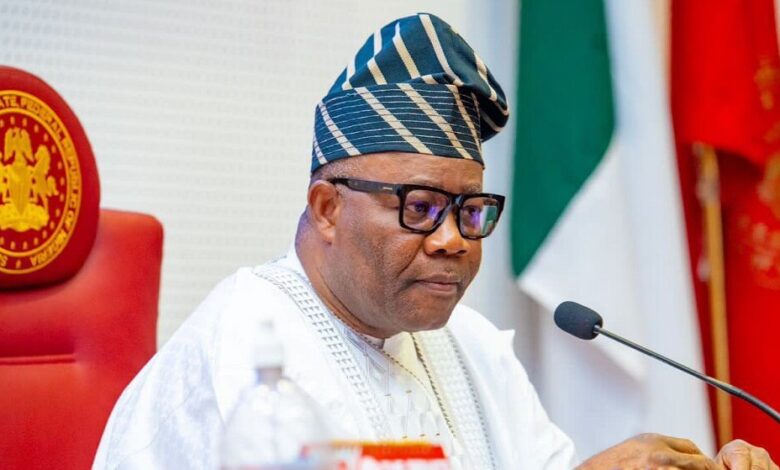
Senate President Godswill Akpabio has opposed a proposed law that would end criminal punishment for people who attempt suicide in Nigeria, insisting that those who survive should face imprisonment. His comments came on Tuesday, 13 October 2026, as the Senate advanced a bill seeking to replace prosecution with medical treatment, rehabilitation and mental health support.
Despite Akpabio’s opposition, the Suicide Prevention Bill 2026 passed its second reading, moving it closer to further legislative scrutiny.
The development has raised questions about Nigeria’s existing suicide laws, the number of people affected and whether police officers should treat survivors as criminal suspects or people requiring urgent medical attention.
The bill was sponsored by Senator Asuquo Ekpenyong, who represents Cross River South. It proposes a national system for suicide prevention, including emergency support, professional assessment and follow-up care.


What Akpabio said about attempted suicide
During the Senate debate, Akpabio argued that attempted suicide should remain a criminal offence, expressing concern that removing punishment could encourage more attempts.
He said: “If you don’t succeed, we will send you to prison.”
The Senate President repeated his opposition while acknowledging that lawmakers had not yet held a public hearing on the proposal.
His position differed from that of Ekpenyong, who argued that people experiencing serious psychological distress should receive treatment instead of criminal punishment.
Ekpenyong questioned whether prosecution should be the government’s first response when someone survives a suicide attempt.
He also warned that criminal penalties could discourage people from seeking medical assistance and lead families to conceal incidents because of stigma or fear of prosecution.
How many Nigerians could be affected?
The debate concerns a wider public health problem that affects thousands of Nigerian families every year.
In August 2026, the Minister of Health and Coordinating Minister of Health and Social Welfare, Professor Muhammad Ali Pate, cited World Health Organisation estimates indicating that Nigeria records more than 7,000 suicide deaths and approximately 300,000 suicide attempts annually.
These are estimates, not a verified count of individuals who would face prosecution or automatically qualify for treatment under the proposed law.
The figures nevertheless underline the potential scale of the legislation’s impact on people experiencing mental health emergencies.
The proposal could also change how police officers respond to suspected suicide attempts across Nigeria.
Under the proposed framework, officers would receive training to recognise mental health emergencies and help connect survivors with medical services.
However, no official figure has been announced for how many police officers would undergo training. The bill does not propose dismissing officers, reducing police numbers or automatically changing their employment conditions.
What Nigeria’s existing law says
Attempted suicide remains criminalised under Section 327 of the Criminal Code and Section 231 of the Penal Code.
These provisions create the possibility of criminal prosecution for people who survive an attempt. However, prosecution or imprisonment is not automatic, and the legal process depends on the applicable law and circumstances.
Ekpenyong argued that these criminal provisions conflict with the approach taken by Nigeria’s National Mental Health Act, which recognises the need for medical care and protection for people experiencing mental health crises.
The proposed legislation would move the response towards assessment, treatment and rehabilitation.
It would also introduce crisis helplines, public education, training for teachers and healthcare professionals, and a national system for recording suicide-related information.
Importantly, decriminalising attempted suicide would not remove criminal responsibility for separate offences involving encouraging or assisting another person’s suicide.
What other senators are saying
The bill has attracted different views within the Senate.
Senator Ned Nwoko, representing Delta North, supported allowing the bill to proceed but questioned how its proposed measures would prevent suicide.
Senate Leader Opeyemi Bamidele raised concerns about the application of federal legislation across Nigeria’s states, particularly where changes to state laws might be required.
Senator Abdul Ningi, representing Bauchi Central, welcomed further consideration of the proposal and the opportunity for medical professionals and legal experts to contribute.
These interventions show that the debate extends beyond whether attempted suicide should remain punishable. Lawmakers must also consider how the proposed system would operate, who would provide treatment and how the legislation would work across different jurisdictions.
Federal Government had already backed reform
The Senate debate comes after the Federal Government approved moves to decriminalise attempted suicide.
On 19 August 2026, the Federal Executive Council approved a proposed amendment to the National Mental Health Act.
The Ministry of Health subsequently confirmed the government’s position on 10 September, describing the proposed reform as an effort to replace punishment with care and timely intervention.
The approval did not immediately change the criminal law. Parliamentary consideration remains necessary before the proposed reforms can take legal effect.
Social media users react to Akpabio’s remarks
Akpabio’s comments have attracted criticism from Nigerians on social media, with some questioning whether imprisonment is an appropriate response to a mental health crisis.
According to Pulse Nigeria’s report on the reactions, several commenters criticised the Senate President’s remarks and called for greater understanding of mental health problems.
One commenter accused political leaders of lacking sensitivity when discussing the issue, while others questioned the approach lawmakers were taking to suicide prevention.
The reactions reflect disagreement over whether criminal punishment helps prevent suicide or creates additional barriers for people who need treatment.
What happens next?
Following its second reading, the bill was referred to the Senate committees responsible for health and judiciary matters.
The committees are expected to examine the proposals and provide an opportunity for professional bodies, government institutions and other interested parties to contribute through a public hearing.
The bill must still complete the necessary legislative stages, including consideration by the House of Representatives and presidential assent, before becoming law. State-level legal issues may also require attention.
For Nigerians living abroad, the outcome could directly affect relatives and friends back home who experience mental health emergencies.
Families should not assume that the proposed legislation has already removed the existing criminal provisions.
What readers should know: Nigeria has not yet decriminalised attempted suicide through this bill. Although Akpabio supports retaining imprisonment, the Senate has allowed the proposal to proceed. The central question is whether Nigeria will continue treating suicide attempts as criminal matters or establish a nationwide system focused on prevention, medical care and recovery.
Related news