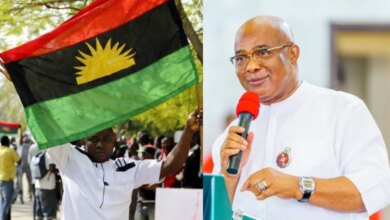
President Bola Tinubu’s media aide, Dr Sunday Dare, has challenged former Vice President Atiku Abubakar’s description of the president as a dull student, citing their different educational backgrounds in a response to Atiku’s criticism of fuel price relief measures.
Dare said it was “sheer absurdity” for Atiku, whom he identified as a graduate of a school of hygiene, to call Tinubu a dull student despite the president’s first-class accounting degree.
The Special Adviser to the President on Media and Public Communications accused Atiku of using economic hardship to gain political support. He made this accusation in a press statement on Sunday, 11 October 2026.
The dispute arose from Atiku’s recent press conference in Abuja, where he criticised the Nigerian National Petroleum Company (NNPC) Retail’s 30-day petrol discount and the government’s price modulation framework.


Dare defended the measures, saying they were intended to ease the effect of rising global crude oil prices on Nigerians without restoring the former fuel subsidy system.
Dare challenges Atiku’s academic comparison
The presidential aide dismissed Atiku’s attempt to present himself as a more knowledgeable student of economic policy than Tinubu.
“First, it is sheer absurdity that a man who graduated from a school of hygiene dares to call a first-class accounting graduate a dull student,” Dare said.
He also rejected Atiku’s proposal for a production subsidy, which he characterised as financially unsustainable without enough crude oil under the direct control of the Federal Government.
Dare cited figures presented by the Coordinating Minister of the Economy and Minister of Finance, Taiwo Oyedele, on Channels Television.
He said Nigeria produces about 1.8 million barrels of crude oil daily for a population exceeding 200 million. However, contractual obligations under joint ventures and production-sharing contracts reduce the volume available for the government to allocate freely.
READ RELATED NEWS
Tinubu reforms raised poverty, but economy is improving — Bwala
Petrol discount: Tinubu faces test of reform credibility as 2027 election nears
Atiku’s plan to reintroduce fuel subsidy is not practicable — Sule
Nigeria, Dare maintained, has fewer than 700,000 barrels daily of unencumbered crude oil after production costs, royalties and profit-sharing arrangements are considered.
He said major refineries, including the Dangote Petroleum Refinery, require more crude oil than the government can supply freely without breaching existing international contracts or reducing national revenue.
Dare noted that domestic refiners must supplement local supplies with imported crude oil. He warned that a blanket production subsidy could encourage fraud, obscure public spending and drain government revenue.
He also compared Nigeria with the United States, which he said produces more than 10 million barrels of crude oil daily for 330 million people but sells petroleum at market-determined prices.
Aide defends 30-day petrol discount
Dare said the NNPC Retail discount was initially offered to celebrate Nigeria’s 66th Independence anniversary before the company extended it for another 30 days.
He rejected Atiku’s claim that the arrangement amounted to a return to fuel subsidies, explaining that NNPC Retail would forgo its profit margin and sell petrol at landing cost during the period.
He also defended the Federal Government’s negotiated ceiling of N1,350 per litre for ex-gantry costs, which refers to the price of petroleum products at the point where they leave a refinery or supply terminal.
Under the arrangement, Dare said, refiners and importers would absorb costs above the ceiling temporarily and recover them later when global crude prices fell or local exchange rates adjusted.
He said the arrangement was intended to reduce sudden petrol price changes that could cause commercial transport fares to rise sharply without falling when fuel became cheaper.
Dare added that the ceiling would undergo monthly reviews based on published cost audits to prevent hidden government liabilities.
He listed other measures adopted by the Tinubu administration, including a strategic energy reserve, expanded compressed natural gas infrastructure and naira-for-crude arrangements.
He said compressed natural gas could cost 60 to 70 per cent less than premium motor spirit, commonly called petrol, offering commercial transport operators a cheaper fuel option.
The aide also cited windfall taxes on energy operators, transport vouchers, minimum-wage support and the enforcement of the 2025 tax reform laws.
Dare defended the removal of the fuel subsidy and the unification of foreign exchange rates in 2023, saying the changes had stopped the diversion of public funds through fuel smuggling and subsidy claims.
He also claimed that federal allocations to states and local governments had reached record levels and that the country had eliminated multi-day fuel queues.
He said the administration had also introduced cash transfers for vulnerable households, subsidised credit for small businesses and wage support for civil servants.
WHAT READERS SHOULD KNOW
The discount period: NNPC Retail’s petrol discount was extended for 30 days after its initial offer to celebrate Nigeria’s 66th Independence anniversary.
The proposed price ceiling: The Federal Government negotiated an interim ceiling of N1,350 per litre for ex-gantry costs, subject to monthly reviews.
The crude oil figures: Dare cited daily production of about 1.8 million barrels and fewer than 700,000 barrels available as unencumbered crude.
The dispute: Atiku criticised the petrol discount and price modulation framework, while Dare defended the administration’s approach and rejected the proposed production subsidy.
For More News Details, Visit www.NewDailyPrime.news.