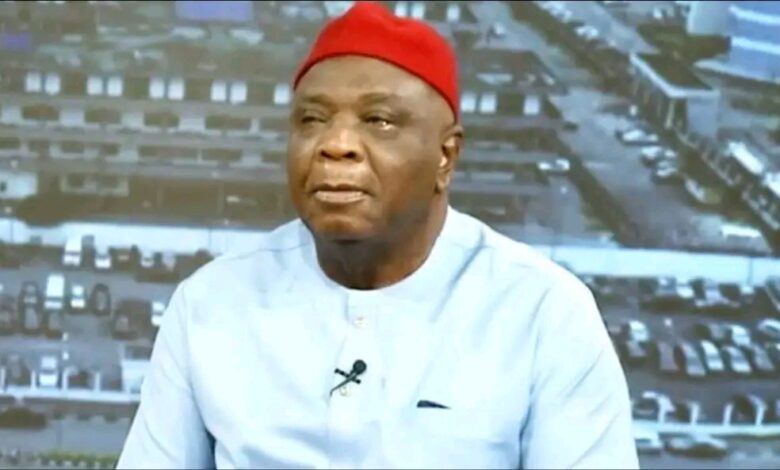
A divided opposition could hand President Bola Tinubu a significant advantage in Nigeria’s 2027 presidential election, Peoples Democratic Party (PDP) chieftain Dan Ulasi has warned, saying it would take “some magic” to dislodge the incumbent under the current political circumstances.
Ulasi made the assessment during an interview on ARISE News on Friday, October 16, arguing that opposition parties were more fragmented than they were before the 2023 election. He also described Tinubu as a highly strategic politician whose electoral strength should not be underestimated.
Recalling the run-up to the last presidential contest, Ulasi said he had questioned the confidence of opposition figures who appeared convinced that their candidate, Atiku Abubakar, would defeat Tinubu.
He said he challenged them to identify the political groundwork that supported their expectations of victory.


“I said who has he won? That Atiku sitting down there, which election has he won against Tinubu? What have we done on the ground to show that Atiku will win?” Ulasi recalled.
Tinubu eventually won the 2023 presidential election, a result Ulasi cited as evidence that political confidence alone cannot replace effective organisation and electoral preparation.
REPATED NEWS:
His latest comments point to a central challenge for the opposition ahead of 2027: converting public dissatisfaction with the government into a coordinated campaign capable of competing nationwide.
The numbers behind the last election offer useful context. Tinubu secured 8,794,726 votes in 2023, while Atiku received 6,984,520 and Labour Party candidate Peter Obi polled 6,101,533, according to the official results declared by the Independent National Electoral Commission (INEC).
Combined, Atiku and Obi received more votes than Tinubu. However, their separate candidacies meant those votes were not cast for a single challenger. The figures do not prove that a joint ticket would have won, since an alliance could change voter behaviour, turnout and campaign dynamics.
Ulasi believes the opposition faces an even more difficult situation this time because its political forces are scattered across competing parties and interests.
“As things are on the ground, it will take some magic for anybody to stop Tinubu,” he said.
He singled out Obi as the only serious opposition figure, but his assessment did not establish whether Obi could secure a unified platform or attract the support needed to challenge the ruling All Progressives Congress (APC).
The distinction matters because opposition strength depends on more than a popular candidate. Parties must agree on strategy, mobilise supporters across regions, select credible candidates, raise campaign resources and organise effectively for election day.
A united front could reduce the risk of splitting votes among rival challengers, but negotiations over tickets, leadership and political interests could also weaken an alliance before the campaign gathers momentum.
Ulasi’s remarks are a political assessment, not a prediction of the election result. Tinubu’s re-election is not guaranteed, just as opposition victory cannot be assumed from dissatisfaction with the government.
The 2027 contest will ultimately test whether opposition parties can turn their separate strengths into a coherent electoral challenge, while the APC will have to persuade voters to renew its mandate.
For now, Ulasi’s warning places the opposition’s internal divisions at the centre of the debate over who can realistically challenge Tinubu.
For More Details, Visit New Daily Prime News