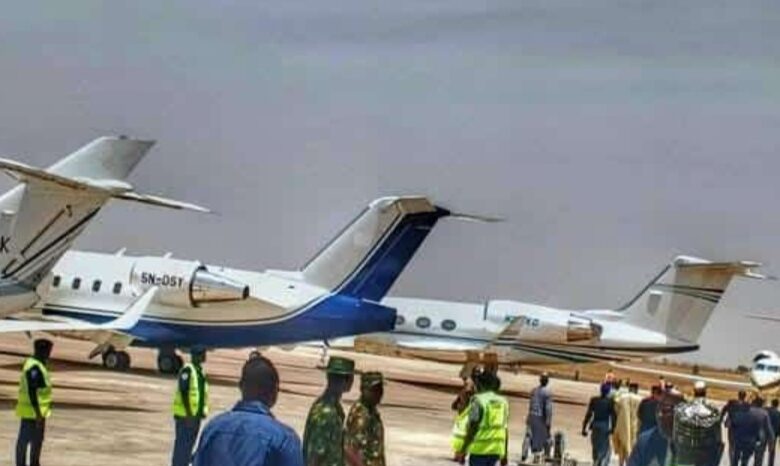
Zamfara State is opening a new chapter in its 30-year history as Gusau International Airport begins scheduled commercial flight operations on Thursday, giving the state its first regular air link with Nigeria’s capital.
The commencement coincides with Zamfara’s 30th anniversary and moves the airport beyond ceremonial flights into a service that could reshape how people, businesses and investors access the state.
Secretary to the State Government Abubakar Nakwada announced the development on Wednesday while briefing journalists on activities marking the anniversary.
The first scheduled route will connect Gusau with Nnamdi Azikiwe International Airport, Abuja, with XEJet set to operate flights twice a week under an Air Route Development Partnership Agreement signed with the Zamfara Government on September 21.


The significance of the route goes beyond convenience.
Gusau previously lacked an operational airport despite Zamfara being created in 1996. Residents travelling by air had to rely on airports in neighbouring states, adding road journeys to the cost and time of air travel.
READ RELATED NEWS UPDATES
The new connection gives government officials, businessmen, investors, professionals and visitors a direct aviation option into the state.
The airport has also passed an important technical hurdle. A recent aviation assessment found that its Instrument Flight Procedures completed all 17 stages of the International Civil Aviation Organisation’s quality-assurance process. An aviation official said the documentation formed part of Nigeria’s submissions following an ICAO inspection.
The facility is therefore entering commercial service after more than one preparatory milestone.
In March, a Bombardier Challenger 605 conducted a test flight into the airport to assess its suitability for VIP operations. The flight received a one-off “No Technical Objection” from the Nigeria Civil Aviation Authority and was conducted under Visual Flight Rules.
Two months later, the airport handled its first Hajj flight. A Max Air aircraft transported 415 Zamfara pilgrims directly from Gusau to Saudi Arabia, sparing them the previous road trip to airports in Sokoto or Kano.
Commercial aviation now brings a different test: whether passenger demand can sustain the route.
The state government has linked the airport to investment, tourism and economic expansion. Regular Abuja connections could make business trips faster, improve access for prospective investors and reduce the logistical burden associated with reaching Zamfara.
Nakwada said the state government’s development programme also covers security, education, healthcare, agriculture, infrastructure, human-capital development and institutional reforms.
On agriculture, he listed improved seeds, fertiliser distribution, tractors and other machinery among interventions intended to expand mechanised farming. The administration has also invested in hospitals, primary healthcare facilities and diagnostic services.
Security is another major consideration for the state. Nakwada said the government had supplied operational vehicles, armoured platforms, surveillance drones and specialised motorcycles to security agencies. He also cited the Community Protection Guards as part of the state’s grassroots security structure.
The government is simultaneously seeking greater economic value from Zamfara’s mineral resources by formalising mining and promoting local processing.
That gives the airport a larger economic role than simply transporting passengers. If commercial traffic expands, the facility could become a logistics channel for people, capital, services and business activity entering and leaving the state.
Yet, the immediate benchmark remains that, Gusau must turn an infrastructure milestone into a dependable transport service.
The twice-weekly Abuja connection is the starting point. Its long-term significance will depend on passenger uptake, route expansion, operational reliability and the ability of Zamfara’s wider economy to generate sustained demand.
On the state’s 30th anniversary, the airport therefore represents more than a new runway. It is a new test of whether improved connectivity can translate into measurable economic activity for Zamfara.