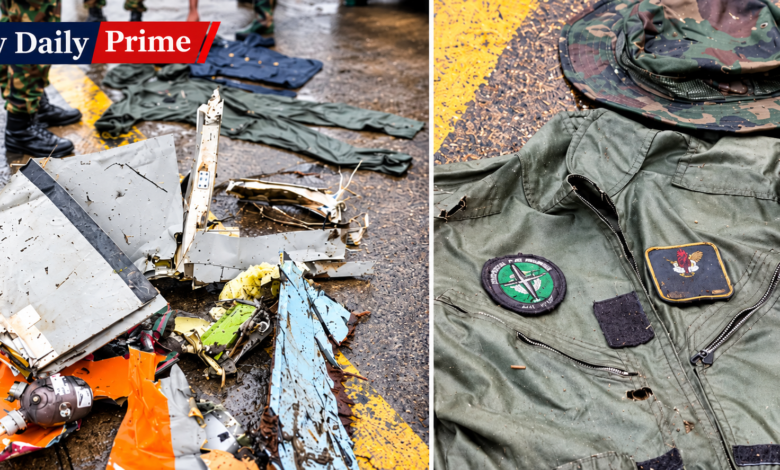
All 32 people aboard a Nigerian Air Force aircraft that crashed in Ondo State on Monday have died after the plane lost contact with air traffic controllers while travelling from Benin City to Lagos.
The ATR-42 aircraft, carrying 25 passengers and seven crew members, disappeared from radar at about 9.13am on October 5 before its wreckage was found in a swampy area near the Naval Base in Igbokoda, Ilaje Local Government Area. The cause of the crash has not been established, and President Bola Tinubu has ordered the Nigerian Air Force to investigate what went wrong.
The Presidency later declared three days of national mourning for the Air Force personnel killed in the crash and directed that flags be flown at half-mast across Nigeria.
The development moves attention beyond the initial search-and-rescue operation to a more difficult question: why did the aircraft suddenly lose communication before crashing?

Ondo NAF crash: What happened before contact was lost
Minister of Aviation and Aerospace Development Festus Keyamo said air traffic controllers lost contact with the aircraft, identified by tail number NGR 931, at about 9.13am.
Attempts to reach the aircraft by radio failed before authorities received information that it had crashed close to the Naval Base in Igbokoda.
The Nigerian Air Force confirmed that the ATR-42 was on what it described as a routine mission from Benin, Edo State, to Lagos when the accident occurred.
A senior air traffic controller quoted by The PUNCH said communication had initially been established with the aircraft after take-off before contact was lost.
The account raises questions investigators will now be expected to answer, but the loss of communication by itself does not establish what caused the crash.
No official finding has so far blamed bad weather, mechanical failure, pilot error or any other factor. Claims about the cause should therefore be treated as unconfirmed until investigators examine the available evidence.
Tinubu orders investigation into cause
Tinubu said he had been briefed by Chief of the Air Staff Air Marshal Sunday Kelvin Aneke and directed the Air Force to begin a thorough investigation.
The President said the purpose of the inquiry would be to establish the cause and help prevent a similar accident.
He also offered condolences to the families of the 25 passengers and seven crew members and described the crash as a painful loss for the Armed Forces and the country.
The identities of those killed were not immediately released publicly. The Presidency said the Air Force would announce the names of the officers after their families had been contacted.
Read related news:
Ondo Air Force crash: cause unknown, Tinubu orders investigation
Two killed in Essex plane crash
Plane crash in Colombia kills 15, including lawmaker
Why the Air Force will lead the investigation
Although the crash involves aviation safety, the Nigerian Safety Investigation Bureau has said responsibility for investigating the accident rests with the Nigerian Air Force because NGR 931 was a military aircraft.
The NSIB said it could provide technical assistance if formally requested by the Air Force.
That assistance could include investigators and use of the bureau’s Flight Safety Laboratory to recover, read and analyse information from the aircraft’s flight recorders.
This distinction is important because the NSIB normally investigates civil aviation accidents, but military aircraft fall under a different investigative framework.
The Aviation Ministry has similarly said regulation of military aircraft falls outside the authority of the ministry and the Nigerian Civil Aviation Authority.
Flight recorder could help establish aircraft’s final moments
One of the important steps in the investigation will be determining whether investigators can recover usable flight recorder data from the wreckage.
Flight data, cockpit information, air traffic control records, maintenance history, weather information and the condition of the wreckage could help investigators reconstruct the aircraft’s final journey.
The crash occurred in difficult swampy terrain, complicating access to the wreckage. Local fishermen were among those who assisted military personnel and emergency responders at the scene, according to accounts from Igbokoda.
The aircraft was an ATR-42, a twin-engine turboprop type used by the Nigerian Air Force for roles including maritime patrol, intelligence, surveillance and reconnaissance.
Three days of national mourning
Following confirmation of the deaths, Tinubu declared three days of national mourning.
He ordered Nigerian flags to be flown at half-mast nationwide in honour of the personnel who died.
The President also commended emergency responders, the Ondo State Government and Air Force personnel involved in the response to the crash.
The investigation is now expected to focus on why communication with the aircraft was lost, its technical condition before the crash, its flight path and whether any mechanical, operational, environmental or other factor contributed to the accident.
Until investigators produce evidence, there is no verified official cause of the Ondo NAF aircraft crash.