A dispute over who has the authority to negotiate for Nigerian workers has divided the country’s two major labour centres, with the Nigeria Labour Congress (NLC) and the Trade Union Congress (TUC) trading claims over the Federal Government’s approved ₦70,000 transport intervention.
NLC President, Joe Ajaero, maintains that his organisation can negotiate independently on labour matters because it represents the largest number of workers. TUC President, Festus Osifo, rejects that position, insisting that the NLC cannot negotiate on behalf of a separate labour centre without consultation.
The disagreement surfaced on Monday during separate appearances by both leaders on Channels Television’s The Morning Brief. It has raised a fundamental question about labour representation: does having more affiliated unions give one congress the authority to speak for workers represented by another?
Ajaero cited the principle of the most representative workers’ organisation under the International Labour Organisation (ILO), arguing that the NLC could negotiate alone while the TUC could participate alongside it.
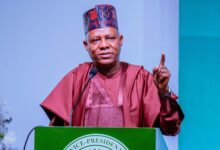

“TUC can negotiate along with NLC, but NLC can negotiate alone based on the principle of most workers representatives of the ILO,” he said.
Osifo challenged him to produce the specific ILO provision supporting that interpretation. He maintained that neither congress could negotiate for the other without its participation or consent.
“He should show me in the ILO Regulations where it says one party is going to negotiate without the other one being there or consulted. He should show me! He should show Nigerians!” the TUC president said.
RELATED NEWS:
The dispute centres partly on the process that produced the ₦70,000 transport allowance. Ajaero said the NLC had secured the intervention after giving the Federal Government an ultimatum and agreeing to suspend planned action following a request for further talks.
“We gave the government an ultimatum; we were supposed to start an action. The government asked for four days to meet with us, and we met, and they resumed sitting after four days.
“After the meeting, the 70k allowance came up,” he explained.
Osifo, however, questioned the legitimacy of the meeting, saying it was not a session of the Joint National Public Service Negotiating Council (JNC), whose membership and quorum, he maintained, were necessary for such negotiations. He also said the TUC was not consulted.
The two leaders further disagreed over union membership. Ajaero cited the Trade Unions (Amendment) Act 2005 and Section 40 of the 1999 Constitution, which protects freedom of association, to support workers’ right to choose their unions.
He questioned Osifo’s claim of substantial membership in the federal civil service, pointing out that seven of the eight unions in the JNC belong to the NLC.
Osifo acknowledged the NLC’s larger number of affiliates but said that did not confer authority to represent TUC members. He put the number of affiliated unions at about 60 for the NLC and 40 for the TUC.
Beyond the exchange, the disagreement exposes a problem with fragmented labour representation: workers may benefit from an intervention negotiated by one congress, yet questions over consultation and representation can weaken confidence in the process.
The ₦70,000 payment also needs to be distinguished from a permanent increase in basic salaries. It is a transport intervention approved for six months, not a replacement for minimum-wage negotiations or consequential salary adjustments.
Until the two congresses settle their differences over representation and procedure, the dispute could complicate future negotiations on workers’ pay and welfare.
The central issue now is not about which union has more affiliates, but who has the mandate to speak for workers and how that mandate is established.
For More News Updates, Visit New Daily Prime News