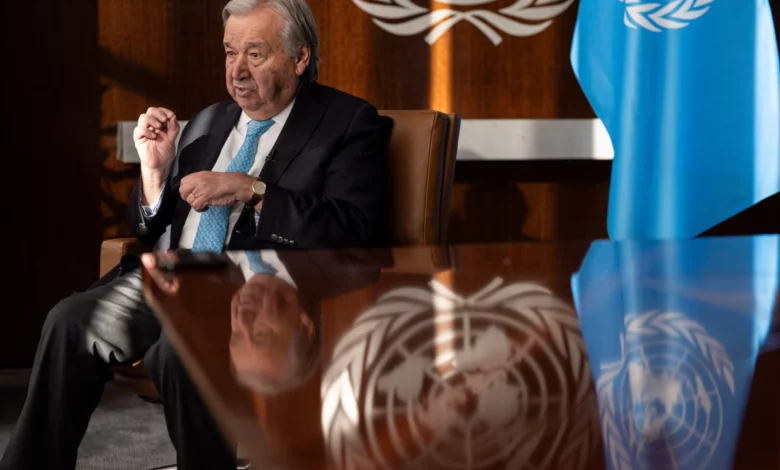
United Nations Secretary-General António Guterres has warned world leaders that the fight against climate change has reached a critical turning point, urging governments to abandon prolonged negotiations and accelerate efforts to reduce greenhouse gas emissions.
Guterres issued the warning ahead of the 31st United Nations Climate Change Conference (COP31), scheduled to begin on November 9 in Antalya, Türkiye, where governments are expected to confront worsening climate impacts, fossil fuel dependence and mounting demands for climate financing.
“This is a moment of truth. We can no longer wait, we can no longer have endless discussions in which everybody tries to push the responsibility to someone else. Everybody must do more, everybody must do more now,”Guterres said he will tell leaders of the U.N. climate conference, known as COP31, scheduled Nov. 9-20.
The warning comes as countries continue to experience increasingly severe climate-related disasters, including destructive floods, prolonged droughts, extreme heat and powerful storms, raising concerns about the consequences of insufficient global action.


Guterres, whose second and final term as UN secretary-general expires at the end of the year, said the international community must confront the growing gap between climate commitments and actual progress.
He recalled a particularly difficult moment last year when scientists informed him that the world could no longer realistically prevent global warming from exceeding the 1.5-degree Celsius threshold established under the 2015 Paris Agreement.
“That was an enormous shock for me,” he said, describing the realisation as one of the most difficult experiences of his life.
The secretary-general attributed the setback not to humanity’s inability to address climate change but to failures in political leadership, arguing that governments had repeatedly prioritised short-term interests over sustained environmental investment.
READ RELATED NEWS
Pope Leo XIV begins 12-day South American tour following lung surgery
United Nation Envoy holds talks with Houthis as Yemen violence escalates
“But it’s not the world that’s failed, it’s the political leadership that’s failed,” Guterres said.
AI GORE PRAISES UN CHIEF’S CLIMATE LEADERSHIP
Guterres’ sustained advocacy for climate action has also received recognition from former United States Vice President Al Gore, who praised the secretary-general’s determination to confront the environmental crisis.
“António Guterres has consistently been eloquent, forceful and right on target in all of his many statements and initiatives to address the climate crisis,” Gore said.
“He’s been so active on this issue because he understands clearly that it is the greatest challenge facing humanity.”
Gore’s remarks underscore the international recognition of Guterres’ efforts to place climate change at the centre of global political discussions, particularly his repeated calls for governments to strengthen environmental commitments and support vulnerable countries.
RENEWABLE ENERGY OFFERS HOPE
Despite the growing challenges, Guterres identified the rapid expansion of renewable energy, particularly solar and wind power, as evidence that a transition away from fossil fuels remains achievable.
According to him, the increasing affordability of clean energy technologies offers governments an opportunity to reduce emissions while strengthening energy security.
He also called for stronger financial commitments to countries disproportionately affected by climate change, particularly developing nations that contribute relatively little to global emissions but face severe environmental consequences.
Guterres argued that fossil fuel companies benefiting from extraordinary profits should face additional taxation, with the proceeds directed towards countries experiencing the most devastating climate impacts.
“Fossil fuel companies are making huge profits and obviously those windfall profits should be taxed and those taxes should be applied in supporting the countries that are having the more dramatic impacts of climate change,” he said.
AFRICA FACES GROWING CLIMATE VULNERABILITY
For Africa, the stakes remain particularly significant, with climate change increasingly threatening agricultural production, water availability, infrastructure and livelihoods across the continent.
Millions of people depend on climate-sensitive activities such as farming, while extreme weather events continue to intensify humanitarian pressures and economic vulnerabilities.
Developing countries have repeatedly demanded greater financial assistance to strengthen resilience against climate-related disasters, protect vulnerable communities and support transitions towards cleaner energy systems.
The upcoming climate conference is expected to place particular emphasis on climate financing, adaptation measures and efforts to translate previous international commitments into practical outcomes.
COP31 EXPECTED TO TEST GLOBAL CLIMATE COMMITMENTS
As COP31 approaches, governments face growing pressure to demonstrate that international climate agreements can produce measurable improvements rather than remain largely diplomatic declarations.
Guterres has warned that climate change is accelerating faster than anticipated, recalling predictions he made during a visit to Nepal in 2023 concerning the dangers posed by retreating glaciers and unstable mountain ecosystems.
He said subsequent disasters demonstrated how quickly climate-related threats could materialise, adding that devastating floods had occurred earlier than he expected.
Despite the growing challenges, the UN chief maintained that governments still possess the capacity to prevent the crisis from becoming significantly worse through coordinated action and sustained investment.
His final message to world leaders was a call for honesty, urgency and responsibility.
Asked what advice he would offer his successor, Guterres replied: “Tell the truth.”
He also urged the international community to recognise climate change as an existential threat, stressing that protecting the planet was ultimately necessary to safeguard human lives.
As COP31 approaches, the conference is expected to test whether governments can move beyond diplomatic declarations and deliver measurable progress towards limiting global warming.