As Nigeria’s 2027 general elections approaches, the Independent National Electoral Commission (INEC) has begun strengthening the capacity of its state-level training personnel to manage election results, placing fresh emphasis on the accuracy and consistency of one of the most sensitive stages of the electoral process.
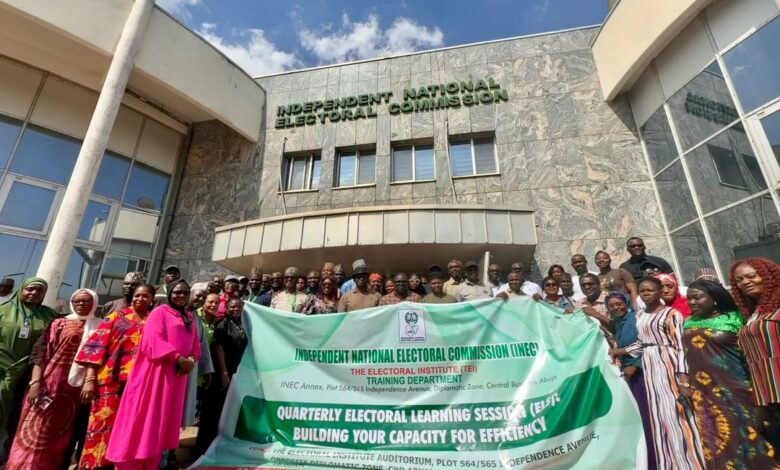
The Commission’s Electoral Institute (TEI), through its Training Department, held a one-day Electoral Learning Session on election result management on Saturday, November 7, bringing together State Training Officers (STOs) and Assistant State Training Officers (ASTOs) from the 36 states and the Federal Capital Territory.
The exercise, announced on Tuesday, November 10, was designed to improve participants’ knowledge, practical skills and professional competence in handling election results ahead of the 2027 polls.
Unlike a routine staff seminar, the programme is structured to extend beyond the officials who attended. Participants are expected to return to their respective state offices and pass the knowledge acquired to other electoral personnel.

This cascading arrangement is intended to spread the training across the Commission’s field structure without requiring every staff member to attend the central session.
RELATED NEWS:
The approach addresses an important administrative challenge in election management. Results pass through several stages after voting, including recording at polling units, collation at designated centres and the declaration of outcomes by authorised officials.
Errors, inconsistent procedures or poor handling of result documents at any stage can generate disputes, delay announcements and weaken public confidence in the process.
State-level personnel therefore occupy an important position in INEC’s preparations. Their ability to train colleagues on established procedures could influence how consistently electoral officials perform their duties across different locations on election day.
The timing is significant. INEC’s revised election calendar schedules the presidential and National Assembly elections for January 16, 2027, while governorship and State Houses of Assembly elections in participating states are fixed for February 6.
The Commission consequently has a limited preparation window to equip its personnel for the demands of the electoral exercise.
TEI described the Quarterly Electoral Learning Session as a capacity-building initiative intended to promote continuous learning, knowledge exchange and professional development among electoral staff at state level.
It also provides an institutional channel for updating personnel on important aspects of election administration.
However, the announcement did not disclose the number of officers who participated, the specific technical modules covered, the resource persons involved or how the Commission would assess the effectiveness of the training after participants return to their states.
Those details will matter in determining how far the exercise translates into improved performance. Training officials is an important first step, but its value will ultimately depend on whether the lessons are understood, properly transferred and consistently applied during the elections.
For voters and political parties, the management of results is not merely an internal administrative responsibility. It is central to the credibility of the electoral process, because the figures announced by election officials must accurately reflect the votes cast.
The latest session therefore places attention on a critical part of INEC’s preparations: ensuring that the personnel responsible for training others are equipped to support accurate, orderly and transparent result management in 2027.
For More News Updates, Visit New Daily Prime News