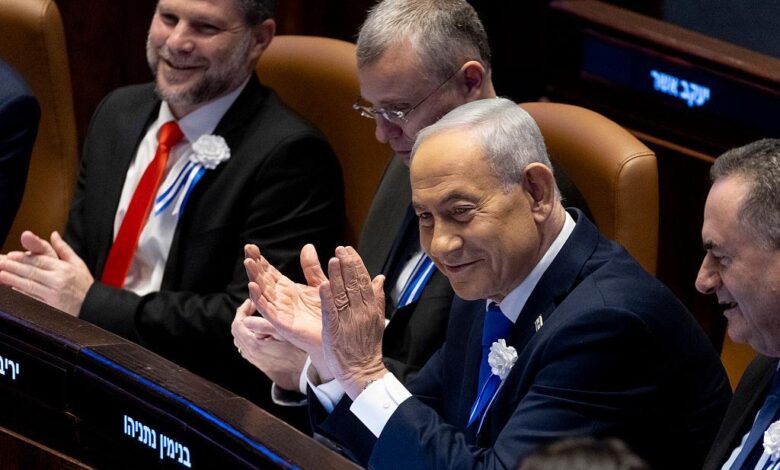
Israel has sworn in its newly elected parliament following a closely contested general election, as opposition politician Gadi Eisenkot attempts to form a government that could end Prime Minister Benjamin Netanyahu’s lengthy leadership.
The newly elected lawmakers took their oaths on Tuesday, November 10, following the October 27 election, which left Netanyahu’s right-wing alliance without a parliamentary majority.
Eisenkot, a former military chief whose Yashar party emerged as a major opposition force, has been tasked by President Isaac Herzog with assembling a governing coalition. However, negotiations remain complicated as neither political bloc has secured enough support to govern independently.
COALITION NEGOTIATIONS FACE CHALLENGES


Netanyahu’s Likud-led alliance holds 53 seats in the 120-member Knesset, falling short of the 61 required for a parliamentary majority.
Eisenkot’s Yashar party and allied factions control 48 seats, while Arab-led parties hold the remaining 19 seats.
Although the Arab-led parties could provide a potential route for Eisenkot to secure parliamentary support, disagreements over political cooperation and the country’s future direction present significant obstacles.
Eisenkot has until December 6 to form a government, with the possibility of requesting a two-week extension until December 20.
If he fails, Netanyahu could be given another opportunity to assemble a coalition. Failure by both leaders could result in another general election.
READ RELATED NEWS
G7 ministers meet in Paris as Ukraine, Iran conflicts dominate agenda
Israel Election: Netanyahu, Eisenkot clash over Iran threat and government legitimacy
US soldier arrested in Britain over alleged espionage linked to Russia
HERZOG CALLS FOR POLITICAL COMPROMISE
Addressing lawmakers during the parliamentary inauguration, President Herzog urged political leaders to avoid another election and work towards national unity.
“You must do everything to avoid a repeat election,” Herzog told parliament.
He also encouraged lawmakers to overcome political differences, urging them to “reach out a hand for compromise, even between rivals”.
Meanwhile, Eisenkot reiterated his commitment to establishing a government that represents the country’s entire population.
“We will act for all citizens of Israel, those who voted for us and those who did not, out of deep commitment,” he said ahead of the swearing-in ceremony.
OPPOSITION TARGETS NETANYAHU’S POLICIES
Beyond the coalition negotiations, Eisenkot’s political bloc has begun pushing legislative proposals aimed at reversing some of Netanyahu’s major policies.
The proposed measures include establishing a state commission of inquiry into the October 7, 2023 Hamas attacks, introducing term limits for prime ministers and reversing judicial changes introduced by Netanyahu’s outgoing government.
The opposition has also initiated efforts to replace Knesset Speaker Amir Ohana, a member of Netanyahu’s Likud party, with Eisenkot ally Matan Kahana.
The proposed changes could reshape Israel’s political and judicial landscape even before a new government is established.
NETANYAHU REJECTS OPPOSITION’S POLITICAL PLANS
Netanyahu has criticised the possibility of an opposition government relying on support from Arab-led political parties, questioning whether such an arrangement would adequately protect Israel’s interests.
“I ask you: Are you prepared to be dependent on those whose goal is the destruction of the Jewish state?” he said during a parliamentary address.
Eisenkot described Netanyahu’s remarks as “divisive” and “hate-filled”, further highlighting the political tensions between the two camps.
For now, Netanyahu remains caretaker prime minister while negotiations continue.
The coming weeks will determine whether Eisenkot can secure the necessary parliamentary backing to form a new administration or whether Israel will face another election.