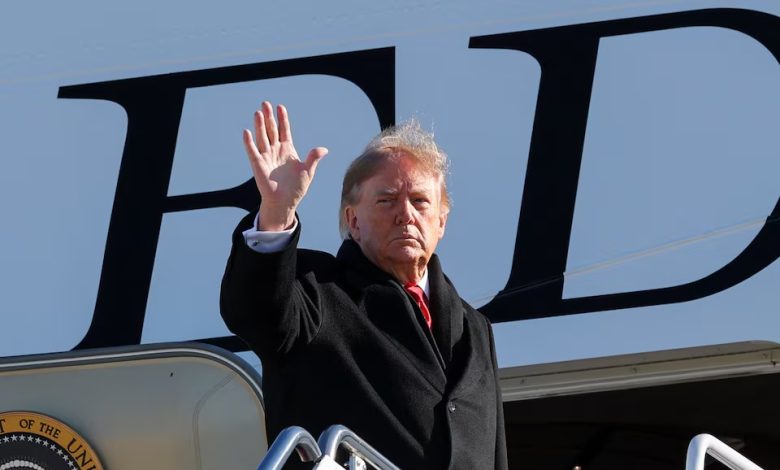
US President Donald Trump is set to begin his Asian diplomatic tour in the Philippines, where he is expected to hold talks with leaders of the Quad alliance before proceeding to China for high-level discussions involving Chinese President Xi Jinping and Russian President Vladimir Putin.
Trump is expected to arrive in Manila on Tuesday, November 17, for discussions with regional leaders as the Southeast Asian summit concludes, with the anticipated Quad meeting marking the first gathering of leaders from the four-country partnership in two years.
The Quad, comprising the United States, Japan, Australia and India, is expected to discuss regional security, maritime cooperation, critical minerals, artificial intelligence and measures to strengthen supply chains.
The meeting comes at a sensitive moment in US-China relations, with Washington seeking closer cooperation with its Indo-Pacific partners while preparing for Trump’s engagement with Beijing.


QUAD MEETING SIGNALS RENEWED REGIONAL COOPERATION
The upcoming meeting is expected to provide an opportunity for the four countries to demonstrate continued cooperation on security and economic issues across the Indo-Pacific.
Former US Deputy Secretary of State Kurt Campbell described the timing of the meeting as significant, suggesting that it could send an important message ahead of Trump’s subsequent discussions with Chinese and Russian leaders.
“Part of what he (Rubio) is thinking is that this is probably the best possible signal if you’re going to go into a trilateral meeting,” Campbell said, referring to the planned discussions involving Trump, Xi and Putin.
The Quad was established as a diplomatic partnership to promote cooperation in the Indo-Pacific, with particular attention to maritime security, economic resilience, infrastructure and regional stability.
Although China has previously criticized the grouping, describing it as an effort to contain its growing influence, the four member countries maintain that their partnership is not directed against any particular nation.
CHINA VISIT TO FOCUS ON TRADE AND SECURITY
Following his engagements in Manila, Trump is expected to travel to Shenzhen, China, to participate in the Asia-Pacific Economic Cooperation (APEC) forum and hold discussions with Xi.
The planned visit also includes a proposed trilateral meeting involving Putin, with discussions expected to cover international trade, the war in Ukraine, Iran and nuclear security.
Trump has also indicated that North Korean leader Kim Jong Un could potentially participate in a meeting during his China visit, although no confirmed arrangement has been announced.
The diplomatic engagements come as Washington and Beijing attempt to maintain a fragile trade agreement reached previously to ease tensions between the world’s two largest economies.
However, disagreements over advanced semiconductor technology, export restrictions and Taiwan continue to complicate relations.
READ RELATED NEWS
Trump, Putin and Xi to hold historic three-way meeting in China
Oman, Iran seek to secure Strait of Hormuz as shipping threats mount
PROTESTS EXPECTED DURING TRUMP’S MANILA VISIT
Trump’s arrival in the Philippine capital could also attract demonstrations from protesters opposed to aspects of American foreign policy.
Demonstrations in Manila in recent days have included the burning of effigies of the US president and demands for an end to the conflict in the Middle East.
Some protesters have also criticised the US-led Pax Silica initiative, which seeks to strengthen cooperation among partners on semiconductor and artificial intelligence supply chains.
Trump is expected to meet Philippine President Ferdinand Marcos Jr. on Wednesday, November 18, while also participating in a special meeting between the United States and the Association of Southeast Asian Nations (ASEAN).
The visit places Washington’s regional partnerships and its relationship with Beijing under renewed diplomatic attention, as leaders seek to address security concerns, trade disagreements and economic cooperation across the Indo-Pacific