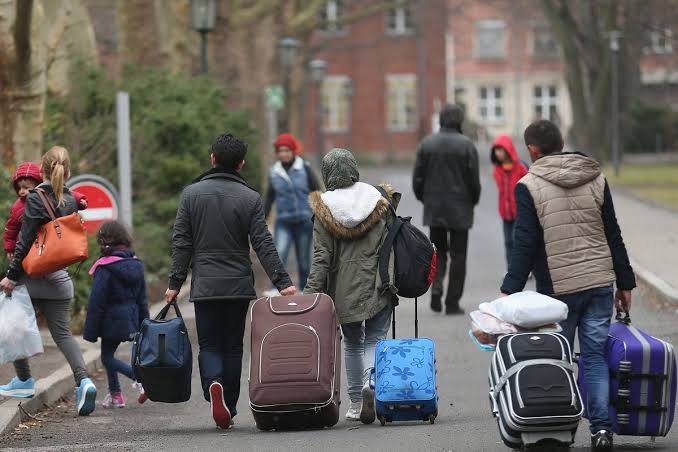
Asylum seekers being deported from Britain have reportedly been subjected to excessive restraints, intimidating treatment and inadequate access to legal assistance, according to a new official inspection report that has raised serious concerns about the UK government’s immigration enforcement practices.
The findings, published by HM Inspectorate of Prisons on Monday, 23 November 2026, revealed cases in which vulnerable migrants were physically restrained and transported onto deportation flights despite concerns about their mental health and whether such measures were necessary.
The investigation examined the treatment of asylum seekers being returned from the United Kingdom to France under the government’s controversial migration agreement.
Some of those affected had previously fled war, persecution, torture or human trafficking.


The findings come as the British government faces continuing scrutiny over its approach to irregular migration and the treatment of people facing removal.
According to information obtained by the NEW DAILY PRIME, 26 incidents involving the use of force were recorded across 26 Home Office deportation charter flights between July and September 2026. However, this does not mean that force was used on every flight.
Suicidal asylum seeker carried onto deportation flight in restraints
One of the most disturbing cases identified by inspectors involved an asylum seeker who was under constant observation because of concerns that he might take his own life.
Despite his vulnerable condition, the man was transported onto an aircraft while wearing restraints around his waist, legs and ankles.
Inspectors also examined the treatment of another man described as physically and psychologically fragile.
The individual had reportedly struggled to eat regularly and had no documented history of violence or active resistance.
Nevertheless, officers wearing protective equipment, including helmets and carrying riot shields, entered his cell to remove him.
He was subsequently placed in restraints and carried away.
Inspectors questioned the necessity and proportionality of the force used against him.
During the flight, the man reportedly remained withdrawn and did not communicate with those around him.
A third case involved an individual who was restrained after indicating that he would not cooperate with his removal.
The findings have raised concerns about whether appropriate consideration was given to vulnerability, medical conditions and the level of risk presented by individual detainees.
26 use-of-force incidents recorded on deportation flights
Freedom of Information figures obtained by The Guardian revealed that 26 incidents involving the use of force were recorded across 26 Home Office deportation charter flights between July and September 2026.
Of the 26 flights, 21 were destined for France, while the remaining five transported migrants to Albania, Lithuania and Romania. However, the figures do not indicate how many individual asylum seekers were subjected to physical restraint or whether force was used on every flight.
In a separate investigation, inspectors reviewed body-camera footage from four earlier deportation flights to France and identified nine incidents involving the use of force. At least one of these incidents had not been officially recorded by escort officers.
The findings raise concerns about the accuracy of official records, the accountability of immigration enforcement officers and the effectiveness of supervision during deportation operations.
However, inspectors acknowledged that most interactions between escort officers and detainees were conducted professionally and respectfully, despite identifying cases where the use of force was considered unnecessary or disproportionate.
Migrants reportedly called numbers instead of names
Beyond the use of physical restraints, inspectors identified problems with the way asylum seekers were treated and informed about their removal.
Some detainees were reportedly identified by numbers rather than their names.
Those transported to aircraft in vans were given bags to urinate into during the journey.
Inspectors also found that many migrants did not properly understand what was happening to them.
Language barriers made it difficult for some individuals to obtain information about their departure, their arrival in France or their legal position.
Although escort officers had access to body-worn cameras with interpretation technology, the system did not always function effectively.
Interpretation services were also used inconsistently.
Some asylum seekers had difficulties accessing legal representation before being removed from the country.
The official inspection found that immigration removal letters were written in English, leaving some recipients unable to understand important information about their cases.
According to the inspectors, Home Office officials were not available at the detention centres to answer detainees’ questions. These failures could have serious consequences for individuals who do not speak English or who are unfamiliar with British immigration procedures.
What is the UK–France ‘one in, one out’ agreement?
The controversial arrangement was designed to discourage irregular Channel crossings.
Under the scheme, people who arrived in Britain on small boats could be returned to France.
In exchange, eligible asylum seekers in France could enter the UK through an authorised route to claim asylum.
The government presented the agreement as part of its wider efforts to reduce dangerous Channel journeys and disrupt people-smuggling networks.
However, the arrangement attracted criticism from migrant support organisations over the treatment of vulnerable individuals.
Medical charity raises concerns about torture survivors
Medical Justice, a charity that supports people held in immigration detention, has criticised the treatment documented in the report.
Its director, Emma Ginn, argued that the findings reflected longstanding problems in the immigration detention system in the UK.
The organisation said its independent clinicians had identified evidence of past torture among many of the people it assessed under the UK–France arrangement.
The charity expressed concern that individuals who had already experienced serious trauma were being exposed to further psychological and physical distress during detention and removal.
Separately, a report by the French healthcare organisation Samusocial de Paris identified signs of possible physical and psychological harm among asylum seekers returned from Britain.
The organisation linked those findings to the conditions experienced by people affected by the migration agreement.
These assessments add to concerns about the treatment of people with complex medical and psychological needs during immigration enforcement.
Home Office responds to allegations
The Home Office defended its approach to deportation operations, maintaining that appropriate safeguards were in place.
Accordingly, the department took the safety and welfare of people in immigration detention seriously.
The department explained that escorts were assigned according to risk assessments intended to ensure removals could be completed safely.
However, the inspectors’ findings suggest that the use of restraints in some cases went beyond what was necessary.
The official report concluded that force was not consistently justified or proportionate.
Inspectors also identified weaknesses in supervision, including occasions when managers did not intervene sufficiently to address intimidating behaviour by escort staff.
Read related news from Newdailyprime.news
UK plans immediate removal of failed asylum seekers without further notice
3,463 Canadian asylum cases won by Nigerians in 2025, up 55 per cent — IRB
New UK guidance changes IPOB asylum Assessments
What the findings mean for Nigerians and other migrants in Britain
Although the latest investigation specifically examined removals to France, its findings raise wider questions relevant to Nigerians and other foreign nationals who may face immigration detention or deportation.
The report does not identify how many Nigerians, if any, were involved in the incidents examined.
It would therefore be inaccurate to suggest that Nigerian asylum seekers were among those subjected to the documented treatment without further evidence.
Nevertheless, the findings highlight several issues that could affect migrants from different nationalities.
These include access to legal representation, interpretation services, medical assessments and safeguards against unnecessary physical restraint.
For people who have experienced persecution, violence or serious trauma, immigration detention and forced removal can create additional health and welfare concerns.
The report also raises questions about the ability of detainees to understand official decisions and communicate concerns before being deported.
What happens next?
The publication of the inspection report places further pressure on the Home Office to explain how it monitors the use of force during immigration removals.
Questions remain about whether all incidents are properly recorded, whether vulnerable individuals receive adequate medical assessments and whether escort officers are sufficiently supervised.
The findings may also increase demands from migrant rights organisations for improvements in detention safeguards and independent monitoring.
While the government maintains that immigration enforcement is necessary to uphold border controls, the latest report highlights the importance of ensuring that removals are carried out lawfully and humanely.
For asylum seekers facing deportation, the central concern is whether their safety, dignity and legal rights will be protected throughout the process.