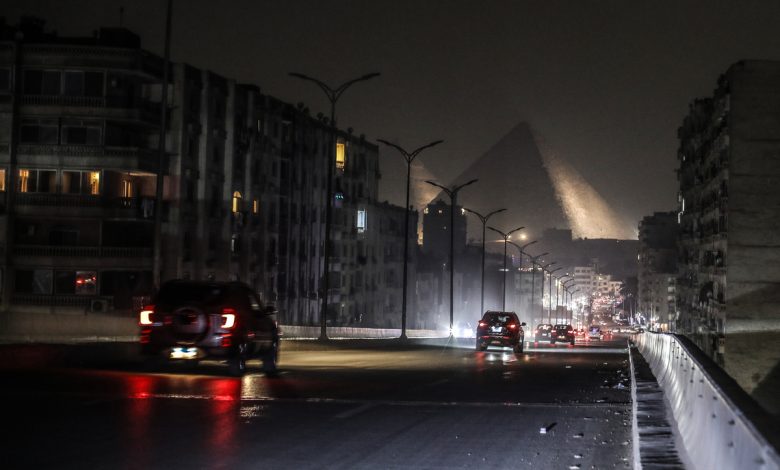
The Egyptian government has launched a media campaign featuring prominent actors and footballers, urging people to stay at home and reduce energy consumption amid rising energy pressures linked to the war with Iran. However, the resulting restrictions have brought significant hardship for Egyptians.
Egyptians did not expect that the sound of explosions in a country on another continent, around 2,200 kilometres away, would leave the streets and neighbourhoods of Cairo, and cities across the country, in darkness.
At 9pm (later extended to 11pm), shops are closed, street lighting is switched off on public roads and on bridges and overpasses, while police vehicles patrol the streets and arrest those who defy the measures.


Blackouts
“It feels unsafe to walk through the streets of the Egyptian capital, as much of Cairo’s neighbourhoods and squares are in darkness, with packs of stray dogs roaming the streets.”
This is how Sayed Ibrahim, 60, described his experience of the blackouts. Egyptian TV host Amr Adib, who is known to be close to the authorities, also criticised the situation on air during his programme Al-Hekaya on the privately owned MBC Masr channel, saying: “There are many places in Cairo that look strange… the streetlights are off and the streets are pitch dark. Giza is dark… very dark.”
The blackout has been used politically to introduce harsh economic measures, driving up inflation and increasing hardship for Egyptians, and pushing new segments of society into a cycle of poverty and hardship.
Less than two weeks after the outbreak of the US-Israeli war on Iran on 28 February, the Egyptian government moved quickly to raise fuel and gas prices by 14 and 30 percent, marking the third increase in the past 12 months, according to a statement by the Ministry of Petroleum and Mineral Resources.
Further increases followed, extending to railway and metro fares, which rose by 25 percent, according to Egypt’s Ministry of Transport.
READ: Egypt and the Gulf states: Sharp differences over the Iran war
The wave of price increases quickly extended to public and mass transit buses, rising by 8 to 14 percent, while minibus and taxi fares increased by 15 to 20 percent, depending on routes and distances.
Any increase in transport costs forces households to reallocate their budgets, with spending on other essential needs such as food being reduced, according to rights activist Mohamed Ramadan.
Earlier this month, the government also implemented a further increase in electricity prices, with commercial consumption across all tiers rising by an average of around 20 percent, and higher household consumption tiers increasing by an average of 16 percent, while keeping tariffs unchanged for all consumption levels up to 2,000 kilowatts per month.
The increases in fuel and energy prices were immediately reflected in the cost of meat, vegetables, fruit, baked goods and most other commodities, placing Egyptians under significant price pressures.
Annual urban inflation continued to rise in March to 15.2 percent, its highest level in 10 months. The Egyptian pound was also among the worst-performing currencies against the dollar, trading at around 52 to the dollar, compared with nearly 55 during the war.
Additional Taxes
Egyptian President Abdel Fattah El-Sisi said the country is in a “near state of economic emergency” as a result of the ongoing war in the Middle East, warning of the impact of the current crisis on prices. Egypt has not been directly affected by the US-Israeli-Iranian war, while its Gulf allies have been targeted by Iranian missile and drone attacks.
Egyptian media have praised the energy-saving measures, saying they have led to daily fuel savings of between 33 and 40 million Egyptian pounds ($650,000 to $750,000), as well as a reduction in demand on the national electricity grid of around 1,000 megawatts, equivalent to the output of a medium-sized power plant, according to Al-Masry Al-Youm.
Economic analyst and researcher Mohamed Fouad told Middle East Monitor that the early closures have caused significant losses to Egypt’s tourism sector and to commercial activity in the “night-time economy”. They have also reduced the incomes of evening workers and revenues from cinemas, theatres, restaurants and cafés, while projecting a negative image of Cairo as a “dark” city.
According to observers, the blackouts and energy-saving measures linked to the war have served as cover for advancing government decisions, aimed at phasing out support for low-income groups while implementing pre-planned measures, including imposing additional taxes, seeking new loans and accelerating the sale of state assets.
The Egyptian government is targeting an increase in tax revenues of around 745 billion Egyptian pounds ($14 billion), representing growth of 27 percent, in the 2026–2027 fiscal year budget (July 2026 to June 2027), according to Finance Minister Ahmed Kouchouk.
Cairo is also considering an emergency loan from the International Monetary Fund that could reach $3 billion. The government is also preparing to offer 60 state-owned companies to the private sector before the end of the current month, including 40 to be transferred to Egypt’s Sovereign Fund and 20 to be listed on the Egyptian Exchange, according to the state-owned Al-Ahram newspaper.
Public discontent
Egyptians have responded with sarcasm to mounting economic pressures, as price increases have become tied to conflicts anywhere in the world. This pattern has been repeated following the wars in Russia and Ukraine, Sudan, Gaza and Iran.
“War in Iran and darkness in Egypt,” said an Egyptian man in his fifties, who asked not to be named, arguing that there was a deliberate intent to introduce harsh measures. He added that, if that were not the case, why did prices not fall when the war ended and oil prices declined?
The truce between Iran and the United States has not been reflected in prices in Egypt, which have remained unchanged amid ongoing uncertainty, increased demand for foreign currency and a continued decline in the value of the local currency. This coincides with the government’s continued focus on financing costly real estate projects, most recently the construction of a new city in eastern Cairo, “The Spine”, with investments exceeding 1.4 trillion Egyptian pounds ($27 billion) and paid-in capital of 69 billion pounds ($1.3 billion), with the participation of the state-owned National Bank of Egypt.
READ: Why has violence increased among Egyptians?
Political Messages
Egyptians are bracing for the worst as state-aligned media prepares the public for a difficult summer, possibly including power cuts and a new wave of price increases, citing the continuing crisis in the Strait of Hormuz and tensions in the Gulf. MP Freddy Elbaiady said in a press statement that this reflects a continued government approach of gradually lifting subsidies, with the state not bearing part of the burden but instead passing the full cost on to people, according to the independent platform Zawya Thalitha.
The “darkness” measures send negative signals, coming alongside reports that Egypt is required to repay around $38.65 billion, including instalments on external loans and interest, between April this year and the end of 2026, according to World Bank data.
Egypt’s external debt obligations due by the end of this year are divided into $34 billion in principal repayments and around $4.64 billion in interest.
All signs point to a severe economic and financial crisis facing El-Sisi’s government, similar to that seen two years ago, when it was eased by the sale of Ras El-Hekma on the Mediterranean coast to the UAE, which brought in $35 billion at the time. The current blackout measures appear to be part of a plan to reduce public spending through electricity rationing, price increases and the imposition of additional taxes, levies, fines, settlements, government service fees and prosecution bail payments. In an already fragile economy, and in the absence of Gulf assistance and Western support, the government is likely to face significant pressure in the coming period, leaving it with little option but to rely further on already strained household resources, according to economic expert Amer Al-Masri.
Egyptians are heading towards a new wave of hardship, increased government revenue collection, subsidy cuts, higher prices and renewed borrowing, citing the war, in a country that has not fought a full-scale conventional military conflict since the October 1973 war.
The views expressed in this article belong to the author and do not necessarily reflect the editorial policy of Middle East Monitor.
🚨BREAKING: Watch The Video Clip Here ➤