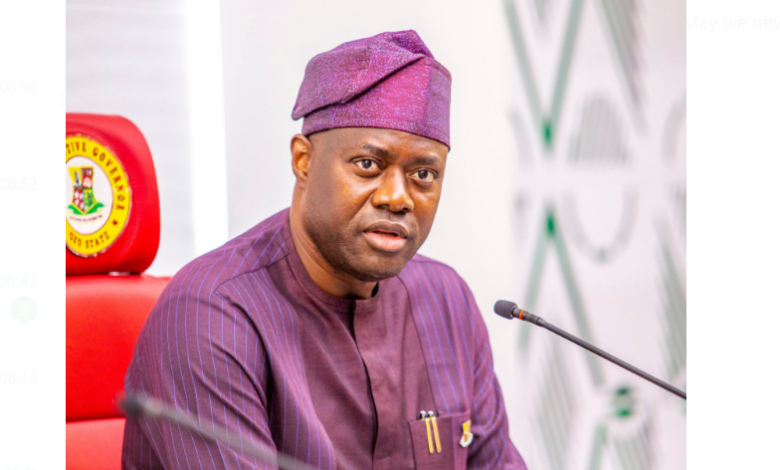
Presidential contenders in the 2027 election, drawn from different political parties, namely Governor Seyi Makinde, Peter Obi, Adewole Adebayo, and Omoyele Sowore, alongside former Minister of Education, Dr Oby Ezekwesili, yesterday decried the state of Nigeria’s democracy.
They spoke at the high-level emergency stakeholders’ engagement on the 2027 general elections organised by the Movement for Credible Elections (MCE), with the theme: “Actualising Credible 2027 Elections in Nigeria.”

In his remarks, the Oyo State governor and PDP-APM presidential candidate, Makinde, stressed that a secure and stable Nigeria cannot be built on a fractured democratic foundation; hence, democracy must be protected at all costs.
Speaking through his Executive Assistant on Administration, Rev. Idowu Ogedengbe, the Oyo governor said credible elections are not just a periodic ritual of casting votes by the electorate but the bedrock of the entire democratic process.
“A credible election guarantees that the leaders who emerge carry the genuine mandate of the people. When a leader knows they were truly chosen by the ballot, they carry a burden of legitimacy.
“Leaders elected through credible elections answer to the citizens, not to a cabal of political godfathers or vested interests. This legitimacy gives government the moral authority to enforce laws, collect revenues, and enact policies necessary for development,” he added.
According to Ezekwesili, the country’s democracy since 1999 has steadily lost the confidence of citizens, and the situation is presently worsening; hence, Nigeria no longer fully qualifies to be called a democratic nation.
The former minister, who is the chairman of the convening committee of MCE, said that by 2023, only 23 per cent of registered voters participated in the presidential election that produced the current administration.
She said this clearly showed that Nigeria had fallen below even the low African average of about 47 per cent voter turnout and that, compared to global data, the country recorded less than one-third participation in elections.
Ezekwesili said this stemmed from distrust in public institutions saddled with the responsibility of conducting credible elections.
“The key reason we are gathered today is to look at how we can create solidarity to ensure that our democracy does not collapse completely. It is edging towards collapse based on the indicators that define democratic societies.
“We no longer fully qualify to be called a democracy. One major crisis is the increasing use of state power against dissenting voices, whether political dissenters or citizens who criticise the government.
“Repeated allegations and instances of intimidation, harassment, and arrest, especially by those who claim democratic credentials, are causes for deep concern in a democracy.
“Citizens must have the liberty to exercise their rights and, as we approach the 2027 elections, citizens operating under fear that their voices will be muffled and their freedoms violated should give everyone reason to worry,” she added.
The pro-democracy activist said the credibility of any electoral process lies in guaranteeing a transparent and level playing field, but unfortunately, that no longer seems to be the case.
She noted that, “In recent months, we have seen defections and intra-party conflicts often alleged to have been instigated by the government, to the extent that Nigerians no longer have the right to choose those they believe will serve them. Such actions undermine the core of competitive democracy.”
Ezekwesili insisted that public confidence in electoral credibility depends heavily on trust in the electoral umpire — the Independent National Electoral Commission (INEC) — as well as confidence in the judiciary and security agencies.