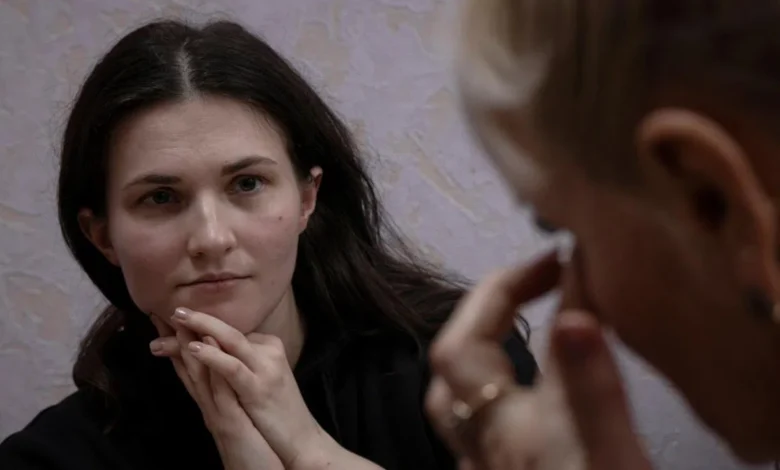
IZIUM, Ukraine, May 31 – Roksolana Makar braved icy roads and the threat of drone strikes to interview a woman in the Ukrainian town of Izium who said Russian forces tortured her.
Surrounded by woods and farmland, Izium still bears scars from a 2022 Russian occupation that left bridges smashed and buildings flattened. The woman told Makar, a war-crimes investigator for a Ukrainian nonprofit, that Russian soldiers detained her at a battery plant for 10 days that year.
There, the woman said, she was beaten, electrically shocked, suffocated with a gas mask and raped.
“I asked them to kill me because I couldn’t take it anymore,” said the woman, 55, who asked to be identified only by one name, Alla.
Horrified by Russia’s alleged atrocities, Makar aims to document such accounts before evidence is destroyed and memories fade. But she worries fewer perpetrators will answer for their crimes after the United States stopped funding her organization, Truth Hounds, and dozens of others seeking justice in Europe’s deadliest conflict since World War Two.
Since the Nuremberg trials of Nazi war criminals, the U.S. has championed accountability for many of the world’s worst atrocities, supporting investigations and tribunals. But the administration of U.S. President Donald Trump cut tens of millions of dollars in funding for this work last year when it slashed overseas-development aid to advance the president’s “America first” agenda, according to a Reuters review of government data and interviews with eight current and former American officials. Ukraine was the largest single recipient, the officials said.
“There’s less hope” for accountability, Makar said after interviewing Alla in an Izium office in January.
Reuters could not independently verify Alla’s account. The Kremlin and Russia’s defense ministry did not answer questions about her case or other specific incidents in this story. Russia has repeatedly denied committing war crimes, calling the accusations Western propaganda.
The Ukrainian Prosecutor General’s Office says it has opened more than 230,000 war-crimes cases since Russia launched its full-scale invasion in 2022. Allegations include targeting of civilians and civilian infrastructure, abduction and deportation of children, torture and sexual violence.
The deep U.S. aid cuts “could lead to a lot of victims being denied justice,” said Beth Van Schaack, ambassador-at-large for global criminal justice under former President Joe Biden.
The State Department said the U.S. is shifting the war’s financial burden to Europe and other “willing partners” but still provides substantial assistance to Ukraine, including programs for “war crimes, justice and accountability for atrocities.”
To understand the consequences of the cuts, Reuters interviewed more than 40 members of an extensive U.S.-supported network engaged in investigating Ukraine war crimes, aiding prosecutions and supporting victims. They included law enforcement officials, legal experts, human-rights activists and researchers. Almost all said their efforts have been curtailed, hampering investigations and dimming hopes for justice.
Among the examples they provided: Truth Hounds had to lay off staff, suspend an archiving project and defer international-law training for judges and prosecutors.
Dozens of foreign experts who helped collect and analyze battlefield evidence can no longer travel to Ukraine after State reduced support for the country’s overburdened prosecutors, according to five sources familiar with the matter.
And plans to rebuild a courthouse destroyed in the war were halted after the Trump administration dismantled the U.S. Agency for International Development and terminated a $62-million program to strengthen the Ukrainian justice system, a source familiar with USAID’s operations said.
TRACKING U.S. DEFUNDING OF WAR-CRIMES ACCOUNTABILITY
Russia’s invasion created huge demand in Ukraine for arrests and trials of those accused of atrocities.
Even when U.S. funding peaked under Biden, the burden overwhelmed Ukrainian prosecutors, who had secured 252 war-crimes convictions as of April 1. In addition, the prosecutor’s office said it had identified 1,175 suspects and indicted 842.
High-ranking suspects could be tried at the International Criminal Court (ICC) in The Hague, which has sought the arrest of President Vladimir Putin. Cases are also being pursued in U.S. and European courts.
Reuters tracked more than $283 million in U.S. funding at least substantially earmarked for Ukraine war-crimes initiatives since 2022 through interviews with over two dozen sources and a review of public announcements, government documents and watchdog reports.
The news organization could not establish how much of that money had been disbursed when Trump ordered a pause in foreign-development assistance in January 2025, pending a review, or how much was later reinstated. But programs accounting for at least 40% of the spending were terminated or allowed to expire, Reuters found.
Reuters’ tallies are likely undercounts, but they offer the most comprehensive assessment to date of the U.S. defunding of war-crimes accountability in Ukraine.
Determining exactly how much aid Washington is providing is difficult because of the number of U.S. agencies and recipients involved. Grants are sometimes shared by multiple organizations, span several years or include money for other priorities. The U.S. also provides expertise and intelligence.
A senior source in Ukraine said Trump’s cuts affect about half the country’s U.S.-funded projects promoting war-crimes accountability and rule of law.
The administration has launched one new program. In March, State said it would provide up to $25 million to support the return of missing Ukrainian children, a cause championed by first lady Melania Trump. Recipients have not yet been announced.
The new grant followed cuts to other programs serving the same purpose, including a Yale University initiative that has tracked thousands of missing Ukrainian children to sites in Russia and Russian-occupied territory.
The Yale School of Public Health’s Humanitarian Research Lab will run out of money in August after State withheld about $8 million in funding, its executive director, Nathaniel Raymond, told Reuters.
A BROADER U.S. RETREAT FROM GLOBAL JUSTICE WORK
Truth Hounds has helped track war-crimes suspects since 2014, when Russian forces seized Ukraine’s Crimean peninsula. Reuters accompanied the group’s investigators on a three-day trip to the northeastern Kharkiv region to gather more testimony.
In Izium, netting to prevent Russian drone attacks was draped over roads, and the lights cut out during interviews because of strikes on power infrastructure. The thud of artillery sounded in the distance.
Truth Hounds has documented some 17,000 war-crimes allegations across Ukraine, said the group’s co-executive director, Dmytro Koval. Their work slowed when the organization lost U.S. funding that had covered a third of its budget since 2023.
“Some important lines of inquiry will not be opened at all,” Koval said.
The cuts reflect a broader U.S. pullback from work on human-rights violations.
Last year, Trump’s administration closed a State Department office that had helped coordinate the global response to mass atrocities since 1997, disbanded a Justice Department team helping Ukraine prosecute war crimes and pulled the U.S. out of a multinational group building cases against Russian leaders for the invasion.
The administration also imposed sanctions on ICC officials over attempts to investigate alleged crimes by Israel’s leaders in Gaza and by U.S. soldiers in Afghanistan. The U.S. is not a member of the ICC and has long rejected its authority to investigate Americans.
Other major donors, including the European Union and Britain, say they remain committed to delivering justice for Ukraine.
But the lost U.S. aid won’t be easily replaced, said Wayne Jordash, deputy lead of an Atrocity Crimes Advisory Group (ACA) set up by the U.S., EU and Britain to support the Ukraine prosecutor’s office. Last year, State stopped funding two out of three core organizations in the initiative, including Jordash’s international law foundation, Global Rights Compliance, according to a recent audit by the department’s Office of Inspector General.
State said it still supports the Ukraine prosecutor’s office, the national police and the ACA initiative, without providing details. The Justice Department said it remains committed to supporting accountability for war crimes.
The British foreign office declined to comment. Since February, Britain has announced an additional £5 million ($6.73 million) to support justice for Ukrainian war-crimes victims and £1.2 million to help verify and trace illegally deported children.
EU foreign affairs spokesperson Anitta Hipper said member states have allocated €10 million ($11.66 million) to create a special tribunal to try senior Russian leaders for aggression against Ukraine and are contributing €1 million toward the creation of an international claims commission to ensure Kyiv is compensated.
In May, the EU announced €50 million in funding for Ukraine’s child protection system and to pursue justice for abducted children.
“Russia will be held accountable,” Hipper said.
A MOTHER’S DESPERATE SEARCH FOR HER SON
For Yuliia Usenko, Ukraine’s lead prosecutor for crimes against children, Yale’s digital investigations have been “invaluable.”
Most alleged crime scenes are in Russian-occupied territory or in Russia, where Ukrainian investigators have no access. Yale’s researchers use satellite imagery, Russian social media posts and other open sources to track children taken to more than 200 sites they say are part of a vast Russian reeducation and militarization network. Some were later placed in Russian foster care or adopted, they said in a series of reports.
War-crimes experts deployed by the ACA have been helping Ukraine sift through cases to identify connections that could indicate a deliberate strategy by Russian leaders.
“We want to show Russia’s true intent is not just to seize a piece of Ukraine’s territory, but much more: to destroy our nation and assimilate it into Russian society,” Usenko said.
Ukrainian authorities accuse Russia of more than 20,500 child deportations or forced transfers and say just over 2,000 children have been returned. Yale researchers estimate 35,000 may have been taken.
Russia denies abducting Ukrainian children, saying it evacuated them from conflict zones for their safety.
Kremlin spokesman Dmitry Peskov told Reuters that in June 2025 Kyiv provided Moscow with a list of 339 children it said ended up in Russia. Ukrainian officials have said the list was a starting point for negotiations to return all missing children.
Aid groups like the Emile Foundation, which operates in frontline villages, have been using Yale’s findings to help reunite children with their families.
“Without it, we are talking about many years of setbacks,” said Mariam Lambert, co-founder of the Netherlands-based foundation.
The last time Hanna Zamyshliaieva saw her son, Anton Volkovych, was on January 14, 2022, when she visited him at a boarding school for children with special needs in Oleshky. He was 19 and in need of constant care due to a neurological disorder. The mother showed Reuters journalists a photograph of Volkovych sitting in a wheelchair, clutching a stuffed owl.
That February, Russian forces occupied the town in Ukraine’s southern Kherson region. Zamyshliaieva kept in touch with the school by phone. But over the coming months, the students and some staff were transferred to locations deeper inside Russian-occupied territory, where she could not reach them, she said.
Of the 87 pupils at Oleshky before the occupation, 13 have returned, Lambert said. Her foundation received a tip about Volkovych’s whereabouts in March, but there has been no confirmation from Russia.
Zamyshliaieva grapples daily with the unbearable uncertainty over whether he has survived the years without the intense care he received at the school.
“I just want to hold him,” she said.
MAKING SURE ‘EVERYONE IS PUNISHED’
Tetiana Popovych is among the Ukrainians demanding justice.
She spent years looking for her son, Vladyslav, who was 29 when he disappeared during Russia’s occupation of Bucha, near Kyiv, early in the war.
Popovych retraced her son’s steps with help from neighbors and returning prisoners of war.
One witness saw Vladyslav, a civilian, hiding in her walnut orchard during an artillery barrage. Another said he bandaged her son’s gunshot wounds before Russian forces captured and beat them.
Finally, a released prisoner told her they had shared a detention cell in the Russian town of Vyazma. She believes he is still there.
“For me it is important that everyone is punished, that everyone is found, no matter how many years have passed,” Popovych said. “I will fight for this until the end.” REUTERS