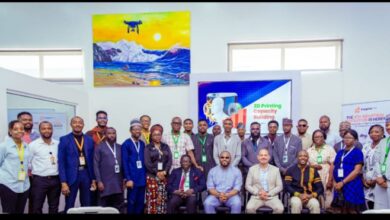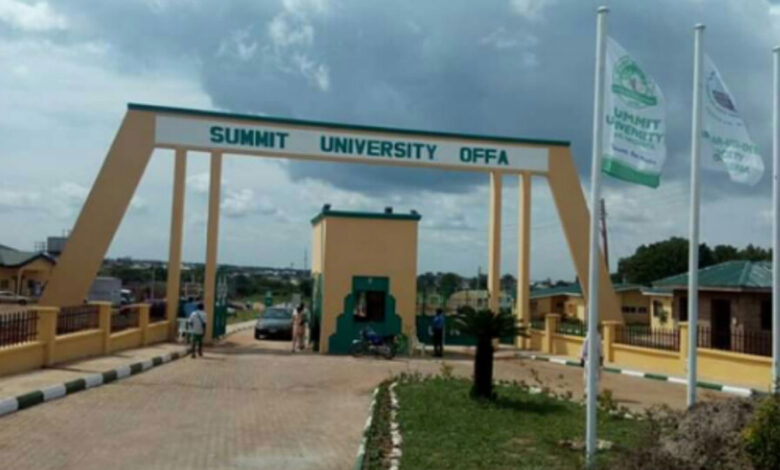
Summit University’s second vice-chancellor, Prof. Abiodun Musa Aibinu, has said the digital transformation of the ivory tower has enhanced teaching and learning in the school.
Aibunu, who highlighted major strides in academic expansion, innovation, infrastructure renewal and global engagement in a statement obtained by our correspondent, outlined plans to launch a College of Nursing and Allied Health Sciences and introduce a Law programme in the coming year.


He said his vision is to build a technology-driven and value-based institution that is globally competitive and locally relevant. Today, that vision is steadily becoming a reality, and I remain deeply grateful to Almighty God for the journey so far.
In just four years, the University has experienced a remarkable transformation: its undergraduate programmes have doubled, postgraduate studies have been successfully introduced, and student enrolment has grown steadily, supported by expanded scholarship opportunities.
“We have also strengthened our academic structure with the establishment of the Kola Balogun College of Artificial Intelligence and Digital Engineering, the College of Postgraduate Studies, and the College of Innovation and Computing Technology, while laying a strong foundation for the Lateefat Gbajabiamila College of Nursing and Allied Health Sciences,” the VC said.
According to him, “We are no longer a university of admission convenience, but a university of first choice. Our goal is not just to graduate students, but to produce globally relevant problem-solvers. Hence, research and innovation have gained strong momentum through increased funding, stronger collaborations, and improved scholarly output.
“At the same time, our digital transformation has enhanced teaching, learning, and administration through platforms such as the Learning Management System, Institutional Repository, and other student-focused systems.”
He said, “We have made Artificial Intelligence and other critical skills accessible to all our students. These include: Artificial Intelligence, grantsmanship, clean and renewable energy, financial literacy, Acadopreneurship, and storytelling. Today, our undergraduates confidently engage with Artificial Intelligence and apply it to real-world challenges.
More significantly, both undergraduate and postgraduate students are now attracting international research grants, fellowships, and collaborations. This is clear evidence of a shift from passive learning to active global participation.”
He added that eight strategic pillars have defined the current administration, including the democratisation of emerging technologies; the expansion of academic frontiers; and a deliberate drive for enrolment growth and institutional visibility.
Others, he further stated, include: the advancement of research and global engagement; the renewal of infrastructure and revitalisation of campus facilities; the development of a digitally driven University; the empowerment of staff and students alongside strengthened welfare systems; and the strategic expansion into high-impact disciplines.”