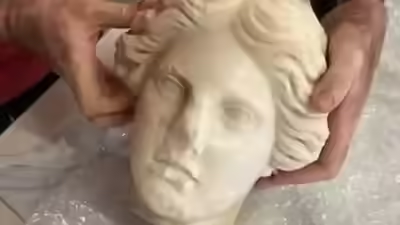
Construction work on a stretch of beach in Alicante has ended up paused after something hard, pale, and unexpectedly shaped turned up in the sand. It wasn’t immediately clear what the object was, and for a short while it seemed to have been treated as just another awkward obstruction in the middle of redevelopment work. Only when it was lifted out properly did its form begin to make sense, and even then, it didn’t quite fit the setting of diggers, fencing, and holiday infrastructure. The object is a marble bust, weathered in places but still sharply defined, and believed to be around two millennia old. Its appearance has shifted the pace of work along the shoreline, drawing in archaeologists and putting ordinary coastal plans on hold.
Roman marble bust discovered during beach regeneration works in Alicante
The discovery happened during regeneration works on a busy beach in Almadraba, a coastal area in Alicante that usually carries the noise of tourism and construction rather than anything resembling ancient history. Workers initially assumed they had struck a chunk of discarded stone or debris buried beneath layers of sand and disturbed ground.It only became clear that the object might be something far older when its surface was cleaned back, and the outline of a carved face started to emerge. By that point, machinery had already been pulled back, and the site quietly handed over for closer inspection.As reported by The Sun, “The bust presents a hairstyle of Hellenistic influence, with wavy hair pulled back with a parting in the middle following the idealised model of representations of divinities such as the Greek Aphrodite or the Roman Venus”, José Manuel Pérez Burgos, head of integral heritage, reveals.Reportedly, “In this context, the goddess Venus was considered in the Empire the mother of the Roman people and represented love, beauty and fertility.”
The marble head and its condition


What has been recovered is a white marble bust, shaped in the classical style associated with Roman-era portraiture and idealised figures. Despite being buried for centuries, the surface remains surprisingly intact. The nose carries the only obvious damage, a detail that looks more like wear from time and pressure than anything sudden or violent.The face itself is calm in expression, with features that still carry definition despite the erosion of edges. The hair is styled in a way that suggests influence from earlier Greek artistic traditions, arranged in soft waves and drawn back from a central parting. It is the kind of styling often linked with representations of divine figures rather than ordinary citizens.
A clue from Rome’s past: The bust may have stood inside a luxurious seaside villa
Early assessments place the bust somewhere in the early Roman imperial period, possibly around the first or second century. That would align it with a time when the region was part of a wider network of Roman settlements along the Mediterranean coast.Alicante itself is no stranger to Roman remains. Archaeological traces have been uncovered in the area for years, including villa foundations and scattered artefacts that suggest the coastline once held private estates and maritime properties belonging to wealthy households.The bust is now thought to be connected to that same broader landscape. There is speculation it may have formed part of a decorative arrangement within a domestic setting, possibly mounted on a base inside a villa or courtyard rather than intended as a free-standing public monument.
A goddess hidden beneath the sand: The Roman bust may portray Venus
One of the early interpretations being considered is that the bust may represent a goddess figure, most likely Venus, given the hairstyle and the idealised facial structure, as reported by The Sun. In Roman culture, Venus carried layers of meaning that went beyond mythology, often tied to ideas of beauty, fertility and civic identity.The hairstyle, in particular, has drawn attention. The centre parting and swept-back waves are consistent with artistic conventions used to depict Venus and similar figures during the high imperial period. These were not portraits in the modern sense, but stylised forms intended to reflect ideals rather than individuals.That said, archaeologists are cautious about assigning identity too quickly. Marble heads of this kind were sometimes reused, relocated or adapted depending on the space they occupied. A divine association is possible, but not guaranteed.