By Emmanuel Oloniruha
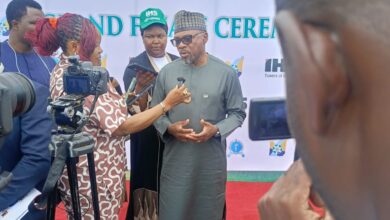
The Peoples Democratic Party (PDP) governorship candidate for Abia, Dr Kelechi Anosike, says the state remains poorly managed despite its vast wealth and resource potential.
Anosike stated this at a news conference in Abuja on Friday, noting that his decision to contest the governorship arose from the need to rescue the state from what he described as a “brick-and-mortar” approach to governance.
According to him, the current approach focuses heavily on social media perceptions of infrastructure development while completely neglecting human capital and citizens’ welfare.

The governorship candidate said that while the current administration had been making progress in road construction, it had failed to deliver holistic development across critical sectors such as health, education and agriculture.
“Abia is not poor, but Abia is poorly managed. The state is poorly managed.
“We acknowledge that something is being done in some areas, but it is not enough or commensurate with the amount of money the state has received in the last three years,” Anosike said.
To address these gaps, he said his administration, if voted into power, would implement a comprehensive welfare manifesto structured around seven core pillars designed to humanise governance and reflate the local economy.
Under this framework, he promised that his government would prioritise human life alongside structural development, ensuring that infrastructure projects were not executed at the expense of citizens’ well-being.
To address the high cost of living in the state, the PDP candidate said there would be a review of the minimum wage structure.
He particularly said that a PDP-led government would implement a ₦90,000 minimum wage for state workers.
Anosike noted that the proposed amount surpassed both the national benchmark of ₦70,000 and the ₦85,000 paid by neighbouring Ebonyi.
The wage structure, he said, would undergo mandatory assessments every one to two years to remain aligned with economic realities.
Anosike expressed concerns about what he described as systemic gaps in the state where public funds had been allocated but yielded no visible results on the ground, particularly in primary healthcare and school rehabilitation.
He promised to establish functional primary healthcare centres equipped with standard, modern diagnostic laboratories across all the 17 local government areas of the state.
“A medical doctor is only as good as his diagnostic equipment and laboratory,” Anosike said, promising to employ biochemists and microbiologists to ensure maximum functionality.
He also pledged that under his watch, the state would introduce a robust health insurance system, absorbing up to 60 per cent of healthcare costs for citizens while introducing completely free maternal care.
On educational reforms, Anosike pledged to revamp the state’s educational curriculum to ensure that graduation is tied to both academic certification and practical skills.
Citing his experiences studying in the United Kingdom, he vowed to reintegrate technical and vocational training—such as woodworking, digital skills and entrepreneurship—into secondary and tertiary institution curricula.
He added that the administration would focus heavily on professionalising teaching through specialized certification programs and regular skills fine-tuning.
To achieve food security, Anosike outlined “Operation Feed Abia (OFA)”, a strategic back-to-farm policy aimed at eliminating hunger and generating agricultural produce for export.
He said the initiative would feature modernised farm settlements equipped with ICT facilities and viewing centres to make agricultural entrepreneurship highly attractive to the youth population.
The governorship candidate added that the state would reintroduce agricultural extension service workers to educate farmers on proper fertiliser application methods, protecting public health and ensuring local crops meet international export standards.
He said that despite Abia’s significant solid mineral deposits and existing cottage industries, no new industrial plants had been established in three years, while previous functional assets like the state’s homegrown rice mills had shut down.
To empower the youth beyond traditional, low-yield interventions like distributing tricycles or mini-buses, Anosike proposed the creation of the Abia Global Opportunities Agency, saying “the world has gone far beyond buying Keke NAPEP and buses for youth empowerment.
“We will establish an agency that trains our youth to secure high-paying, remote international jobs.
“They can live in their villages in Abia and earn in dollars or pounds by working for multinational organisations, just as youth are doing in India and Kenya,” Anosike said.
He said that his administration would also institutionalise a talent-hunt system focused on sports development to discover and market local athletic talents to international clubs, keeping youth productive and reducing rural-urban migration.
As a legal practitioner and holder of a PhD in Property Law and Mortgages from the University of Abuja, Anosike condemned the recent three-month strike by judiciary workers in the state, which, according to him, paralysed the courts and left numerous citizens languishing in police detentions and correctional facilities.
Anosike expressed his commitment to launching an immediate inquiry within his first 100 days in office to address the plight of Awaiting Trial Persons (ATPs).
He added that his administration would systematically review cases of individuals detained without legal representation, and those whose period in pre-trial detention had already exceeded the maximum prescribed prison sentence for their alleged offences.
To further decongest the regular High Courts, he said his administration would establish specialised rent tribunals to handle tenancy and property disputes expeditiously.
Addressing infrastructure development, Anosike cited the ongoing airport project as an example of development executed without consideration for local communities.
He alleged hat land owners and elders had been left uncompensated, leading to severe communal grievances and ritual protests on the site.
The governorship candidate promised that his administration would implement “infrastructure with a human face” by engaging host communities in transparent negotiations, paying complete land compensations, and securing job quotas for their children.
He assured that with proper communal alignment, a PDP government would complete one of the finest international airports in Africa within eight to 12 months of assuming office.
Anosike also urged the electorate to look beyond social media propaganda and evaluate the actual quality of life in the state, expressing confidence that the PDP’s welfare-centred blueprint represents the definitive pathway forward for the state.(NAN)(www.nannews.ng)
What do you think about this?
Drop your opinion in the comment section.
FOLLOW US & Share this with someone who needs to see this.