Someone you know has left or is planning to leave. 1,000 Ways to Japa speaks to real people and explores the endless reasons and paths they take to japa.
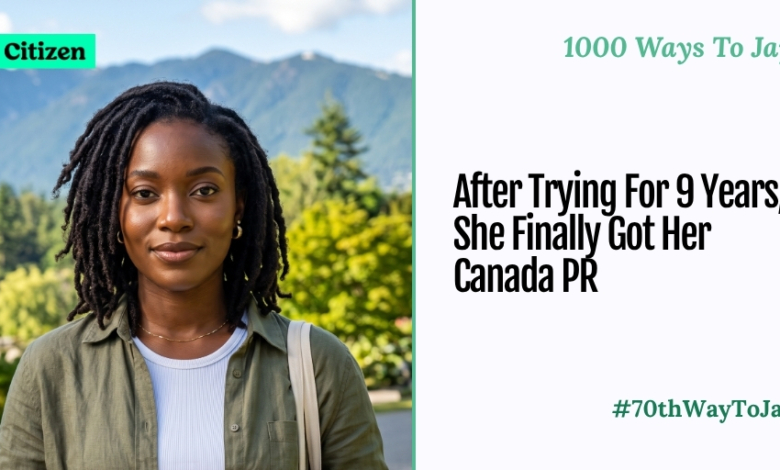
Jumoke* (27) spent years building a career in Lagos until a global design contest she won convinced her that Nigeria was holding her back. She talks about her family’s nine-year wait for Canadian PR, the paperwork setbacks, and why Vancouver has made it all worthwhile.
I currently live in British Columbia, Canada. I left Nigeria in August 2025.
I already had a life built around my career. I had an existing community there. I worked as a visual designer, and I enjoyed it.


In 2018, Adobe was running a contest sponsored by Marvel and Sony, and I won. But I was in the wrong country for it — it was a whole back-and-forth, and it took a year before everything was sorted before I could even get the prize I’d won. Just being in a country that wasn’t on their eligible list cost me that much time and stress. That was one of my “I have to move” moments. I felt there’d be more opportunities for me outside Nigeria.
The United States (US) was actually my first choice early on. I wanted to study Visual Effects (VFX) at a school in Los Angeles so I could eventually work at Marvel Studios. But as the changes in US politics took it off the list. Canada became the next option, mainly because my mum had already been here for a few years and understood how the system worked. Family was a big part of it. It’s also close enough to the US that if I ever wanted to move there later, I still can.
I came here as a Permanent Resident (PR) through my mum. I didn’t have to go through the route a lot of people take, which is more strenuous, but mine still took time; we started the process in 2017, and it only clicked last year.
My mum had been there long enough to qualify for permanent residency. Once that clicked for her, she applied for the rest of the family. The COVID-19 pandemic caused some disruptions that delayed things. All in, it took almost a decade, but I’m here now as a permanent resident.
A lot of forms, honestly. It felt like one small mistake, even a stray full stop, could stop the whole thing from moving forward. There was a lot of back-and-forth with the paperwork. You had to fill out eight to ten forms per person, and we moved as a family, so imagine all of us filling that many forms each, all at once.
Want to share your japa story? Please reach out to me here.
Birth certificates, school certificates, basically, whatever certificates you had pertaining to school. A police background check. Photos showing family relationships, so pictures of us together, and my parents’ marriage certificate. And bank statements — I think what they also wanted to see there was proof of the jobs I’d held and payments from those jobs.
The PR application itself costs roughly $10,000. The flights for all of us came to about ₦15 million in total. We also had to do medicals twice, actually, at different stages — one was basic tests, the other was more in-depth, with X-rays and blood tests for certain diseases, which cost about ₦250,000 per person.
Honestly, I’d say the forms. It felt like our forms kept getting lost, or there’d be mistakes that genuinely shouldn’t have been there. It would take months for them to come back and say a detail was missing, you’d refill it, wait another four or five months hoping for good news, and then hear it’s something else missing. The whole thing was frustrating.
The people, honestly. Everyone was so much nicer than I expected.
In my second week here, I walked into Walmart when a Nigerian woman approached me, noticing I was new. She gave me her number and invited me to a Bible study where I met other Nigerians and people from different backgrounds. That’s how I started building community here.
Also, the system just works. When Google Maps says the bus will arrive in three minutes, it does exactly that.
Being outside. Where I live, there are mountains everywhere, and the greenery is nothing like what we have in Lagos. Beyond the environment, there’s a feeling of possibility. I no longer feel that government incompetence or random hindrances will stop me from achieving anything I work towards.
The pace, honestly. I don’t feel like I have enough time to actually enjoy things — I’m always on the move, always working. I think that’s partly because I’m still building my life here, so I have to lock in now if I want the future I’m picturing for myself.
Good question, actually. I think it’s more of a Western thing, you know, always being busy, leaving little room for family and friends unless you intentionally create it. I’m learning this.
I’d say I’m an introverted extrovert, so it doesn’t come naturally — I have to push myself, especially after a few days stuck indoors working. But even with how nice people have been, I still find myself too busy for the friends I do have. So it’s been about intentionally carving out time and accepting that things have to be scheduled here, not spontaneous like back home.
I didn’t have a job for about ten months after arriving, which, honestly, led to another shock for me: how much the government actually helps you. There’s a program through community centres that serves citizens and new PRs, and that program paid me 1,060 Canadian Dollars (CAD) a month to cover rent, groceries, and living costs while I looked for work. That’s what sustained me and allowed me to contribute to the household rather than leave everything to my parents.
Rents are pretty expensive here. A friend of mine has a one-bedroom and told me she got a good deal, and she still pays around CAD 1,600 a month.
For transport, I use a transit card, about $2.75 a tap, and any trip within roughly an hour to an hour and fifteen minutes of that first tap is free. Minimum wage here is around $18 an hour, and groceries usually cost me about $70 for a two-week stretch. Friends who’ve been here longer say prices have increased, but right now it seems pretty fair to me.
Sometimes, yes, mostly the community of people. Family, friends, church. I have a church here too, but it’s not quite the same. I miss being able to call someone up to hang out or go to friends’ houses spontaneously.
Definitely planning to visit, even next year. Moving back, though, I don’t think so. I might move to another country other than Canada someday, but unless Nigeria sorts itself out, I don’t see myself moving back permanently.
The route I came through isn’t exactly common, so that’s worth keeping in mind. But generally, make sure anything you state on your forms can be backed up with actual documents, your certificates, your birth certificate, everything.
I didn’t have my master’s certificate on hand at one point and had to send a statement of completion instead, which, luckily, still worked. Triple-check everything before you submit.
I wish I had connected more while I was still in Nigeria and maybe even gotten an internship before leaving, even something small, because most employers here want “Canadian experience” no matter how strong your background is elsewhere. They want to see that you’ve worked somewhere in Canada first, even if it was volunteer work. I ended up volunteering to build that experience.
I wish I’d taken LinkedIn more seriously earlier; building connections and a presence there before moving would have helped, since referrals matter a lot here.
I still design. I volunteered with an organisation for about a month. They saw my portfolio and the work I was already delivering, and then told me about a countrywide summer programme that runs for about eight weeks. I applied, and I got it. Now, I’m hoping they retain me permanently, but I’m still sending out applications just in case.
I’ll say eight. The two points I’m taking off are for the family and community I built back in Nigeria, which I don’t have here yet. Outside of that, everything’s been enjoyable. I haven’t run into anything particularly frustrating yet, no political unrest, no government incompetence — though I know I’m still fairly new, so there’s a lot I haven’t experienced yet.
The Naira Life Conference is returning on August 22, 2026, in Lagos! Come learn from finance experts and industry leaders, and partake in unfiltered conversations about building wealth and diversifying your income stream in a country like Nigeria. Real stories, expert advice you can actually use, and a community ready to build wealth together. Secure your spot here.
What do you think about this?
Drop your opinion in the comment section.
FOLLOW US & Share this with someone who needs to see this.