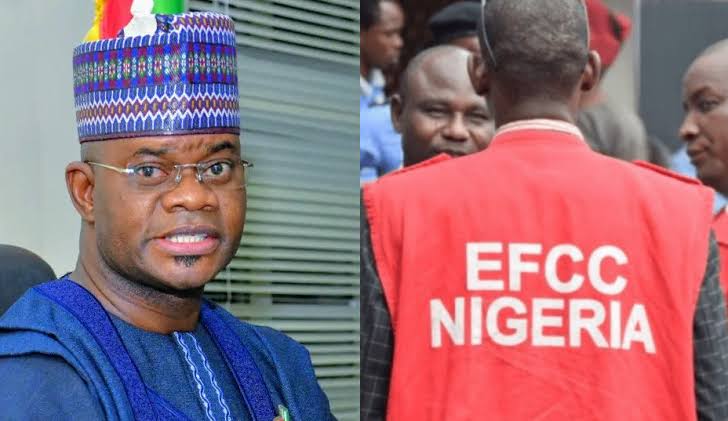
A prosecution witness in the ongoing alleged money laundering trial involving former Kogi State Governor, Yahaya Bello, on Wednesday told the Federal High Court that the ex-governor did not participate in any of the property transactions being examined in the case.
The witness, Shehu Bello Bala, who appeared as the 17th prosecution witness for the Economic and Financial Crimes Commission (EFCC), made the disclosure while responding to questions during cross-examination by counsel to the defendants.
Bala informed the court that Yahaya Bello was not involved in the acquisition of the properties that form part of the allegations before the court. He also stated that Umar Shuaib Oricha, the second defendant in the matter, did not take part in any of the transactions.
According to him, the transactions were handled by Dr. Farouk Bello, whom he described as the agent that facilitated the property purchases.
During proceedings, the witness acknowledged that he was aware that key title documents relating to the properties, including the Deed of Assignment and Power of Attorney, were eventually returned to the management of Efab Estate by Farouk Bello.
Bala further clarified that he had no family relationship with either Ali Bello or Farouk Bello, despite mentioning both men during his earlier testimony. He also stressed that he was not from Kogi State, distancing himself from any suggestion of a connection to the former governor.
The witness, who identified himself as a commodity trader from Katsina State, told the court that he had known Ali Bello for about 14 years through business dealings.
Explaining the nature of their relationship, Bala said they had engaged in the trade of agricultural commodities, including grains and ginger sourced from northern Nigeria. He added that beyond commodity trading, he was aware that Ali Bello had interests in the real estate sector.
When questioned by counsel representing the second and third defendants, Bala stated that he did not know the third defendant and could not link him to any of the transactions under scrutiny.
The witness also told the court that by the time the title documents were returned to Efab Estate, Dr. Farouk Bello had already passed away. He recalled that an individual later approached him with documents relating to one of the properties, expressing an intention to sell it.
Although he could not confirm whether the individual was a son of the late Farouk Bello, Bala said he collected the documents and delivered them to the chairman of Efab Estate.
According to him, it was during that process that concerns emerged regarding an ongoing investigation into the property.
“That was when we realised that the property was being investigated,” the witness told the court.
Bala further disclosed that another property which was not marked by the EFCC was the one allegedly purchased by Farouk Bello.
At one point during the cross-examination, defence counsel attempted to ask whether Ali Bello inherited the property from his mother. However, the prosecution objected, arguing that the witness had not given evidence relating to inheritance.
The defence maintained that it was entitled to establish the basis of its case and should be allowed to question the witness within the scope of his knowledge.
The trial was subsequently adjourned for the continuation of proceedings.