0
Chidi Ugwu
The 36 state governors under the aegis of Nigeria Governors’ Forum (NGF) has intensified its push for the establishment of state police, insisting that any framework for decentralised policing must be firmly grounded in the Constitution and designed to protect citizens’ rights.
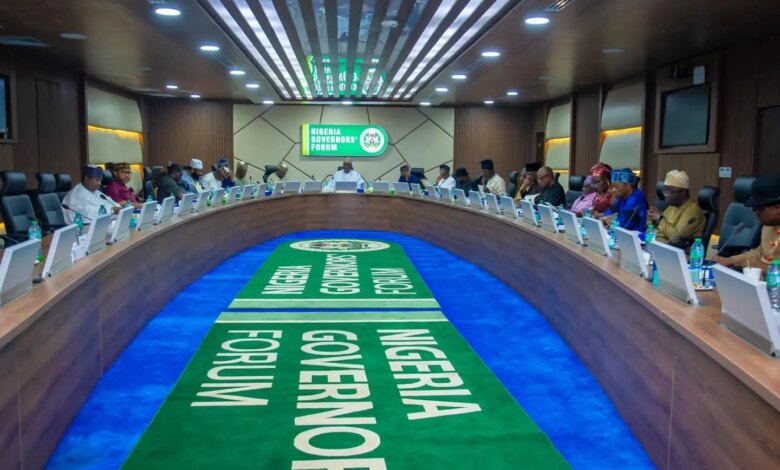
This position formed the central outcome of the Forum’s second meeting of 2026, held on Wednesday, June 17, under the chairmanship of , who also serves as NGF chairman.


In a communiqué signed by AbdulRahman AbdulRazaq, the NGF Chairman and Governor of Kwara State, and read out to newsmen after the meeting by Dapo Abiodun, the governor of Ogun state, the governors said they received a presentation from the NGF Secretariat alongside a delegation of state Attorneys-General on ongoing efforts to support the creation of state police.
The governors disclosed that consultations had been held with the Attorneys-General to review proposed constitutional amendments and operational frameworks for the initiative.
They stressed that state police must not merely be created as an administrative reform, but must be structured in a way that aligns with Nigeria’s federal system and guarantees the protection of civil liberties.
According to the communiqué, the governors agreed that the outcome of the legal consultations would help strengthen the collective position of states as national conversations around policing reform continue.
“We, members of the Nigeria Governors’ Forum (NGF), at our meeting held today, deliberated on issues affecting the country. Following extensive deliberations, the Forum resolved as follows:
“The Forum received a presentation from the NGF Secretariat and a delegation of the Honourable Attorneys-General of the States on efforts to support establishing State Police in Nigeria. It noted a dedicated consultation with the Attorneys-General to review the proposed constitutional amendments and frameworks. Governors’ emphasised the need for the State Police to be constitutionally sound and aligned with federalism and citizens’ rights. The Forum noted the collaborative effort and added that the consultation outcomes would strengthen the States’ collective position” the communiqué reads in part.
The renewed call for state police comes amid persistent insecurity across several parts of Nigeria, including banditry, kidnapping, insurgency and communal violence, which have continued to stretch the operational capacity of the centrally controlled police system.
Beyond security, the Forum also deliberated on critical national development issues. Governors reaffirmed their commitment to tackling malnutrition through the National Nutrition 774 Initiative, while supporting ongoing legislative work on the National Nutrition Bill aimed at improving governance and policy coordination in the sector.
The Forum also received a briefing from the worldbank.org on its proposed Country Partnership Framework for Nigeria covering 2026 to 2032.
Governors backed the proposed agricultural growth programme designed to improve productivity, strengthen value chains, boost private sector participation and improve food security.
In the power sector, the governors reviewed the proposed National Solar Super-Grid initiative, a major energy expansion plan focused on large-scale decentralised solar generation integrated with the national transmission network.
They said the project could accelerate industrialisation, deepen state electricity markets and improve access to affordable electricity nationwide.
The communiqué reflects a growing consensus among governors that states should assume greater responsibility not only in security management but also in key sectors such as nutrition, agriculture and power, as subnational governments seek stronger roles in driving national development.
“The Forum received a presentation from the Federal Ministry of Budget and Economic Planning on progress under the National Nutrition 774 (N-774) Initiative.
“The Forum reaffirmed the Govenors’ commitment to improving nutrition outcomes and reducing child malnutrition across Nigeria. The Forum also noted the ongoing work on the National Nutrition Bill and encouraged continued engagement with relevant stakeholders to strengthen the legal and policy framework for nutrition governance.
“The Forum received a briefing from the World Bank Country Office on the proposed Country Partnership Framework (CPF) for Nigeria covering the period FY2026-2032; the proposed Nigeria Sustainable Agricultural Value-Chains for Growth (AGROW) Programme, a results-based initiative designed to improve agricultural productivity, strengthen value chains, increase private sector participation, enhance food security, and Early Childhood Development (ECD).
“The Forum supported ongoing collaboration with the Federal Government, the World Bank, and other stakeholders to ensure successful implementation and deliver benefits to participating states.
“Governors approved state specific interventions and stressed the importance of better coordination across sectors like health, nutrition, education, water and sanitation, social protection, and family support.
“The Forum received a presentation on the National Solar Super-Grid (NSSG) Initiative, a proposal to expand electricity access through large-scale decentralised solar generation integrated with a national high-voltage transmission network.
“The Forum noted the initiative’s potential to support industrialisation, improve energy security, strengthen state electricity markets, and accelerate economic growth.
“Governors reiterated their commitment to ongoing power sector reforms and to strengthening collaboration among stakeholders to expand access to reliable and affordable electricity for Nigerians” the communiqué reads.