Ijaw Youths’ Solidarity Protest Rages As Defendants’ Absence Stall Bayelsa LGAs Expansion, Resource Control Suits

0
Proceedings in a suit seeking the creation of additional local government areas for Bayelsa State suffered a setback on Monday following the absence of the National Assembly and the Attorney General of the Federation (AGF), who are the first and second defendants, at the Federal High Court sitting in Yenagoa.
The case was instituted by a Niger Delta sociocultural pressure group, the Supreme Egbesu Assembly (SEA), which is seeking the creation of 24 additional local government areas in Bayelsa State, currently made up of eight LGAs. The group also joined the Federal Government and the National Assembly as defendants in the matter.
In a related suit on resource control, also filed by the Supreme Egbesu Assembly, neither the defendants nor their legal representatives were present in court when the matter came up for hearing.


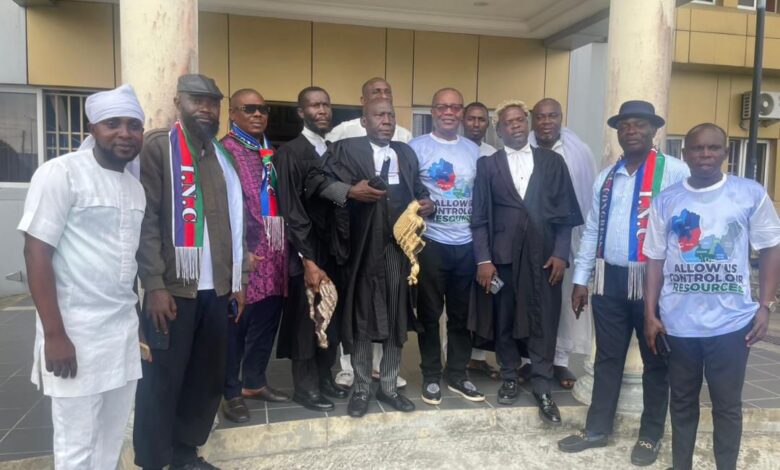
Counsel to the plaintiff, Barr. Ebibenabo Okorodas told journalists after proceedings that both cases, marked FHC/YNG/CS/63/2026 and FHC/YNG/CS/64/2026, were scheduled for hearing but could not proceed due to the defendants’ absence.
He explained that in the resource control suit, the AGF had already filed a counter-affidavit, which the plaintiffs responded to with a further affidavit and a reply on points of law. However, he noted that the absence of the defendants meant the matter could not proceed.
On the LGAs expansion suit, Okorodas stated that the defendants had not filed any counter-affidavit, describing the situation as a procedural delay that still required fair hearing for all parties.
Okorodas said, “Today was supposed to be for hearing. There are two cases. In one of them, which is the resource control, the Attorney General has filed a counter, challenging the issue of resource control that we have filed. Incidentally, they are not in court.
“And what they filed, we have also filed better affidavits, and we have also done what is called a reply on point of law because they raised some legal issues which we have responded.
“Since they are not in court, you know the law gives them the opportunity of a fair hearing so that no party will be undone unnecessarily.”
The presiding judge, Justice Ayo Emmanuel, consequently adjourned the matter to July 1, 2026, for hearing.
The Secretary-General of the Supreme Egbesu Assembly, Mr Felix Tuodolo, said the group had long pursued both resource control and the creation of additional LGAs through peaceful protests across the Niger Delta but had now resorted to the courts.
He said the legal approach was adopted to prevent further unrest among aggrieved youths in the region, stressing that delayed justice could undermine peace and stability in the oil-rich area.
Tuodolo urged the authorities to respond promptly to the issues raised in the suits, warning that continued inaction could heighten frustration among younger activists.
“Now that we have chosen the legal path to pursue these things, it behoves the government to listen and act fast before the youths decide to do otherwise,” he said.
Speaking on political developments in Rivers State, Tuodolo insisted that the Ijaw people must not be politically marginalised, warning that the group would mobilise if necessary against any political actors perceived to be undermining the Ijaws.
“Any political party willing to undermine the Ijaws in Rivers State shall not have the support of the Ijaw people. We are watching as events unfold in the political arena of the state, and we shall respond accordingly in due course.”
He also assures that the Supreme Egbesu Assembly will not sit back and watch political gladiators in Rivers who would want to treat the Ijaw man as a second-class citizen in the State.
Tuodolo further revealed that the group is also pursuing a separate case before the ECOWAS Court of Justice, challenging Nigeria’s participation in the Morocco-Nigeria Gas Pipeline project.
Meanwhile, hundreds of Ijaw youths converged on the Federal High Court premises in Yenagoa in support of the ongoing legal action, dressed in white and chanting solidarity songs.
They were later directed by court officials to remain in a designated area to maintain order during proceedings