June 12: ‘The Silence At The Polls Is Growing Louder’ – Olusegun Adeniyi Raises The Alarm Over Voter Apathy

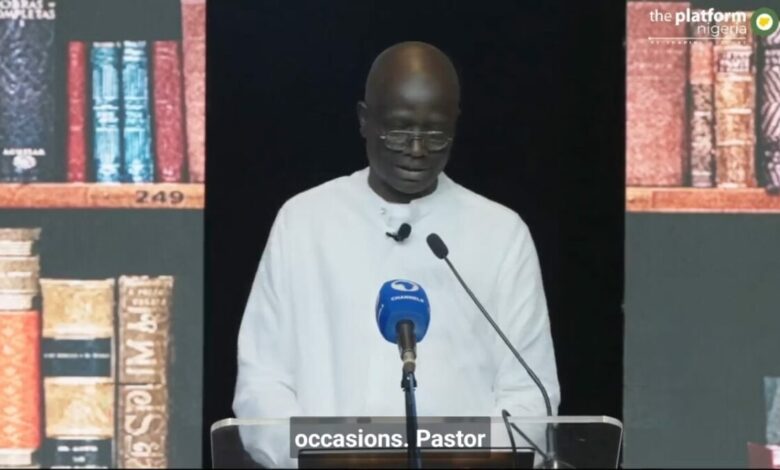
Senior journalist and former presidential spokesman, Olusegun Adeniyi, has warned that Nigeria’s democracy was facing a deepening crisis of public trust, lamenting that millions of citizens were turning their backs on the electoral process as voter participation continued to decline.
Speaking at The Platform Nigeria Special June 12 Lecture in Lagos on Friday, Adeniyi described the country’s dwindling voter turnout as “a haunting silence spreading across democracy,” warning that the trend threatens the legitimacy of elected governments and the future of democratic governance.


The annual lecture, organised by the Covenant Christian Centre under the leadership of Pastor Poju Oyemade to commemorate Democracy Day, was themed “Governance, Democracy, National Security.”
Opening his address, Adeniyi said the greatest concern confronting Nigeria’s democracy was not merely electoral malpractice but the growing apathy of citizens who no longer believe participation in elections can change their lives.
“I would like to talk briefly about a haunting silence spreading across democracy. It is the silence of citizens turning their backs on the very process meant to give them voice. And nowhere does this echo more ominously than in Nigeria,” he said.
He noted that the 2023 presidential election recorded the lowest voter turnout in the country’s history, with only 24.9 million Nigerians voting out of more than 93 million registered voters.
“The 2023 presidential election recorded a voter turnout of just 26.72 per cent, the lowest in Nigeria’s electoral history. Out of 93.47 million registered voters, only 24.9 million showed up to vote.”
According to him, the statistics revealed a disturbing pattern of declining civic participation over the past two decades.
He recalled that voter turnout stood at 69 per cent in 2003 before dropping to 53.7 per cent in 2011, 43.7 per cent in 2015, 34.75 per cent in 2019 and eventually 26.72 per cent in 2023.
“The trajectory is unmistakable. With each election cycle, more Nigerians are choosing not to choose.”
Adeniyi argued that while politicians celebrate electoral victories and claim democratic mandates, the low level of participation raises fundamental questions about legitimacy of their mandates.
“Our politicians have been quick to celebrate their victories and issue acceptance speeches about mandates and democratic legitimacy. But that’s a question we must now confront. What does it mean to govern with the consent of so few?”
Placing Nigeria’s experience in a global context, he cited international research showing declining electoral participation worldwide but stressed that Nigeria’s situation is significantly worse.
“The OECD average stands at 65 per cent. Nigeria’s 27 per cent represents the worst turnout in Africa.”
He acknowledged that logistical challenges, insecurity, voter suppression and inadequate voter education contribute to low participation, but insisted that the root cause was a collapse of public confidence in governance and the electoral system.
“At its core, Nigeria’s voter apathy crisis is about trust, or rather, the catastrophic erosion of trust.”
The veteran newspaper columnist added: “The uncomfortable truth our political class must face is this: the democracy we practise does not inspire enough Nigerians to make them care about voting.”
Quoting findings by the Centre for Democracy and Development (CDD), Adeniyi said many Nigerians no longer believe their votes count or that election outcomes have any meaningful impact on governance.
“Citizens no longer trust that their votes will count or, most devastatingly, that it matters who wins.”
He warned that when the overwhelming majority of registered voters abstain from elections, democracy itself is weakened.