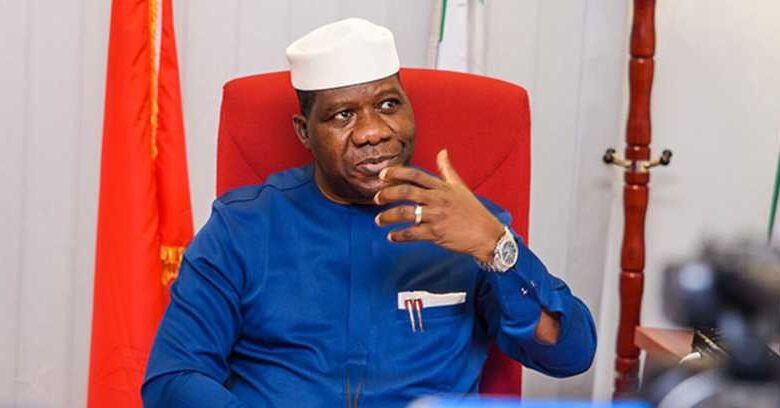
Senate Leader, Opeyemi Bamidele, has declared that the National Assembly will not amend Nigeria’s Electoral Act before the 2027 general elections, insisting that the current law must be allowed to run its full course before any fresh changes are considered.
Bamidele made this known on Saturday after casting his vote in Iyin-Ekiti during the ongoing Ekiti State Governorship Election.
The Senate Leader said lawmakers have reached a firm decision not to tamper with the electoral framework ahead of the next general election. According to him, changing the law too close to a major election could create unnecessary uncertainty in the political process.
He also commended the Independent National Electoral Commission for the conduct of the governorship poll in Ekiti State, noting that the election process had so far been peaceful and well-coordinated.


Bamidele praised voters across the state for turning out to participate in the exercise, describing the turnout as encouraging. He said early reports from several local government areas showed strong voter participation and a generally smooth voting process.
“There is no doubt that our electoral system is evolving and improving. This is one of the first major elections being conducted under the amended Electoral Act, and I have observed a high level of compliance not only by INEC but also by political parties and voters themselves,” he said.
“Today, people are more aware of what constitutes electoral offences and the consequences such violations carry for both political parties and individuals. That growing awareness is a positive development for our democracy.”
Bamidele stated that the country’s electoral system is gradually improving, adding that both voters and political actors now have a better understanding of electoral laws and the consequences of violating them.
He noted that improved voter awareness and compliance with electoral rules are clear indicators that Nigeria’s democracy is making progress, despite existing challenges.
Speaking further, the Senate Leader said he monitored developments across Ekiti through direct reports and phone calls from different parts of the state. He expressed satisfaction with the feedback received regarding voter turnout and election conduct.
“I made several calls across the state to obtain firsthand information on how the process was progressing in different local government areas. The reports I received regarding voter turnout have been encouraging,” he said.
“I am equally impressed by INEC’s performance, particularly the prompt deployment of officials to polling units and the timely arrival of voting materials. This represents a significant improvement on previous elections.”
He added that the timely deployment of election officials and materials to polling units reflected operational improvements by INEC compared to previous election cycles.
Bamidele further disclosed that Ekiti State has about 1.059 million registered voters, with over one million already having collected their Permanent Voter Cards (PVCs). He said this could translate into one of the highest voter participation records in the state’s electoral history.
The Senate Leader also revealed that the National Assembly would carry out a broader review of Nigeria’s electoral process after the 2027 general elections, using observations from current elections and future by-elections as reference points for possible reforms.
Explaining the legislature’s position, Bamidele stressed that electoral laws should evolve with time, but such changes must happen at the right moment and not in the middle of an active electoral cycle.
“The law is like a human being — it grows and evolves. As people grow, they often need to change their clothing to suit new realities. That is the purpose of amending existing laws,” he said.
“However, one thing we have resolved as a Parliament is that between now and the 2027 general elections, we do not intend to make any further amendments to the Electoral Act. We will allow the law to operate as it is.
“After the February 2027 general elections, we can then begin to consider any further reforms. Making amendments at this stage would be akin to changing the rules in the middle of a game, and that is something we must avoid.”
Bamidele expressed confidence that lessons from ongoing elections across the country would provide useful insights for future reforms aimed at strengthening Nigeria’s electoral system and democratic institutions.