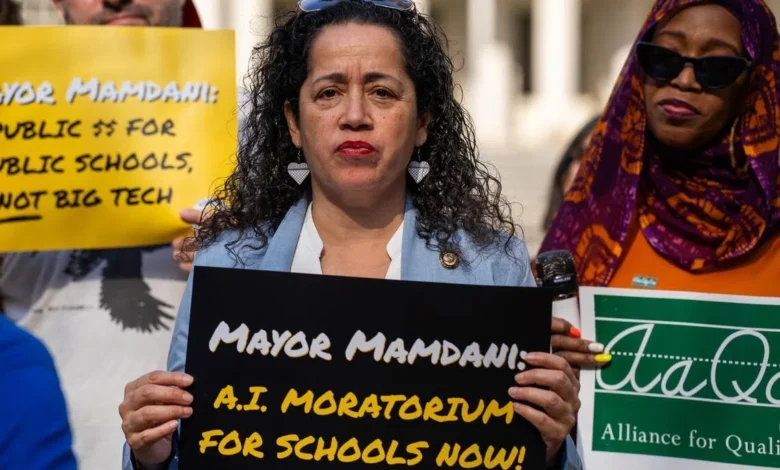
NEW YORK – A majority of New York City Council members on June 9 urged the mayor and the schools chancellor to pause the use of artificial intelligence in the city’s schools, saying that the technology poses a “risk to student learning and mental health”.
The request was conveyed in a letter signed by 29 of the city’s 51 council members, who said that they had a range of concerns with AI in the classroom, including the technology’s effect on students’ cognitive development, critical thinking and privacy. The council members joined a growing roster of parents across the city who have spoken out against the technology as well as screens in the classroom, with some demanding a moratorium on AI in schools.
“We urge you to hold off and pause the use of AI in our schools except for education on the multiple risks in employing the technology until rigorous guardrails can be developed with public and expert input to prevent serious damage to NYC children and their future,” the council members wrote.
The letter adds to the pressure that New York City Mayor Zohran Mamdani has faced in recent weeks to rein in the technology in public schools. Mamdani has repeatedly sidestepped questions about his opinion on an AI pause. But he has said that he understands parents’ concerns about technology and suggested he supports reducing screen time at school.

School districts across the United States have deployed AI chatbots and software for teaching and learning, and some have gone further, creating AI-themed schools. The New York City school system, led by Kamar Samuels, the chancellor, has moved relatively slower, temporarily blocking access to ChatGPT after it was first released, and has yet to fully embrace the technology like some of its peers.
But the use of AI applications by teachers and students has expanded in New York schools, and officials at the city’s Department of Education have been working in recent months on the school system’s first guide to how teachers can incorporate artificial intelligence into their work and classrooms. The final version is expected to be published this summer.
The school system released a preliminary version of the guide in March. It explains when AI is prohibited, when it should be used with caution and when it could be a helpful tool. Teachers could use AI to create lesson plans, for instance, but not to grade homework.
More than 6,000 people submitted feedback about the guide to the Education Department, with many making comments critical of the technology. In New York City and beyond, the pushback to AI has grown in recent months, uniting parents across age groups and backgrounds.
The backlash in the city contributed to the Education Department’s decision in April to pause the creation of an AI-focused high school in Manhattan for next school year.
Parents have complained about the lack of insight into which AI applications are used at their children’s schools and the data that they may collect. They also worry that the larger embrace of technology in the classroom, including watching YouTube videos during recess and playing video games to learn math, undermines restrictions on screen time at home.
“Chancellor Samuels has a chance right now to come out and have some really strong regulation on technology,” said Kailee Graham, whose oldest daughter is in kindergarten in a Manhattan school. “We have lost control and need to bring books back.”
During the past several months, Samuels has heard from parents who both support and oppose AI and appears to have shifted his view.
When the Education Department released its preliminary guide, he said that the department needed to move with a “certain level of urgency” because AI was already in schools. “The system needs guidance,” Samuels said. “The system needs significant safeguards so that families can feel comfortable.”
But at an event two weeks ago, Samuels said that public opinion on AI had drastically changed since he became chancellor in January. He called it “the most invasive technology that we’ve seen,” Chalkbeat reported, and acknowledged that parents were deeply sceptical of technology companies. NYTIMES