Meet Connor Gibson: The 22-year-old engineer giving free 3D-printed dentures to Americans who need them most

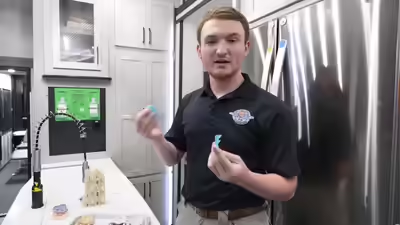
At an age when many graduates are just beginning their careers, 22-year-old Connor Gibson is already changing lives with technology. The Tennessee engineer has taught himself dentistry and 3D printing to provide free dentures to Americans who cannot afford them. Working with the nonprofit Remote Area Medical (RAM), Gibson uses mobile 3D printers to produce custom dentures in just hours, reducing a process that once took months. His work has restored smiles to thousands of patients, many of whom break down in tears when they see themselves again. Gibson calls these emotional reactions “mirror moments” and says they remind him why he does the work.
How the Connor Gibson taught himself dentistry
Gibson never imagined that his engineering degree would lead him into dentistry. A native of Seymour, Tennessee, he was studying at Walter State Community College when he first came across Remote Area Medical, a nonprofit that provides free medical, dental and vision care across the United States.Inspired by the charity’s mission, he began volunteering and quickly became determined to find a better way to help patients who needed dentures. The problem was that he had no background in either dentistry or 3D printing.“Honestly, if you told me three years ago, this is what I would be doing, I would have called you crazy,” Gibson told CNN.Instead of giving up, Gibson immersed himself in learning. Using online videos, documents and software tutorials, he taught himself dental anatomy, terminology and how to design dentures digitally.“I made it my mission and studied up like I was doing a test,” he said.His engineering background in computer-aided design proved useful. Before long, he was creating digital denture models and learning how to manufacture them using 3D printers.RAM CEO Chris Hall said Gibson’s progress surprised everyone.“Connor self-taught himself the majority of the dental anatomy and the terms and vocabulary of the dental industry to take this project and move it forward,” Hall told CNN.
Reinventing how dentures are made


Traditional dentures often require several visits and can take up to three months to complete. Gibson believed the process was outdated and unnecessarily slow.He eventually developed RAM’s Mobile Digital Denture Lab, believed to be the first mobile denture laboratory of its kind in the United States. Patient images are converted into digital files, which Gibson uses to design custom dentures before printing them on 3D printers.The new approach allows patients to receive dentures during the same weekend clinic instead of waiting weeks or months.
Chasing ‘mirror moments’
Gibson says the most rewarding part of his work is watching patients see themselves smile again.He remembers grown men with tattoos crying in front of mirrors and elderly widows becoming emotional after receiving their new teeth.“Something that I was able to have a hand in makes a grown man burst into tears,” Gibson said. “To see that raw, human emotion and just know that I played a change in this person’s life, it’s very humbling, and I’m beyond blessed.”He calls these emotional reactions “mirror moments.”“Since then, it’s all just like fireworks every weekend. That’s what we’re striving for, to get more and more of those mirror moments,” he said.
Working around the clock
During RAM’s weekend clinics, Gibson often sleeps inside the Mobile Digital Denture Lab while the machines continue running around the clock.The lab currently houses two 3D printers, and Gibson recently produced a personal record of 35 dentures in a single weekend.His only frustration, he says, is that there are always more patients than the organisation can serve.“You have people that are really down on their luck,” he said. “The reality is we’re all one slip or one fall away from needing two teeth in the front just to be able to smile again.”
Why the work matters
According to figures cited in reports, around 72 million American adults do not have dental insurance. Even Medicare generally does not cover routine dental care, dentures or implants.For many people, replacing missing teeth is simply too expensive.Since its founding in 1985, Remote Area Medical has treated more than one million patients and provided nearly $240 million worth of care through the work of around 230,000 volunteers.Founded by British-born adventurer and television personality Stan Brock, the charity now plans to host more than 90 free clinics in 2026.
Recognition beyond his years
Although Gibson had no formal training in dentistry, his work has attracted attention within the field. At a dental convention in Las Vegas, he was recognised as a leading figure in digital dentistry.Chris Hall said Gibson represents the spirit of RAM founder Stan Brock.“If Stan was to meet Connor, I think Stan would see someone who truly has the ability to change the world, someone who has passion to help other people,” Hall said.The organisation’s work was also featured on CBS’s “60 Minutes,” leading to increased donations and offers from manufacturers willing to provide additional 3D printers.
Looking to help even more people
Remote Area Medical hopes to expand from one mobile dental lab to three, which could allow the organisation to produce more than 100 dentures during a single weekend clinic.For Gibson, the mission remains simple.“With the mobile denture lab, it lets us bridge that gap and meet patients where they are at,” he said.And as he often reminds himself, “we’re all one slip or one fall away” from needing a smile restored.