“My Nigerian Education Prepared Me Far Better Than UK Universities Prepare Their Nurses” — Abroad Life

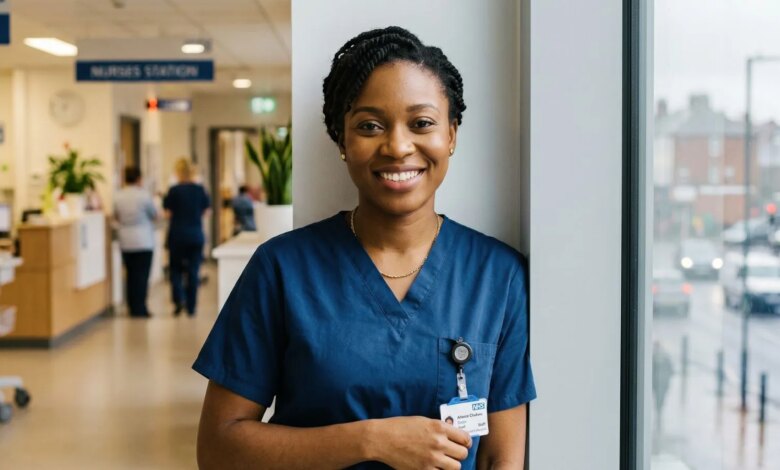
The Nigerian experience is physical, emotional, and sometimes international. No one knows it better than our features on #TheAbroadLife, a series where we detail and explore Nigerian experiences while living abroad.
Bambs (31) funded her relocation to the UK on a corper’s salary. In this story, she shares how her determination to practice nursing in a working environment saw her submit 20 applications a day and endure hundreds of rejections until she achieved her dream. She also shares the culture shocks she experienced in the UK, the best and worst parts of life abroad.
I live in the United Kingdom (UK). I left Nigeria in 2021, towards the end of the COVID-19 pandemic.
To be honest, I had always wanted to leave. Growing up, I was drawn to healthcare and wanted to be a doctor or a nurse. But I quickly noticed a huge gap between what our nursing textbooks taught and the reality in Nigerian hospitals. That was when I realised I could not practice in Nigeria.

For instance, textbooks teach you to use a defibrillator on a patient in cardiac arrest. Yet, most Nigerian hospitals—at least the ones I worked in—did not even have one, which is wild. My main motivation was simply wanting to practice nursing the proper way. After university, I completed my National Youth Service Corps (NYSC) and immediately began my relocationstarted my relocation process.
It gave me a solid foundation. Working in Nigeria taught me resilience, empathy, and how to perform under intense pressure. Nigerian healthcare workers do their absolute best, even when patients do not appreciate how far we go for them.
You could have a malnourished baby at the brink of death, and doctors and nurses will rally to save that child despite a lack of resources, poor infrastructure, and parents who cannot afford to pay. We do everything to give that child a chance at life, yet these efforts go unnoticed. Still, it taught me how to maximise the smallest resources to achieve the greatest good.
It was long and expensive, and I could barely afford it at the time. I had to work for a bit to save up, slowly taking the required exams and paying the processing fees.
I registered with the UK Nursing and Midwifery Council (NMC) and sat for my Computer-Based Test (CBT) in October. After that, I began job hunting. I aimed for 20 applications a day because I was that desperate to leave.
Throughout November, my routine after work was to shower, open my laptop, and apply for roles. Some days I submitted 20 applications, other days 30. Every Monday morning, I’d check my email and see a long list of rejections. I refused to let that discourage me because I knew I would make it. Whenever a rejection came, I reviewed my application, did some research, and refined my next attempt.
Out of hundreds of applications, I landed about ten interviews in December. I remember having to take an interview while at work; I asked my colleagues to cover for me for 30 minutes while I took it in the toilet.
By January, those interviews turned into four job offers. I weighed the pay, location, and cost of living before choosing. They wanted me to resume in March, but I deferred it to April to spend time with my family. I quit my job in February and spent three weeks at home. The day I left, my mum and sister cried; it was an emotionally heavy moment.
There was a huge demand for migrant nurses in the UK at that time, so the hospital was recruiting a lot of nurses from Nigeria. They booked our flights, so we arrived as a cohort of Nigerian nurses. The UK was still under lockdown, so we had to be isolated for ten days in accommodation provided by the hospital. It was April, and I vividly remember how cold it felt that first day. I also struggled with the British accent; it felt like everyone spoke too fast.
Yes. On our first day, we reached our accommodation around 4:00 PM. I was so exhausted, I went straight to sleep. When I woke up at 8:00 PM, it was still bright outside. I thought I had slept for 12 hours before I checked the time and realised that during the summer, the days are much longer here.
I constantly charged my phone out of the habitual fear of power outages in Nigeria; it took me some time to stop. I also struggled getting used to how the bus system works.
Then there was the food. I don’t like English food. I initially lived in a town without African stores, so I had to endure it. Eventually, I discovered other options like Asian and Mediterranean food.
Another shock was summer fashion. People wear very little clothing—short skirts, shorts, and some men even walk around shirtless. Now I have started doing that too; in the summer, my legs are out.
Religion is also viewed differently here. It is treated as deeply personal, and you cannot be overt about it or impose it on others. It’s not like Nigeria, where you even have morning devotions at work.
Then there’s racism. Some people will literally cross the street to avoid walking near you because you are Black. You face differential treatment even at work. You only begin to understand these dynamics after living here for a while. I initially chalked it up to being new until I saw newly hired white colleagues receive completely different treatment. That is when it hits you: “Oh, it’s because I am Black.”
But you ultimately shrug it off and keep moving forward because you remember the sacrifices it took to get here.
I have learned to understand how the system works and use it to my advantage. When a patient was once racist to me, I informed my superior, who instructed me to file a report. The system provides real support for these issues, and the police can even get involved in some cases. Now, when it happens, I stand up for myself and use those safeguards the system provides to protect myself.
It is deeply unsettling. Currently, houses are being burnt in Belfast after an asylum seeker stabbed someone. Last year, large anti-immigrant marches were organised by people demanding that foreigners leave. I was terrified at the time, and my family constantly checked on me. But there is little we can do besides pray and trust in God.
Yes. Honestly, Nigeria’s educational system is highly robust. I see newly qualified nurses from UK universities, and some of them don’t know anything. I often have to teach them. Seeing how easily it has been for me makes me incredibly grateful for my training back home.
The Naira Life Conference is returning on August 22, 2026, in Lagos! Come learn from finance experts and industry leaders, and partake in unfiltered conversations about building wealth and diversifying your income stream in a country like Nigeria. Real stories, expert advice you can actually use, and a community ready to build wealth together. Secure your spot here.
Yes, I visited in 2023. I also hope to travel back this year. I have already asked for my leave so I can be in Nigeria for Detty December.
I recently discussed this with a Zimbabwean colleague who is nearing retirement. She owns properties in Zimbabwe and plans to retire there for a comfortable life, which is wonderful. I used to share that dream, but with how things are going in Nigeria, I’m not sure it would be a wise decision. But if things change for the better, why not?
I’m also considering moving to the United States (US). I’ve already passed the US nursing exams. In the UK, professional growth for nurses is a bit limited; you eventually hit a ceiling and plateau. In America, growth is astronomical, and nurses earn a lot more. I’m just not sure of the exact timeline yet. Relocating from Nigeria was stressful, and I am not entirely ready to repeat that process just yet, but I will move whenever the time is right.
First is my friends. Most of them are fellow nurses who arrived at different times. Since we don’t have family here, we lean on each other. My best friend and I moved at the same time—she flew from Lagos, and I flew from Abuja. We isolated together, learned together, and worked in the same hospital before some of us moved to other places. We take annual trips together, and every December, we have a potluck where we eat, party, and cry together.
My church has also been an incredible pillar. They organise forums that offer guidance on surviving in the UK. My pastor is highly approachable; you can call him at any time, even at midnight, and he will listen.
Of course, there’s my family back home too. Whenever I struggled initially, I would call my parents and cry. Settling in was tough; I cannot tell you how much I cried when I first came into this country. But my family’s support kept me going.
The winter. Oh my god! I hate the winter. If I make enough money, I will start leaving the UK from December through March to stay in Nigeria, and only work here from April to October.
I love the economic reward system here. If you work, you will make money. In Nigeria, your salary is never enough, and even if you work extra shifts, it won’t make much difference.
I also love how safe it is. I live far from London, so when I go there for concerts, I often return home around 2:00 AM. I can walk from the train station to my house without worrying about being harassed. I could never dare do that where I grew up in Nigeria.
Travel is also incredibly affordable. If I want a weekend trip to Italy and have just £300, I can easily do it. I can fly out, chill for a few days, and come back. And £300 isn’t even a lot of money; I can make that in a single shift. It’s not like Nigeria, where going abroad is like a big flex; here, it is just a normal thing to do.
Quite a bit. I have visited Albania, Egypt, Morocco, Spain, Montenegro, Greece, and Rome. I am also heading to Monaco later this year. Mind you, I had planned that trip long before the whole Monaco craze that’s going on right now.
Most have been fantastic. I thoroughly enjoyed my recent vacation to Egypt with a close friend. Mykonos was also incredibly relaxing; Greece is beautiful. I had the best pizza I have ever tasted in Rome. I went paragliding for the first time in Albania. I was just reciting Psalm 91 in the air because I thought I was going to die, but it was amazing.
I’ll say Morocco. We’d booked a resort in Agadir for my friend’s birthday, but we missed our direct flight. So we got a flight to Marrakesh and had to take a five-hour drive to Agadir. There were six girls in a car with a driver who only spoke Arabic and a bit of French. I used my limited French to communicate with.
The route had a lot of police checkpoints, and we drove past three horrific accidents with dead bodies on the road. We were absolutely terrified and spent the entire ride praying.
Despite the scary start, the vacation turned out to be incredible. I loved the resort, rode a camel, and even tried quad biking for the first time. It was a wonderful experience, but that first day was really scary.
Honestly, nothing here compares to the experiences from Nigeria. Growing up in Delta State, I saw a lot if you get what I mean.
What do you think about this?
Drop your opinion in the comment section.
FOLLOW US & Share this with someone who needs to see this.