0
Deputy Speaker of the House of Representatives, Rt. Hon. Benjamin Okezie Kalu has assured international investors that Nigeria is prepared to translate its climate ambitions into viable investment opportunities, declaring that the country’s green transition presents immediate and commercially attractive prospects across multiple sectors of the economy.
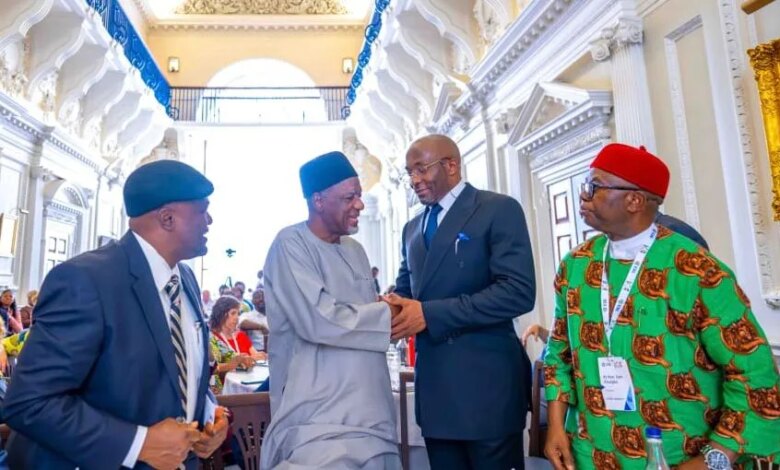
Kalu asserted on Tuesday while delivering a keynote address at the Nigeria Climate Investment Summit, a flagship event of the London Climate Action Week 2026, held in London under the theme, “Catalyzing Nigeria’s Climate Policy Progress into Financial Flows for Green Projects.”
Addressing policymakers, financiers, development institutions, and private investors, the Deputy Speaker said Nigeria’s climate agenda has moved beyond policy formulation and is now focused on unlocking investment that can drive sustainable economic growth while addressing environmental challenges.
He identified renewable energy, agriculture, transportation, manufacturing, and climate adaptation infrastructure as some of the sectors offering substantial opportunities for investors seeking to participate in Africa’s emerging green economy.
According to him, Nigeria’s green transition must be anchored on projects that not only reduce emissions but also improve livelihoods, create jobs, and strengthen resilience against the growing impacts of climate change.
“The opportunities before investors are practical, immediate, and diverse. They include distributed renewable energy, solar mini-grids, battery storage, clean cooking solutions, electricity transmission and distribution infrastructure, and industrial energy efficiency. They include climate-smart agriculture, irrigation, cold-chain logistics, food processing, and resilient rural infrastructure; investments that can strengthen food security while improving incomes for millions of Nigerians.
“They include electric mobility, mass transit, low-carbon urban transport, waste-to-value systems, methane reduction, circular-economy enterprises, and green manufacturing.
“They also include climate adaptation: flood-control systems, resilient drainage, coastal protection, nature-based solutions, climate-resilient housing and infrastructure that can protect communities and productive assets from the growing effects of climate change,” Kalu said.
The Deputy Speaker noted that climate change presents both mitigation and adaptation challenges for Nigeria, pointing to recurring flooding, land degradation, food insecurity, and climate-induced displacement affecting communities across the country.
“This is especially important because Nigeria’s climate challenge is both a mitigation challenge and an adaptation challenge. Our people are already living with the consequences of extreme weather, flooding, land degradation, food insecurity, and climate-related displacement. Climate finance must therefore support both emissions reduction and human resilience.
“Our message is simple: Nigeria’s green transition must be a just transition. It must expand access to affordable energy, create decent work, support communities, equip young people with new skills, promote women’s participation in the green economy, and ensure that no region or social group is left behind,” he added.
Kalu linked the country’s climate investment drive to ongoing economic reforms undertaken by the administration of President Bola Ahmed Tinubu, arguing that macroeconomic stability remains a critical factor in attracting long-term capital.
He said recent reforms have improved fiscal sustainability and strengthened investor confidence in the Nigerian economy.
“Distinguished ladies and gentlemen, climate investment thrives where there is confidence in the broader economic environment. Under the leadership of His Excellency, President Bola Ahmed Tinubu, GCFR, and supported by robust legislation from the 10th National Assembly, the government has embarked on significant economic reforms aimed at restoring fiscal credibility, improving revenue mobilisation, strengthening the foreign-exchange framework, and creating a more sustainable foundation for long-term growth.
“The removal of the fuel subsidy has redirected vital public resources toward infrastructure, doubling government revenues in 2025 to over 28.3 trillion naira.
“Furthermore, the unification of the foreign exchange market has reduced trade arbitrage, increased foreign exchange liquidity, and boosted international investor confidence,” he said.
The Deputy Speaker also highlighted the role of the legislature in creating a predictable policy environment for climate-related investments.
He cited the Climate Change Act and the Electricity Act as key legal frameworks designed to provide certainty for investors and accelerate Nigeria’s transition to a low-carbon economy.
According to him, the Climate Change Act establishes mechanisms for climate governance, carbon budgeting, emissions reporting, and climate action planning, while the Electricity Act has expanded opportunities for private-sector participation and empowered states to develop their own electricity markets.
“The 10th National Assembly has a central role in this national effort. The Climate Change Act provides Nigeria with an important legal framework for climate governance, carbon budgeting, emissions reporting, climate-action planning, and the development of market-based mechanisms that can support low-carbon growth.
“It gives institutional expression to Nigeria’s climate ambition and creates a framework through which government, business, and civil society can pursue coordinated action.
“The Electricity Act has also opened a new chapter in Nigeria’s power sector. By enabling greater decentralisation and expanding the scope for state electricity markets and private-sector participation, it has created fresh opportunities for subnational governments, investors and innovators to develop electricity solutions that respond to local needs,” he said.
Kalu noted that states such as Lagos are increasingly positioned to become hubs for green investment through project development, land facilitation, urban planning, and strategic partnerships with private capital.
To deepen investment flows into climate projects, he called on international investors, pension funds, banks, insurers, development finance institutions, and philanthropic organisations to collaborate with Nigerian institutions in designing innovative financing structures.
He advocated blended finance models, green guarantees, first-loss facilities, political risk insurance, local currency financing, and project preparation support as essential tools for reducing investment risks and lowering the cost of capital.
The Deputy Speaker also proposed the establishment of a structured Nigeria-London Green Finance Partnership aimed at developing a pipeline of investment-ready projects across renewable energy, transportation, agriculture, resilient infrastructure, and the circular economy.
“Nigeria is therefore inviting international investors, pension funds, insurers, green asset managers, banks, development finance institutions, and philanthropic capital to work with Nigerian financial institutions and public authorities to develop innovative financing structures.
“We require blended-finance models that combine public, private, and concessional capital. We require green guarantees, first-loss facilities, political risk insurance, local-currency financing, project preparation support, and credit enhancement instruments that can reduce the cost of capital for viable green projects.
“Today, I propose that this summit should not end as another important conversation. It should become the beginning of a structured Nigeria–London Green Finance Partnership. This is how ambition becomes action. This is how policy becomes finance. And this is how finance becomes infrastructure, jobs, resilience, and shared prosperity,” Kalu said.
The summit forms part of broader efforts to position Nigeria as a leading destination for climate finance and sustainable investment, as the country seeks to leverage its policy reforms, demographic advantage, and growing energy needs to attract capital capable of driving both economic growth and environmental sustainability.