0
The Chief Executive Officer of ARCA Payment Limited, Otunba Oluwadare Owolabi, has called on governments, university administrators, lecturers, and students to deliberately embrace multidisciplinary education as a strategy for addressing contemporary societal challenges and improving the quality of higher education.
He also challenged lecturers to adopt teaching methods that integrate knowledge from different fields, preparing students to thrive in an increasingly interconnected world.
Delivering a lecture titled “Multidisciplinary Studies as a Catalyst for Grassroots Development: Reflections from the Career and Experience of Oluwadare Owolabi’’ he appealed to governments at all levels to provide adequate funding, modern teaching facilities, qualified lecturers, and other resources needed to strengthen multidisciplinary education.


He said such investments would equip graduates with the knowledge and skills required to tackle Nigeria’s complex social, economic, and technological challenges.
He further encouraged students to broaden their academic horizons by embracing learning opportunities beyond their primary fields of study, noting that multidisciplinary education equips graduates with the skills needed to adapt to changing global demands.
According to him, prioritising practical solutions over excessive bureaucracy would strengthen universities’ contributions to national development and position graduates for greater success in the modern workforce.
Owolabi also challenged students to be intentional in their pursuit of knowledge by going beyond classroom requirements and applying what they learn to real-life situations.
He said such investments would equip graduates with the knowledge and skills required to tackle Nigeria’s complex social, economic, and technological challenges.
Owolabi also challenged students to be intentional in their pursuit of knowledge by going beyond classroom requirements and applying what they learn to real-life situations.
He stressed that institutions of higher learning must break down barriers between academic disciplines to encourage collaboration, innovation, and problem-solving.
“Do more than what you are asked to do. Learn more than what you are asked to learn and put it into practice,” he said, stressing that such an approach would produce innovative leaders capable of driving sustainable development.
He further urged governments, university administrators, lecturers, and students to deliberately promote multidisciplinary education while reducing bureaucracy and prioritising practical solutions.
The Vice-Chancellor of EKSU, Professor Joseph Babatola Ayodele, represented by the Deputy Vice-Chancellor (Development), Professor Michael Oke, described the maiden lecture as a landmark event in the university’s history.
He said the annual lecture series would encourage intellectual engagement, interdisciplinary collaboration, and practical solutions to societal challenges, noting that grassroots development requires contributions from education, technology, health sciences, management, economics, and the humanities.
Earlier, the Dean of the Faculty of Multidisciplinary Studies, Professor Isaac Abiodun Ajayi, said the faculty was established to foster collaboration across diverse fields of knowledge for societal advancement.
He expressed confidence that the annual lecture would inspire students, academics, and professionals to appreciate the importance of multidisciplinary thinking in solving national development challenges.
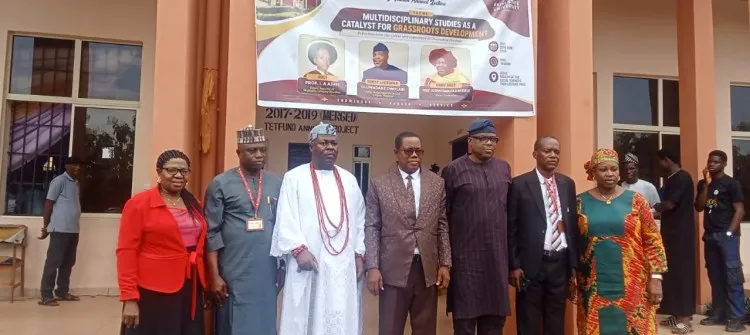
The lecture, held at the Twin Hall of Ekiti State University, attracted traditional rulers, principal officers of the university, deans, heads of departments, academics, students, industry leaders, media practitioners, and other distinguished guests. Participants described the event as a significant step toward strengthening multidisciplinary education and promoting grassroots development through innovation, collaboration, and purposeful leadership.