Renewed Hope @3: How Prof. Audi Abubakar’s NSCDC is Forging Nigeria’s Economic Defence Oladapo Sofowora

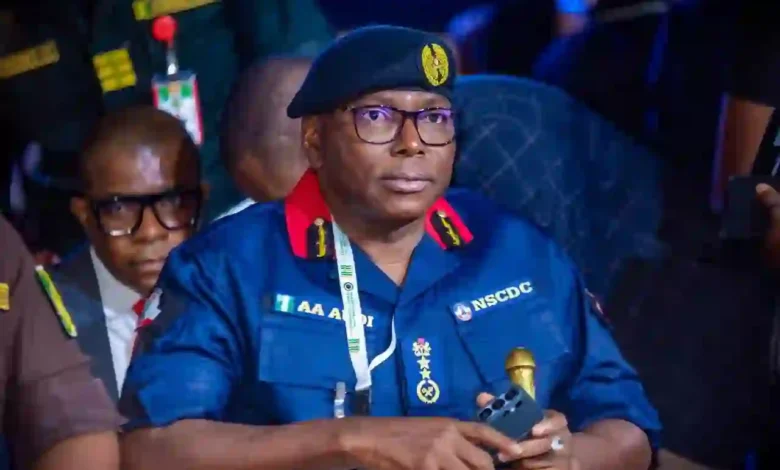
As President Bola Ahmed Tinubu marks three years at the nation’s helm as President of the Federal Republic of Nigeria; the “Renewed Hope” agenda has found one of its most reliable engines in the most unexpected of places, not in the marbled halls of policy think-tanks nor in the headline-grabbing press releases of the Presidency media team, but in the methodical, grinding and increasingly sophisticated operations of the Nigeria Security and Civil Defence Corps (NSCDC), under the quiet but relentless command of Professor Ahmed Abubakar Audi mni OFR. The NSCDC has undergone a transformation so radical, so structural and so deeply embedded in the logic of modern security models that it has effectively redefined what it means to protect a nation in the 21st century with technology driven innovation. Where the average citizen once saw a uniformed auxiliary force guarding public buildings, there now stands a technology-driven, intelligence-led and globally-aligned economic shield working assiduously in protecting critical infrastructure, combating economic saboteurs and also protecting our collective economic resources. Audi has not merely reformed a government security agency; he has built a blueprint for how Nigeria can secure its commonwealth against the vandals, saboteurs and shadow economies that have, for decades, bled the nation dry.
The architecture of this transformation rests on three unshakable pillars: technological revolution, institutional specialization and grassroots intelligence integration. Each has been executed with a focused precision that suggests Audi, an erudite scholar by training and a strategist by instinct. The NSCDC head honcho understood from his first day in office that the old methods of analog patrols and reactive responses were doomed to fail against the sophisticated networks of oil thieves, illegal miners and infrastructure vandals. His answer has been to digitize the Corps from the ground up and the evidence of this shift arrived in dramatic fashion in March 2026, when he unveiled and distributed what stands as the largest consignment of high-tech operational equipment in the Corps’ history. All 36 state command including the FCT, received three aerial surveillance drones, night vision goggles that turn darkness into daylight and the true game-changer: operational backpacks fitted with mini-tablets, solar chargers, GPS trackers and situation room connectivity packs that allow commanders in Abuja to track the real-time movements of every patrol officer in the field . For the first time in history, the vandal who digs up an armoured cable in a remote village at 2 a.m. is no longer anonymous; his location is triangulated, his movements logged and the nearest response unit is alerted before he can cart his haul onto a waiting truck.
This technological leap is not a vanity project. It is a direct response to the brutal arithmetic of economic sabotage that has, for years, undermined the Renewed Hope mandate. When President Tinubu spoke of revitalizing the solid minerals sector as a cornerstone of non-oil revenue, he was speaking into a vacuum of enforcement. Illegal miners operated with impunity across the North-Central and North-Western belts, extracting gold, lithium, lead without licenses, without royalties and without any regard for environmental or labour laws . The revenue from this sector languished at a meager N6 billion annually, a fraction of its true potential. Audi’s answer was the creation of the Mining Marshals, a specialized unit within the NSCDC trained specifically for the unique challenges of securing extractive sites across the country. The results have been nothing short of transformative. In the span of two years, the Marshals dismantled over 1,000 illegal mining sites, chased out the foreign-backed cartels that controlled them and restored order to a sector in chaos. The Marshalls have secured legal convictions and have jailed those found culpable of economic sabotage. The revenue from solid minerals royalties exploded from N6 billion to N38 billion, a sixfold increase that speaks directly to the economic logic of the Renewed Hope agenda under President Tinubu. This is not security for its own sake; it is security as wealth creation, security as fiscal policy, security as the invisible hand that clears the path for legitimate commerce to flourish.
Yet the mining sector is only one theater in a multi-front war. The oil and gas industry, the historic jugular of the Nigerian economy, has long been hemorrhaged by illegal refining and crude theft on an industrial scale. Under Audi, the NSCDC has taken the fight into the creeks alongside with the NAVY and other relevant security agency with a ferocity that has surprised even seasoned observers. The destruction of over 400 illegal refineries has been accompanied by the arrest of 4,677 suspected economic saboteurs and the securing of 638 convictions. The NSCDC has become a nightmare for oil thieves. They have become dreaded because of their intellegence gathering finesse and their sophisticated weapons and technology driven information gathering gadgets. These are not the statistics of a passive agency waiting for crimes to be reported; they are the product of aggressive, intelligence-driven operations that combine the Corps’ own assets with strategic partnerships, including the controversial but effective collaboration with Tantita Security Services in the Niger Delta. Where previous administrations debated the legality of private security involvement, Audi simply focused on the outcome which is to drastically reduced theft, increased crude production and a slow but steady reclamation of the nation’s stolen wealth.
But perhaps the most innovative aspect of Audi’s strategy and the one that will have the longest-lasting impact, is his understanding that no amount of drones or night vision goggles can succeed without the active participation of the Nigerian people. Security, he has argued repeatedly, is not a monopoly of the state; it is a shared responsibility that begins in the village square and the market stall. This philosophy has found concrete expression in the Corps’ grassroots engagement framework, launched first in Lagos State across all 50 divisions and now being replicated in other states. The model is deceptively simple but operationally profound. Galvanizing traditional rulers, market leaders, youth groups, religious bodies and owners of critical infrastructure into a structured intelligence-sharing network. By formalizing channels through which grassroots intelligence flows to the NSCDC, Audi has effectively multiplied the Corps’ eyes and ears by millions, turning ordinary citizens into active intels of the nation’s critical assets.

This community-driven approach has been further strengthened by the institutionalization of specialized units designed to address specific security gaps in the national architecture. The Agro Rangers, for instance, have emerged as a critical force in the battle for food security, one of the most urgent priorities of the Renewed Hope mandate . In Gombe State, the Corps recently commissioned a fully equipped Agro Rangers base at the Kanawa Forest Reserve, complete with residential facilities, solar power, and a motorised borehole, built in collaboration with the state government and the Agro-Climatic Resilience in Semi-Arid Landscapes (ACRESAL) project. This is not a temporary outpost; it is a permanent statement of intent. The Rangers stationed there have a clear mandate which is to effect zero encroachment, zero illegal logging and the mediation of farmer-herder conflicts before they escalate into a full blown communal violence. By embedding security directly into the agricultural value chain, Audi has positioned the NSCDC as a guarantor of the nation’s food supply, protecting not just silos and ranches but the very livelihoods of millions of smallholder farmers.
None of this institutional muscle would be possible, however, without a parallel commitment to the welfare and professionalism of the personnel who wear the uniform. Audi, drawing on his academic background in public administration, understood early that a demoralized force is an ineffective force. He moved aggressively to clear backlogs of unpaid salary arrears and stagnated promotions, addressing grievances that had festered for years and sapped the Corps of its fighting spirit . Simultaneously, he launched a sweeping ethical crackdown, warning that the new equipment and elevated status would be accompanied by zero tolerance for indiscipline, misconduct or the diversion of operational assets for personal gain. The message has been consistent and unmistakable; the NSCDC has transitioning from a volunteer paramilitary organization to a professional security service bound by a clear code of conduct, standard operating procedures and a performance management framework that rewards results and punishes deviance.
The ambition, however, extends far beyond Nigeria’s borders. Audi has positioned the NSCDC as a regional leader in security sector reform and the recent validation of the Corps’ revised Gender Policy II, supported by the UK Commonwealth and Development Office through the SPRiNG Programme, underscores this global orientation. The policy, scheduled for launch in 2026, mainstreams gender-responsive leadership, strengthens disability inclusion, and aligns the Corps with Nigeria’s Third National Action Plan on Women, Peace and Security . The deployment of Female Special Squads to vulnerable schools, which has already thwarted 48 planned kidnap attempts, is a direct operational outcome of this policy orientation. It reflects a sophisticated understanding that security in the modern era is not merely about firepower but about inclusivity, about bringing all segments of society into the protective embrace of the state.
The most recent manifestation of Audi’s digital transformation agenda came in June 2026, just days ago, when the Corps launched a strategic capacity-building programme focused on research methodology and operational excellence. For two days in Abuja, officers from all 36 state commands and the Federal Capital Territory gathered to be trained not in weapons handling or riot control, but in data analysis, strategic communication and evidence-based threat assessment. The message from the Commandant General was unambiguous; the future of security belongs to those who can analyze trends, interpret intelligence and develop research-driven solutions to emerging threats. The induction of Critical Thinking, Research and Innovation desk officers across all commands signals a permanent institutional shift toward a knowledge-driven security culture, one where the officer with a laptop and a hypothesis is as valuable as the officer with a rifle and a patrol vehicle.
As President Tinubu’s administration looks toward the horizon, the transformation of the NSCDC under Professor Audi Abubakar offers a powerful template for how Nigeria can secure its economic future. The Corps has moved from the periphery to the center, from a reactive guard force to a proactive intelligence-led enforcer, from an analog relic to a digital vanguard. It has demonstrated, through verifiable results, that protecting critical infrastructure is not a cost to be managed but an investment to be optimized. Every illegal refinery destroyed, every illegal mining site dismantled, every kilometer of pipeline secured and every agro-ranger base commissioned represents a brick in the wall of Nigeria’s economic sovereignty. The commonwealth of the nation, long treated as a common quarry for thieves and saboteurs, is finally being defended with the seriousness it deserves. Professor Audi has not just restructured a security agency; he has redefined the very meaning of national security, proving that in the struggle for Nigeria’s soul, the battle for its pipelines, its mines, its farms and its cables is the battle to ensure that Renewed Hope becomes a reality. The vandals are on notice. The era of impunity is ending and the NSCDC, under the steady hand of its scholar-commander, stands ready to enforce the peace that Nigeria’s prosperity demands.
From all Indication, Prof Audi’s approach has helped highlight and turned a beam light to the President Bola Ahmed Tinubu’s Renewed Hope mandate inline with the security of lives and property which the NSCDC is not taking the back seat on. The Corp is working round the clock to ensure the presidential mandate is upheld at the highest professional level and also ensuring that the force is leading in its core mandate and also contributing to the economic development of Nigeria on a larger scale.