0
Nigeria’s drive to strengthen subnational diplomacy and position its states as attractive destinations for trade and investment received a major boost at the Trade Commissioners Summit 2.0, where diplomats, state commissioners, development partners and private sector leaders called for deeper collaboration to accelerate regional development.
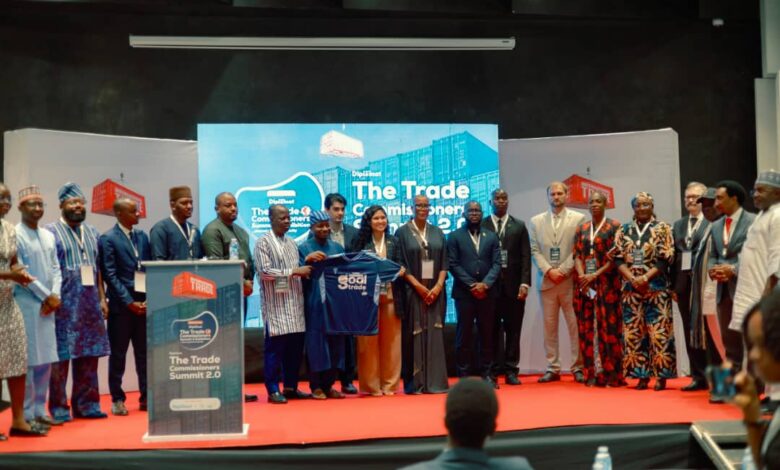
The summit, held at the Afreximbank African Trade Centre in Abuja, according to a press release on Monday was co-hosted by Globalafri Diplomat and Afreximbank, bringing together commercial attachés, commissioners of commerce, captains of industry and international development partners to explore new opportunities for cooperation between Nigeria’s subnational governments and the global community.
During Afreximbank’s presentation on digital trade and cross-border commerce, Al Amin Ishaq and Ugonna Nwankwo highlighted the bank’s African Trade Gateway, describing it as a flagship digital ecosystem designed to connect businesses, facilitate trade financing and improve competitiveness across Africa under the African Continental Free Trade Area (AfCFTA).

Representing the Comptroller-General of Customs, Dr. Bashir Adewale Adeniyi, Deputy Comptroller M.M. Nuhu of the Trade Facilitation Unit commended the organisers for creating a platform that promotes dialogue among key stakeholders.
“At a time when nations are increasingly interconnected through trade and commerce, forums such as this provide valuable opportunities for dialogue, partnership and the exchange of ideas that can drive sustainable economic growth,” he said.
Speaking on “The Role of State Governments and the Opportunities Available for Development of Critical Minerals,” the Director-General of the Nigeria Mining Cadastre Office, Engr. Obadiah S. Nkom, represented by Barr. Yakubu Yahuza Muri, explained that while mineral resources remain under the control of the Federal Government, state governments play indispensable roles in ensuring successful mining development.
He noted that states contribute through security coordination, local economic planning and workforce development, adding that investors increasingly evaluate states—not just countries—before making investment decisions.
“The states that provide ease of doing business, infrastructure readiness, skilled labour, community stability and policy consistency become choice destinations for investors,” he said.
He further emphasised that although states do not administer mineral titles, they are responsible for creating the right environment that transforms mineral resources into jobs, industrialisation, infrastructure and sustainable prosperity.
A fireside discussion featuring Olawale Aro, Managing Partner of BlueGrid Advisory, also underscored the need for stronger collaboration between federal and state institutions in implementing electricity sector reforms, enabling states to maximise the benefits of their newly expanded constitutional powers.
The summit also featured a panel discussion on digital trade and e-commerce involving Akinbulejo Onabolu, Head of Public Sector and Corporate Segments at MTN Nigeria, Dr. Okhae Enahoro, Chief Executive Officer of GIG Mobility, and Afreximbank’s Al Amin Ishaq.
Panelists agreed that while investment in digital infrastructure and cross-border payment systems remains essential, policies must also accommodate Africa’s vast informal sector, which they described as powering a trillion-dollar economy.
Earlier in his welcome address titled “The Urgency of Subnational Diplomacy,” Publisher of Globalafri Diplomat, Sòókò Deji Ajomale-McWord, stressed that Nigeria’s states must become more visible on the global stage to unlock investment, trade and development opportunities.
According to him, recent constitutional and policy reforms have created an enabling environment for states to pursue development more independently while working within Nigeria’s national foreign and trade policy framework.
“There are clear indicators that the current administration is taking bold steps to return Nigeria to the days when the regions were strong,” Ajomale-McWord said.
He cited the National Regional Development Policy (2026–2030) and the establishment of additional regional development commissions covering the North-West, North-Central, South-West and South-East, alongside the already existing Niger Delta and North-East Development Commissions, as evidence of renewed commitment to regional development.
Reflecting on Nigeria’s economic history, he recalled that before the oil boom, the country’s regions thrived on commodities such as cocoa in the old Western Region and the famous groundnut pyramids in Northern Nigeria.
According to him, decades of excessive centralisation following Decree 34 significantly weakened the economic independence of the regions, limiting their ability to drive development.
“Our states are open. Our regions are open for business,” he declared, urging commercial attachés and development partners to expand their engagement beyond Abuja and Lagos.
Ajomale-McWord also reaffirmed Globalafri Diplomat’s commitment to sustaining conversations around subnational diplomacy.
“This is a marathon, not a sprint. We will continue this dialogue in different forms and bolster collaborative efforts aimed at advancing development across Nigerian states,” he said.
Commissioners responsible for commerce and trade from various Nigerian states also showcased investment opportunities within their respective states, pitching directly to diplomats, commercial attachés and development partners in attendance.
The event concluded with the unveiling of “Goal for Trade,” a sports diplomacy initiative that will use football as a platform for networking and strengthening relationships among stakeholders across Africa’s international trade ecosystem.