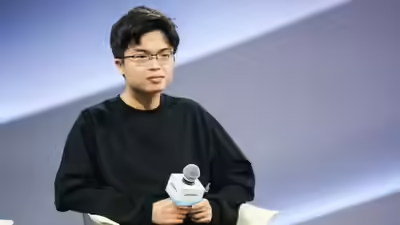
MOSCOW – Vadim Moshkovich switched paths multiple times during the Post-Soviet era of wild capitalism, from distributing vodka to flipping apartments. He ultimately made his big bet on commodities, founding Ros Agro, the Russian agricultural firm behind his fortune.
Decades in the making, it all came crashing down in May when a Moscow court ordered the seizure of his family’s 49 per cent stake in the company. His crime, prosecutors say, was violating a ban on combining public service with business activities while he served in the upper chamber of Russia’s Parliament between 2006 and 2014, and abusing his political position for illegal enrichment.
The country’s billionaires are under increasing state pressure, with charges ranging from corruption to accusations of giving non-military support to the enemy and even dual citizenship. Asset seizures are breaking up business empires and redistributing wealth, often transferring it to more loyal business groups.
The recent Moshkovich allegations will not be lost on other members of the elite: five of the top 20 richest Russians in the Bloomberg Billionaires Index have either worked in the ruling system or still do.


In 2025, Russia seized 1.1 trillion rubles (S$19 billion) of assets in anti-corruption cases, according to Moscow-based law firm Nektorov, Saveliev & Partners.
That is about eight times higher than in 2024 and represents about a third of the total asset confiscations carried out by the state in 2025. In many cases, the businessmen targeted had held elected positions as members of federal or regional parliaments and, according to prosecutors’ claims, used their posts to help their companies profit from their roles.
“Anti-corruption lawsuits are becoming not merely a tool for combating corruption, but a driving force behind the redistribution of assets in favour of the state,” said Ilia Shumanov, managing partner at TriTrace Investigations, a corporate intelligence firm which tracks Russia’s nationalisation efforts.
Moshkovich’s agricultural assets were given to the management of an affiliate of state-owned Russian Agriculture Bank, also known as Rosselkhozbank, just days after the court’s decision to seize them, according to the update in the companies register.
Asset seizures where corruption has been cited as a specific charge have intensified since a 2024 Russian Constitutional Court decision. At the time, it ruled that the statute of limitations, which imposed a 10-year cap for the prosecution of alleged crimes, would not apply to the property of officials designated as corrupt.
It is a worrying development for some of Russia’s wealthiest citizens who have taken political positions. President Vladimir Putin’s government system often used loyal businesspeople as conduits of influence in the regions. In return, the tycoons often got to lobby their business interests.
Roman Abramovich, once the country’s richest man, served as governor of the Far Eastern Chukotka region for seven years. Andrey Guryev, whose family controls fertiliser-maker PhosAgro PJSC, was a member of Federation Council, Parliament’s upper chamber, where Suleiman Kerimov, whose family once controlled Russia’s biggest gold miner Polyus PJSC, still holds a seat.
None of these men have been investigated or accused of wrongdoing. So far, most of the tycoons whose assets have been nationalised had weaker connections to the Kremlin than some of the country’s top businessmen.
While Moshkovich was not considered especially close to the top powers, he did attend multiple meetings with Putin, including a gathering between the Kremlin leader and billionaires on Feb 24, 2022, hours after he started the full scale invasion of Ukraine. Most of those present at the meeting, including the Ros Agro founder, were later sanctioned.
The tycoon had at times been openly critical of Russia’s policy in his sector and had experienced some issues with authorities even before 2022. He was arrested in March 2025 in connection with a separate case involving allegations of fraud, and has been in custody since. The corruption case was brought against him in 2026 and he rejected the accusations.
Some of his connections asked Putin during meetings to intervene, but the Russian leader declined to get involved, a person familiar with the situation said, asking not to be identified because the information is not public. A lawyer for the businessman did not respond to phone calls and messages seeking comment, while Kremlin spokesman Dmitry Peskov did not immediately respond to a request for comment.
Konstantin Strukov was another who had to surrender an empire stretching from gold mining to agriculture after anti-corruption claims in 2025. It was a surprise to some of his peers as the 67-year-old businessman was seen as aligned with the authorities throughout his career.
Strukov is a member of the ruling United Russia party and for more than two decades served in the parliament of Chelyabinsk region, where his now former main asset, gold miner Yuzhuralzoloto PJSC, operates. In 2021, Putin awarded Strukov the second-class Medal of the Order “For Merit to the Fatherland”, a significant state honour typically given to senior officials and business leaders for contributions to Russia’s economy.
“The Kremlin relies on the continued loyalty of insiders and key stakeholders, gluing the system together through a combination of carrots and sticks,” said Maria Snegovaya, senior fellow for Russia and Eurasia at the Washington-based Center for Strategic and International Studies.
The fact that former, even loyal, officials can face repercussions years after leaving office serves as a reminder that membership of the elite is conditional in Russia, she said.
To be sure, Russia has long grappled with corruption. In 2025, the country ranked 157th out of 182 countries on Transparency International’s Corruption Perceptions Index and it has been in the bottom third of the rankings every year for the past decade.
And Russian businesses’ fears of asset seizures have increased since the Ukraine invasion. Billionaires have, for example, intensified lobbying efforts to convince the Kremlin to finally set a deadline for cases revisiting the privatisations of the 1990s and early 2000s.
They formally scored a victory in May when the State Duma passed a Bill setting a 10-year statute of limitations for the review of privatisation cases. However, the time cap still will not apply to anti-corruption lawsuits against current and former officials. That still leaves some of Russia’s richest tycoons exposed.
Some are volunteering cash.
Kerimov, a Russian senator for nearly 18 years, offered to donate 100 billion rubles to the budget during a closed-door meeting between Putin and Russian business leaders in March, according to people familiar with the matter. His office did not respond to requests for comment.
Russia, grappling with the expense of the ongoing war, has struggled to sell many of the assets seized from its tycoons, with auctions repeatedly failing or relaunched as Dutch sales, in which the price is gradually lowered until a buyer emerges.
In May, the state twice failed to sell about a 67 per cent stake in Yuzhuralzoloto and affiliated companies formerly owned by Strukov, with even a Dutch auction not attracting meaningful bidding.
The third attempt is due to take place in June, with the state saying it will proceed even if there is only a single bidder. Even Moscow’s Domodedovo airport was eventually sold at roughly half the initial asking price earlier in 2026 after an earlier auction had also failed to attract buyers.
Other wealthy Russians will now be wondering with trepidation if their assets may be next to come on the market. BLOOMBERG