It won’t take long to understand what lies ahead for Iraq—and for the Iran‑aligned militias—after President Donald Trump appointed Tom Barrack as his Special Presidential Envoy for Syria and Iraq. All one needs is the paragraph Barrack published just hours after the announcement. He wrote that “the balance of power around which the United States operates works best when allies become more self‑reliant and share the burden—always within a framework that preserves American influence, stability, and alignment with core U.S. strategic objectives.”
That single sentence makes something unmistakably clear: Washington no longer views Iraq as a political file requiring relationship management, but as a security file requiring decision management.
The irony is that the focus on Barrack’s name obscures the real shift. The issue is not the replacement of one envoy with another, nor the illusion—long cultivated by Iraq’s militias—that U.S. policy changes every time Washington rotates a mid‑level official. That illusion fed a false sense of victory for years, as if Iraq’s fate hinged on the temperament of a bureaucrat. But Barrack is not that type. He is not a practitioner of soft diplomacy. He calls things by their real names. He insults publicly. He speaks without silk gloves.
American media have repeatedly described him as the “man for the dirty jobs” in U.S. foreign policy—one of the few capable of convincing Trump to take on complicated files personally.
Before his appointment, Politico and Axios reported that Barrack had been pushing for a “merged‑file approach” to the region: treating Iraq, Syria, and Lebanon as a single interconnected arena rather than three separate problems. Today, it seems we have moved from “quiet execution” to “execution with audible slaps.” Barrack is not a diplomat who smiles for the camera. He is the man who once described Iraq as a “failed political experiment,” Lebanon as a “farce,” and journalists in terms unfit for print. Imagine that language becoming part of U.S. policy toward the Green Zone and the militias surrounding it.
But the fixation on Barrack’s personality hides something deeper: Washington no longer sees Iraq as a political partner. It sees a malfunctioning security file. And once Iraq becomes a security file, the language shifts from negotiation to surgery—excision, not maneuvering; control, not accommodation.
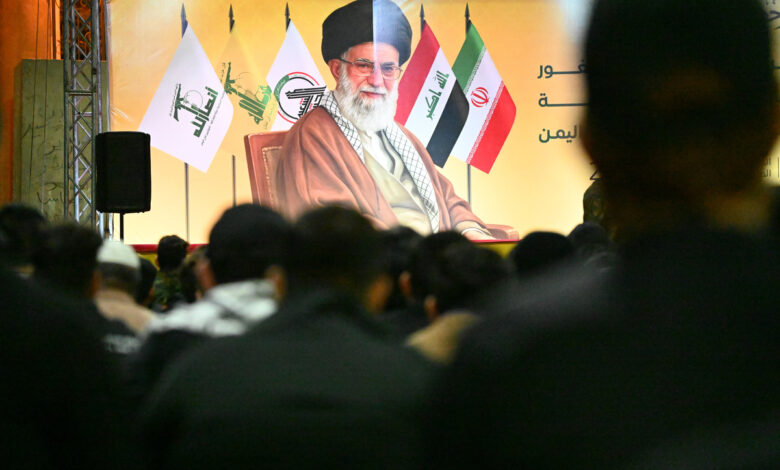
This explains the panic among Iran‑aligned factions the moment Barrack’s name surfaced. He embodies a shift that is too blunt to be misread and too sharp to hide behind slogans of sovereignty.
For Iran’s parties and militias, the picture is even clearer: they are the inevitable losers. The U.S. decision to curb their dominance is not a personal whim; it is an institutional choice. Barrack is merely the executor—armed with a dose of diplomatic cruelty he is well known for.
Militias accustomed to whispered diplomacy will now face diplomacy that shouts, delivered by a man who writes messages in bold and reads them aloud.
READ: US envoy welcomes Iraqi move to place weapons under state control
Washington now treats Iraq as part of a regional network, not a standalone case that can be indulged or excused. In the eyes of the current administration, Iraq is one link in a chain stretching from Tehran to Baghdad to Beirut. The tighter the interconnection, the more likely the three files will be handled with one mind, one hand, and one envoy who neither flatters nor smiles.
This is why Barrack’s arrival is not a personnel change—it is the declaration of a new phase in which decisions are measured by their ability to break stagnation, not by their ability to appease local actors.
In an interview with The National in Abu Dhabi, Barrack abandoned even the minimal diplomatic varnish. He said the United States had “divided Iraq and Syria,” and that the Iraq invasion became “a glaring example of what should never be repeated.” He was not trying to beautify the past. He was diagnosing it: three trillion dollars spent, twenty years of fractured history, hundreds of thousands of lives lost, and, in his words, “we walked away empty‑handed.”
This is not self‑criticism. It is a policy statement: no more spending without results, no more patience for dual power between state and militia.
Iraq is entering a phase with no courtesies. Washington no longer sees Baghdad as a relationship‑management file but as a decision‑management file. The duality of power is no longer tolerable, and American patience with “state thieves” is wearing thin. The coming language will not be diplomatic—it will be direct, exposing, and perhaps wounding.
If Iraqi media celebrated the removal of Mark Savia, they may need to brace themselves. The man replacing him does not speak the language of traditional diplomacy. He speaks the language of shock.
So the question now is: who can afford to sleep in Iraq’s current landscape?
Certainly not the militias. The era of “grey understandings” is over. The era of “sharp decisions” has begun.
What awaits Iraq under Barrack is not a change of faces, but a change of rules.
OPINION: Why does Muqtada al‑Sadr expect us to believe him?
The views expressed in this article belong to the author and do not necessarily reflect the editorial policy of Middle East Monitor.