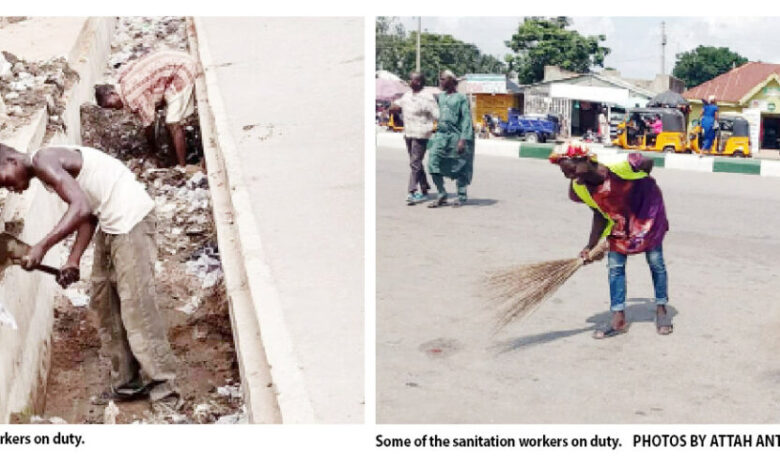
Long before most residents of Jalingo begin their day, hundreds of sanitation workers are already on the streets, sweeping roads, clearing refuse and helping to keep Taraba State’s capital clean. Their efforts form the backbone of the state’s environmental sanitation drive, yet behind the cleaner streets lies a story of sacrifice, hardship and growing concerns about workers’ welfare. In this report, ATTAH ANTHONY reveals that the labourers fear worsening hardship amid controversy over a salary review, with pay proposed to be cut from N20,000 to N10,000, even as officials deny any pay cut.
Every morning, long before the first rays of sunlight touch the streets of Jalingo, the Taraba State capital, hundreds of women quietly leave their homes carrying brooms, rakes and waste bags for their daily bread, the “urgent 2k,” as some jokingly call it. While most residents are still asleep, they are already at work.

Some begin as early as 5:00 am, sweeping roads, clearing refuse, and collecting scattered waste across major streets, while others operate in shifts from 8:00 am to 10:00 am, 10:00 am to 12 noon, 12 noon to 3:00 pm, and 3:00 pm to 6:00 pm. Their mission is simple: to keep Taraba clean, especially the state capital.
Day after day, the work takes a heavy toll on their bodies. Many street sweepers complain of persistent back, neck and muscle pain from hours of bending, sweeping and lifting refuse in difficult conditions, all for a wage that barely covers a few days’ family expenses. Yet, they continue with surprising resilience and even a sense of duty, showing up each morning despite the strain.
Beyond the physical exhaustion, some suffer health complications such as hypertension, worsened by stress and harsh working conditions. Others have become silent casualties of the job, with reports of hit-and-run incidents involving speeding motorists. At the same time, they work along busy roads, underscoring the constant risks they face in the line of duty.
Yet behind the cleaner streets and renewed environmental campaign lies a story of sacrifice, hardship and growing concern over the welfare of the workers who make it all possible, preventing the city from being littered with refuse.
The story of the Taraba State Environmental Sanitation Agency (TSESA) began with the state’s determination to tackle mounting environmental challenges. For years, successive administrations grappled with indiscriminate refuse disposal, blocked drainage systems, seasonal flooding, and poor sanitation practices in both urban and rural communities.
To address these concerns, the Taraba State Government under Governor Agbu Kefas proposed the Environmental Sanitation Agency Establishment Bill. During a public hearing organised by the House Committee on Environment, stakeholders argued that a dedicated agency would provide a stronger legal framework for sanitation management.
The Commissioner for Environment and Climate Change, Aisha Barde, explained that the proposed law would create synergy among environmental institutions while eliminating conflicts of responsibility between existing departments and the new agency.
She maintained that environmental sanitation was central to public health and sustainable development, hence the need for a law to back the agency’s operations.
In December 2025, the Taraba State House of Assembly passed the Taraba State Environmental Sanitation Agency (Establishment) Bill, 2025, after extensive deliberations. The legislation was widely celebrated as a major step toward improving waste management, environmental hygiene and public health.
Upon receiving executive assent, the agency officially came into existence under the supervision of the Ministry of Environment and Climate Change.
Fast forward to the present, and the agency was tasked with coordinating environmental sanitation activities across the state’s 16 local government areas under the flagship programme, Operation Keep Taraba Clean.
Its responsibilities include clearing blocked drainages and waterways, evacuating refuse dumps, preventing floods, enforcing sanitation regulations and promoting environmental awareness.
To execute these duties, the agency established a structure comprising local government coordinators, supervisors, monitoring teams, and sanitation workers spread across the state.
At the helm is Hon. Illiya Kefas, who previously coordinated the ‘Operation Keep Taraba Clean’ initiative before becoming chairman of the agency.
It is important to note that ‘Operation Keep Taraba Clean’ was originally an initiative by former Governor Darius Dickson Ishaku. During that period, workers were volunteers, working without stipends or transport allowances.
Despite the lack of government support, Mr Illiya Kefas, now the agency’s chairman, remained committed, mobilising family and relatives to keep the city clean—an effort driven by passion and sacrifice.
The goal was ambitious: to build cleaner cities, healthier communities and a more environmentally responsible state.
For many residents, the impact was immediately visible as roads became cleaner, drainage was regularly desilted, and refuse heaps disappeared from several public spaces.