Congressional ‘BRRRRT Act’ seeks to keep the A-10 flying, but veteran pilot warns of capability gap

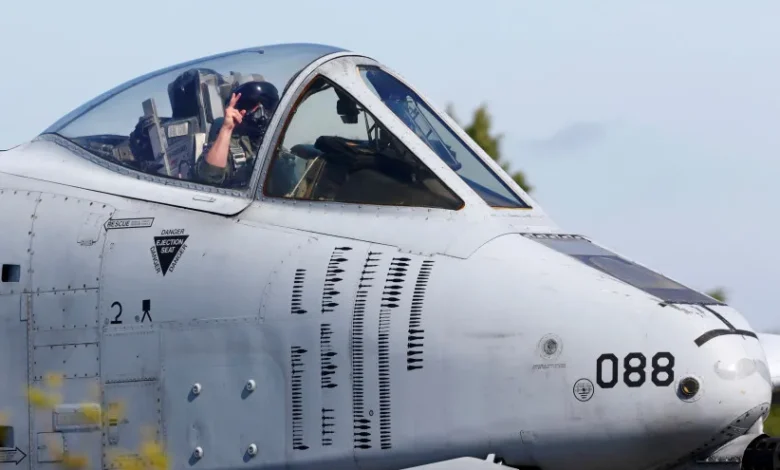
A bipartisan group of lawmakers is seeking to keep the US Air Force’s A-10 Thunderbolt II flying through 2033. This is important because the iconic close air support platform does not have a unique replacement for some of the missions it performs.
A-10s played a role in supporting the rescue of the crew of an American F-15 that was downed over Iran in April. It has played a role in many major conflicts in the Middle East as an essential element of US Central Command’s arsenal.
US Congressman Abe Hamadeh introduced the Bolstering Recognition, Resurgence, Retention, and Remembrance of the Thunderbolt Act, known as the BRRRRT Act, on July 20. The bill is co-led by Representative Don Davis and has several cosponsors. Its name is a reference to the distinctive sound of the A-10’s cannon.
The legislation comes amid a long-running debate over the future of the A-10 and whether newer aircraft can adequately replace its close air support and combat search and rescue capabilities.


Lt. Col. Joel Bier, a retired US Air Force Weapons School instructor pilot with more than 2,500 hours in the A-10, argues that keeping at least 126 of the aircraft flying is important. The Air Force must also preserve the training, maintenance, and institutional knowledge that enable the A-10 community to perform its missions.
Bier was qualified as a Forward Air Controller (Airborne) and as a Rescue Mission Commander (Sandy 1) Instructor Pilot until his recent retirement, and he commanded at the squadron level. He now works as a contract pilot, independent consultant, and freelance author.
Bier served 21 years in the Air Force and began flying the A-10 in 2007 after graduating from the US Air Force Academy and completing his pilot training. He said efforts to reduce or retire the A-10 fleet repeatedly surfaced during his career.
A-10’s claim to fame in Operation Epic Fury rescue mission
The importance of the A-10 gained renewed attention after an American F-15 was lost during Operation Epic Fury. A-10 pilots took part in the effort surrounding the recovery of the aircrew. “When DUDE44 went down, there were A-10 pilots there at the beginning when they picked up the pilot and then A-10s led the second mission,” he said.
“The A-10 is a unique combination of man and machine,” he said. A-10 squadrons specialize in close air support and combat search and rescue, meaning their pilots develop deep expertise in missions that may receive less emphasis in other fighter communities.
After originally moving to fully retire the A-10 in 2026, the Air Force announced in April that it plans to keep A-10s flying through 2030. Current plans envision an active-duty squadron at Moody Air Force Base in Georgia and a reserve squadron at Whiteman Air Force Base in Missouri. The BRRRRT Act would go further by requiring the Air Force to maintain the aircraft through 2033.
However, Bier argues that simply extending the retirement date does not solve the problem. He compared maintaining aircraft without the infrastructure behind them to keeping something alive without its vital organs. Training new pilots, maintaining depot-level support, producing spare parts, and preserving the Air Force Weapons School pipeline are all necessary if the remaining aircraft, around 100 of them, are expected to remain operational in numbers that matter and can contribute to overseas operations.
The A-10 depot at Hill Air Force Base, for instance, was shut down in January, Bier said. The Weapons School has also been affected as the Air Force moves toward retirement of the fleet. In April, the pilot training unit in Arizona graduated its last class, just weeks before the Air Force announced A-10s would fly through 2030. The BRRRRT Act seeks to preserve or restore some of this institutional backbone.
The numbers also matter. Previous legislation established a minimum inventory of 103 A-10s. Bier said supporters are now seeking 126 aircraft, enough to sustain operational squadrons while providing aircraft for testing, training and the Weapons School.
Without such numbers, the remaining force could face a punishing deployment schedule. Bier said Air Force plans could otherwise leave roughly 54 aircraft, insufficient to reasonably maintain deployments and training.
This debate is not new. The A-10 was developed after the Vietnam War as a dedicated close air support aircraft, designed around its powerful cannon and intended to operate close to ground forces. Its relatively low speed, maneuverability, survivability, and ability to operate from austere locations were designed for a potential confrontation with Soviet armored legions in Europe.
The US Air Force has considered retiring or replacing the aircraft for decades, as early as 1984 when A-10 production ended. Even after its excellent performance during the 1991 Gulf War showed it was still relevant, the Air Force increasingly favored multirole fighters that could conduct air superiority missions while also carrying out other tasks.
The A-10 nevertheless remained heavily involved in the post-September 11 wars. Bier deployed to Afghanistan in 2009, where he flew close air support missions from Kandahar.
He recalled one mission in which he scrambled after a helicopter was downed during fighting involving a US Army convoy. Without a Joint Terminal Attack Controller on the ground immediately available to direct fire, Bier worked directly with the convoy commander while coordinating with Apache helicopters. The A-10s remained overhead until a quick reaction force arrived.
Experiences such as these underpin the argument for retaining specialized close air support aircraft.
What could replace the A-10 if the US military stops flying it?
The larger question is what eventually replaces the A-10. The Air Force is investing heavily in advanced aircraft such as the F-35 and future F-47. However, Bier argues that an F-35 or another sophisticated fighter cannot simply become equally proficient at every mission the A-10s do without dedicated training.
There is also a cost calculation. Using an expensive new fighter for missions that can be performed by an existing A-10 may not always make sense. Bier compared buying high-end fighters for close air support to “using a Ferrari to mow your lawn.”
The BRRRRT Act therefore represents more than an attempt to preserve a historic and well-known aircraft that has performed well for fifty years. It raises a broader question about how the US military manages the transition from proven systems to future capabilities.
The A-10 will eventually leave service. The question is whether the close air support and rescue expertise built around it is maintained in a new platform and, if not, how these key roles will be performed by F-15s or F-35s.
Bier argues that the Air Force should maintain the aircraft and the ecosystem behind it until a replacement can actually perform those missions. The bill’s proposed 2033 deadline, he said, provides more time for industry to sustain production and maintenance while the military determines what comes next.


