The federal government has launched a nationwide learning assessment aimed at tackling declining literacy and numeracy levels across basic and secondary education in Nigeria.
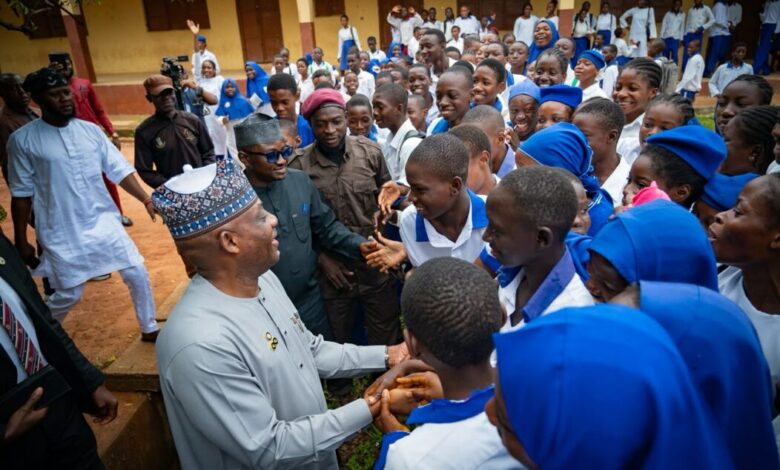
The Minister of Education, Dr Tunji Alausa, as part of the monitoring exercise, undertook a working visit to selected schools in Kuje, Federal Capital Territory (FCT), on Friday.
Schools visited included Government Secondary School, Kuje, Junior Secondary School, Kuje Central and Topaz Model Primary School, Kango Road, Kuje.
During the tour, the minister said the exercise was part of a renewed effort to evaluate what pupils are actually learning across different levels of the education system.
He said the assessment targets Primary 2, Primary 3 and 5 pupils, as well as Junior Secondary School 2 and 3 students, alongside selected Senior Secondary School subjects such as English, Mathematics and Basic Science.
According to him, the initiative is designed to generate reliable national data on learning outcomes.
“We are conducting a national learning assessment to understand how our students are performing in core subjects across primary, junior secondary and senior secondary levels.
“We have not had a comprehensive national learning assessment in a while. The last one was in 2023 conducted by UBEC, and before that in 2018 by the Federal Ministry of Education.”
He noted that the plan is to institutionalise the assessment every three years to ensure consistent data for policy decisions.
“Going forward, this assessment will be done every three years so that we can track progress and respond appropriately,” he added.
The minister expressed concern over the widespread learning poverty, stressing that many children are unable to meet expected literacy and numeracy benchmarks.
He linked the initiative to the broader education reform agenda of President Bola Ahmed Tinubu. “Education is central to the President’s vision of building a one trillion dollar economy. We must ensure that what is being taught translates into actual learning outcomes,” he said.
On the field visit, Dr Alausa said he observed the learning assessment being conducted in both public and private schools, noting variations in infrastructure and classroom conditions.
“I have visited a primary school, a government secondary school and a private school today. The students are generally engaged and the environment is improving in many places.
“In some public schools, the facilities are well renovated and the learning environment is conducive. In private schools, while some classrooms are overcrowded, they are helping to keep many children in school.”
He added that private schools remain an important part of the education ecosystem and should be supported through regulation rather than exclusion.
Also speaking, the Mandate Secretary of the FCT Education Secretariat, Dr Danlami Hayyo, commended the initiative as a major step towards education reform in the country.
He noted that the FCT Administration, under Nyesom Wike, has invested heavily in upgrading school infrastructure across the territory.
“We have renovated over 120 education facilities, including classrooms, toilets and other critical infrastructure. This assessment aligns with the President’s vision and will help us place our students at the right academic level nationally.”
Dr Hayyo added that the FCT is fully committed to supporting the federal government’s education transformation agenda.