0
Communities across the Ika axis of Delta State are facing an escalating environmental crisis as persistent flooding and advancing gully erosion continue to destroy homes, displace families and threaten livelihoods.
Residents of Agbor, Owanta, Owa-Alero and neighbouring communities say what used to be occasional flooding has evolved into a yearly disaster that now leaves many homeless, damages businesses and places critical infrastructure at risk.
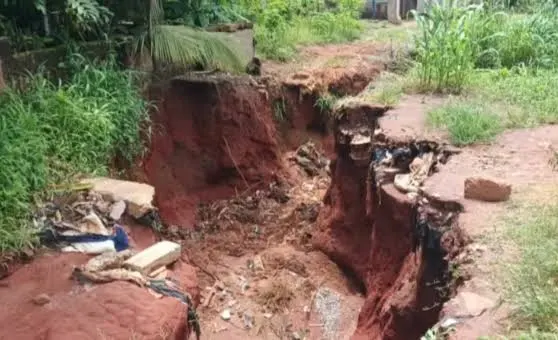
Among the worst-hit locations is Yahweh Street, behind the Ayo Ben area in Agbor, Ika South Local Government Area, where residents say worsening erosion has forced several households to abandon their homes over safety concerns.

The affected residents have appealed to the Delta State Government, the Ika South Local Government Council and the Dein of Agbor Kingdom, His Royal Majesty Dr. Benjamin Ikenchuku, Keagborekuzi I, to urgently intervene before the situation deteriorates further.
Community members explained that although Yahweh Street has traditionally experienced seasonal flooding because of its low-lying terrain, the problem intensified after the construction of Ayo Ben Street, the major road linking the neighbourhood with adjoining communities.
According to them, the road project disrupted the area’s natural drainage pattern, redirecting stormwater into Yahweh Street and accelerating severe erosion that has produced expanding gullies and dangerous sinkholes.
Residents said the erosion has already consumed sections of the road and is steadily encroaching on residential buildings, fences and other public infrastructure.
As gathered by DAILY INDEPENDENT, several homeowners said cracks have appeared in their buildings, compelling many families to relocate while numerous tenants have vacated the neighbourhood over fears of possible structural collapse.
The growing gullies have also become a serious safety hazard for motorists and pedestrians, especially during heavy rainfall when they are often concealed by floodwater.
A community leader lamented that residents now live with constant anxiety during the rainy season.
“Whenever the clouds gather, everyone becomes worried. We no longer sleep with peace of mind because the erosion keeps advancing toward our homes. Some families have already moved out because they fear their buildings could collapse. We are appealing to the government to intervene before lives are lost,” he said.
The environmental challenge extends beyond Agbor. In Owanta, floodwaters have displaced several families after inundating residential buildings and destroying household property, food items and personal belongings.
One of the victims, Mrs. Isioma Akpenyi, said her family had no option but to vacate their home after it became submerged.
“The flood destroyed almost everything we own. Remaining in the house became impossible. We are pleading with the government to provide proper drainage infrastructure so this does not continue happening every rainy season,” she said.
Residents of nearby Owa-Alero attributed the recurring floods to uncontrolled physical development and the blockage of natural waterways by buildings and other structures.
A resident, who simply identified himself as Johnson, said heavy rainfall has become a nightmare because water can no longer flow through its natural channels.
He added that several farmlands were also washed away during the recent downpour, raising fresh concerns over farmers’ incomes and food production within the area. Commercial activities have equally suffered.
Along the busy Lagos-Asaba Expressway in Agbor, traders reported substantial losses after floodwaters entered their shops and damaged goods valued at millions of naira.
The traders urged government authorities to immediately clear blocked drainage channels and enforce environmental sanitation regulations to discourage indiscriminate dumping of refuse, which they said has compounded the flooding problem.
Residents also pointed to the contrast between the Ika communities and Asaba, where recent rainfall reportedly resulted mainly in temporary flash floods, a situation many attributed to improved drainage facilities and stricter environmental management.
Responding to growing public concern, the Delta State Government reiterated its commitment to addressing erosion and flooding across vulnerable communities.
The Commissioner for Environment, Mr. Ejiro Jamani, said the state had fulfilled key requirements for intervention by paying its ₦1 billion counterpart funding and was collaborating with the Federal Ministry of Environment, the Nigeria Erosion and Watershed Management Project (NEWMAP) and the European Investment Bank to secure long-term erosion control projects.
Despite the government’s assurances, residents of Yahweh Street, Owanta, Owa-Alero and other affected communities insist that immediate action is needed as the rainy season gathers momentum.
They warned that unless urgent erosion control measures and effective drainage infrastructure are put in place, more homes, businesses, roads and farmlands could be lost, while the humanitarian impact on vulnerable families is expected to worsen.