BERLIN – Germany’s interior minister announced a security overhaul on July 27 after a deadly vehicle attack near Berlin’s Pride celebration prompted an angry debate on why the suspected driver had not been in prison at the time.
The suspect, who was shot dead by police on July 26, was identified as 21-year-old German citizen Abdul Ballout, who had been convicted and sentenced to jail time in May for preparing a serious act of violence endangering the state.
Ballout was out and free at the time of the attack on July 25, prosecutors said, as he had been convicted under juvenile law for the earlier offence, despite his age, and had been released under the supervision of a probation officer for six months.
Applying juvenile criminal law to adult security threats was “unacceptable,” Interior Minister Alexander Dobrindt told Bild newspaper.


Dobrindt said he would change that and bring in measures to let authorities fit dangerous people with ankle bracelets. New powers to make preventative detentions would also “take dangerous individuals off the streets,” he added.
The vehicle ploughed into crowds in Tiergarten park near the Brandenburg Gate on July 25, killing a Polish woman in her 60s.
Ballout, a German citizen with Lebanese roots born and raised in Berlin, was shot dead a day later when he ran at officers with a bladed weapon, police said.
Merz under pressure as security threat shifts
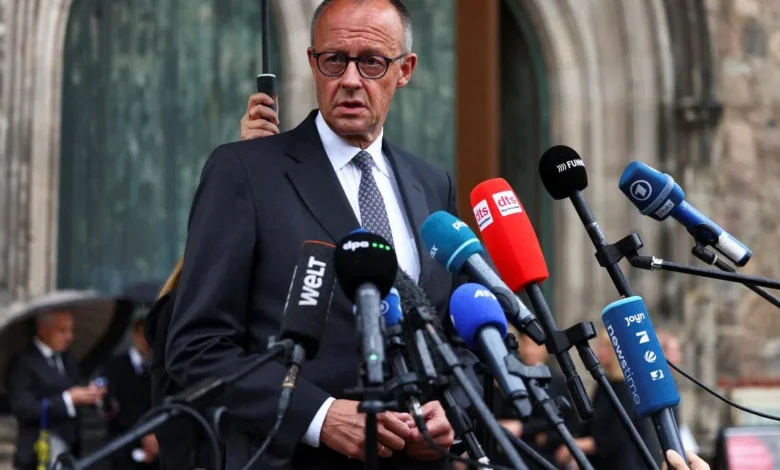
Chancellor Friedrich Merz, whose coalition government is going through a bruising Cabinet reshuffle, is under pressure to take political action as debate grows over tougher security laws.
He earlier said he had asked the interior minister to examine whether to shift jurisdiction over police surveillance of convicted criminals from regional states.
“We must do everything we can to restrict the freedom of movement of such potential offenders as much as possible,” Merz said in Berlin.
He called for stripping citizenship from dual nationals deemed security threats, though he said this would not apply to those holding only German nationality, as in Ballout’s case.
Security services should also have greater powers to keep track of individuals, he said.
“What I simply cannot understand is this: I can locate my mobile phone anywhere in the world, and I can use it myself to find out where, for example, my iPad is,” he said.
“Yet we are told that Germany’s security authorities are either unable, or technically incapable, of determining at any given moment where individuals classified as dangerous threats are located.”
Germany’s domestic intelligence service said in its 2025 annual report that the country faces a growing Islamist threat, with 28,645 individuals identified as Islamist and 9,110 of them thought to be potentially violent.
The agency said the significance of jihadist ideology was declining, while fascination with brutal violence was increasing.
The agency also warned that anti-LGBTQ hostility was increasingly finding a home in both Islamist and far-right ideologies – a convergence it said it was watching closely. REUTERS


