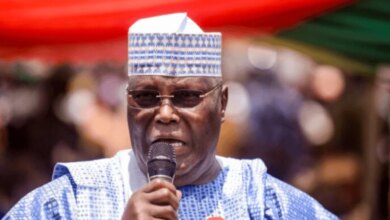
Former Vice President and presidential candidate of the African Democratic Congress (ADC), Atiku Abubakar, has criticised the United States Federal Bureau of Investigation (FBI) over its latest attempt to keep parts of its records concerning President Bola Ahmed Tinubu from public disclosure.
Atiku said the FBI’s argument that releasing some of the records could endanger lives should not be used as a blanket reason to keep information that can legally be made public away from Nigerians.
He spoke after the FBI asked a United States federal court for permission to privately explain why it is withholding some records connected to an investigation involving Tinubu in the 1990s.
The FBI made the application on August 20 before the United States District Court for the District of Columbia.


The agency wants to submit an ex parte, in camera declaration to the judge. Such a declaration allows the FBI to explain sensitive matters privately to the court without putting the information on the public record.
The request is part of a long-running Freedom of Information Act (FOIA) case over records relating to investigations involving Tinubu.
The FBI said it had relied on several FOIA exemptions in withholding portions of the requested material.
It specifically cited exemptions covering personal privacy, confidential sources, law enforcement methods and information that could reasonably be expected to endanger the life or physical safety of an individual.
The agency said it could not publicly provide the full justification for some of the exemptions.
It therefore asked the court to allow it to present the explanation under seal.
Reacting in a statement issued on Saturday in Abuja by his Senior Special Assistant on Public Communication, Phrank Shaibu, Atiku questioned the FBI’s reference to possible danger to lives.
“The FBI says disclosure could endanger lives. Which lives? Nigerians are already dying,” Atiku said.
He linked the argument to the economic difficulties Nigerians have faced since the removal of the petrol subsidy by the Tinubu administration.
According to him, the impact of the policy has gone beyond the price of petrol. He said higher transportation costs have affected food prices, production and household income.
“Fuel affects transportation. Transportation affects food prices. Energy affects production. Transportation affects jobs. All of them determine whether an ordinary Nigerian family can survive until the end of the month,” he said.
Atiku said his position was not that the FBI should expose sensitive information that could compromise its operations.
Rather, he argued that information protected by American law should be properly redacted while records that can legally be released should be made available.
“Protect your agents. Protect your sources. Protect legitimate investigative methods. Redact whatever American law genuinely requires you to redact. But do not stretch those protections until they become a bulletproof vest for Tinubu,” he said.
The ADC candidate also rejected the suggestion that his demand amounted to an attempt to involve the United States in Nigeria’s domestic politics.
He said Nigerians have a legitimate interest in information concerning the background of the person occupying the country’s highest political office.
“Our demand of American law enforcement is not a call to interfere in Nigeria’s politics. It is a humanitarian and democratic appeal rooted in the principle that people have a right to information legitimately available about those who exercise enormous power over their lives,” he said.

Politics Nigeria earlier reported on Friday that a US federal judge ordered the Department of Justice to move ahead with the release of records sought under the FOIA process.
US District Judge Beryl Howell had previously rejected the broad use of so-called “Glomar” responses by the FBI and Drug Enforcement Administration.
The position had allowed the agencies to refuse to confirm or deny whether certain records existed.
In April 2025, Howell directed the agencies to search for and process records that were not exempt from disclosure.
The dispute was brought by Aaron Greenspan, a US transparency activist who filed FOIA requests for records concerning investigations involving Tinubu and other individuals.
The requests include material relating to a Chicago investigation dating back to the early 1990s.
The case has remained politically sensitive in Nigeria because of previous US court proceedings involving about $460,000 that was forfeited to the US government in 1993 from accounts associated with Tinubu.
Tinubu has consistently denied wrongdoing and has rejected allegations that he was involved in drug trafficking.
The civil forfeiture proceeding has also featured in previous legal challenges involving Tinubu’s eligibility and the 2023 presidential election.
Nigerian courts ultimately rejected arguments based on the US forfeiture case, noting, among other things, that it was a civil proceeding and did not amount to a criminal conviction.
The renewed FOIA battle, however, has kept the issue alive.
In recent weeks, Atiku has intensified his campaign for the release of the US records. His Washington-based government affairs and strategic advisory firm has also been involved in efforts to draw attention to the documents and the ongoing court proceedings.
A US court had recently granted the Justice Department only a limited extension after prosecutors sought additional time to comply with an order concerning the records.
The court set August 21 as the new deadline for compliance.
The filing does not mean that all the records sought will remain permanently secret. It is instead a request for the judge to privately examine the FBI’s reasons for withholding specific portions of the material.
Atiku, however, wants the process to result in the release of every document that can legally be made public.
He maintained that protecting genuine intelligence sources and investigative techniques should not become a reason to conceal information that Nigerians have a legitimate interest in seeing.
“Protect your investigators. Protect your sources. Protect your methods. But do not protect the truth from Nigerians. Our people are already paying for bad governance with their lives,” he said.