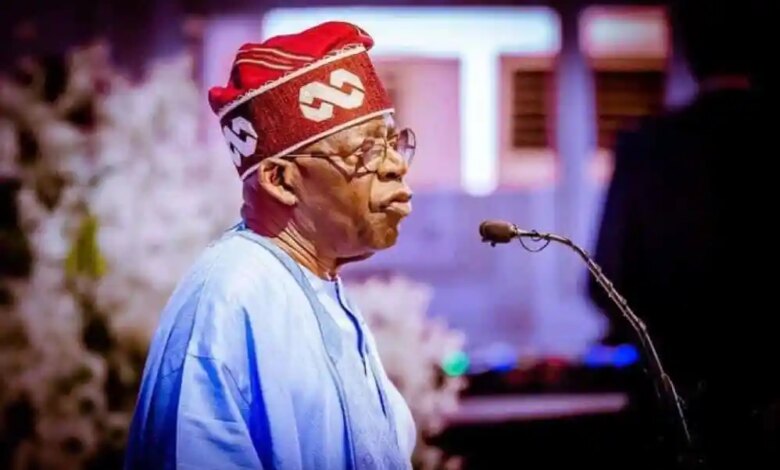
President Bola Tinubu has urged Nigerian journalists to prioritise facts, accuracy and professional ethics over sensationalism and the growing pursuit of clicks, likes and online engagement.
Naijaonpoint reports that the President spoke on Thursday at the maiden State House Media Dinner in Abuja, where he reaffirmed his administration’s commitment to press freedom but cautioned that constitutional rights must be exercised with responsibility.
Tinubu described himself as a longstanding advocate of a free press, insisting that his position on media freedom had remained unchanged throughout his public life.
“I am an apostle of a free press. I have defended and advocated for the rights of the media throughout my public life and will continue to do so,” he said.

The President said freedom of expression and press freedom should not be used as avenues to spread false information or deliberately mislead the public.
According to him, journalists have a duty to report events carefully and accurately, particularly in a manner that does not inflame tensions in society.
“While press freedom and free speech remain the bedrock of an open and democratic society, journalists and citizens must also not forget the imperative of balancing rights with responsibility and the duty you hold to society to report and inform with care and accuracy to facts and in a manner that ensures the society is not set on fire,” Tinubu said.
He urged media professionals to resist the pressure to prioritise sensational stories and viral content over credible journalism.
“The media must choose fact over falsehood. The media must choose substance over sensation. The media must choose credibility over clickbait and the endless race for followers, likes, and viral outrage,” he added.
Tinubu said professional journalism had become even more important amid the spread of misinformation, disinformation, deepfakes and content generated by artificial intelligence.
The President noted that members of the public increasingly rely on trained journalists to verify information and distinguish credible reports from speculation.
“The public depends on journalists not merely to report events but to separate fact from fiction, truth from speculation, and evidence from opinion,” he said.
“In a world where everyone with a smartphone is now a journalist, the responsibility of professional journalism has never been greater.”
Tinubu stressed that freedom of expression should not be interpreted as permission to damage the reputation of others or intentionally circulate misleading information.
According to him, freedom of expression “is not freedom to defame”, while press freedom “is not freedom to deliberately mislead”.
Speaking on the relationship between government and the media, Tinubu described both institutions as partners in nation-building, despite the natural tension between journalists and those in power.
“We are adversaries only in the democratic sense, as the media constantly distrust those in power. In nation-building, we are partners,” he said.
“Government exists to serve the people through leadership, policy, and public service. The media exists to serve society by watching those entrusted with power, asking difficult questions, and holding government accountable.”
The President said the tension between the government and the press was inevitable and necessary in a functioning democracy.
“Government must act. The media must watch. The government must explain. The media must question. That arrangement guarantees a certain level of tension,” he said.
The President also defended existing legislation regulating activities in the digital space, including the Cybercrimes Act, saying the laws were intended to protect citizens rather than suppress journalism.
“The media space is no longer an unregulated frontier. Nigeria has enacted laws, including the Cybercrimes Act and other relevant legislation, to protect citizens from malicious falsehoods, cyberstalking, identity theft, and other abuses that increasingly accompany the digital age,” Tinubu said.
“These safeguards are not intended to weaken press freedom. Rather, they exist to protect citizens and preserve the integrity of our information ecosystem.”
Turning to the economy, Tinubu said the reforms introduced by his administration were beginning to produce positive results.
“Our economy is stabilising. Public revenues have strengthened significantly. State governments are receiving substantially higher allocations to support development. Investor confidence is returning,” he said.